Van's Air Force

The definitive Van's Aircraft support community! Buying, building or flying an RV? Join our exclusive family of mentors and enthusiasts!

...

Or, those aerobatic pilots are properly trained and *less* likely to exceed Vne by 20% or more because they've been *taught* how to do aerobatics within the envelope?

I think this sums it up best.
If you are a 7 builder and you are nervous about what occurs well past Vne then the best mitigation is investing in the training to ensure that dosent occur.
By all means switch to a smaller tail if you think there’s some marginal difference in the point at which your airplane disintegrates but remember you’re trading away something else that the original designer thought was more important.
 
-----SNIP------
By all means switch to a smaller tail if you think there’s some marginal difference in the point at which your airplane disintegrates but remember you’re trading away something else that the original designer thought was more important.

This is starting to look like the never ending primer debates.

I'll just say, the Service Bulletin allows the smaller original rudder or the larger RV-9 rudder. So, for us using the original rudder, we are in compliance with the Van's engineering parameters. And if one want to use the larger rudder, the same applies.
 
Given the low absolute numbers of occurrences

Is it a low number?

How many RV-7s are flying? What rate of in flight breakups? 1 in 300? Is that low?

We are told you don't do aerobatics in non-aerobatic aircraft, even if the manoeuvre should not exceed G and airspeed limits because they do not have enough margin if it goes wrong.

Maybe the RV-7 with the large rudder is in the same category. Maybe the rudder design and low drag means it also doesn't have enough margin for safe aerobatics?

Are there other aerobatic aircraft with a similar history of in flight breakups?
 
Problem thread

This is the problem with this thread. With no scientific research people are jumping to a conclusion that the RV-7 tail is not safe. No one has presented any data to support the conclusion that the tail can not handle aerobatics or does not have sufficient safety margin.

If the accidents convince you to install a different rudder, great. It’s your airplane. If you think the existing rudder is just fine, great it’s your airplane.

But can we stop questioning the safety of the entire model fleet. Because the only thing we know is exceeding VNE is a problem and in a few cases have led to accidents.

To answer the previous poster there are 1909 flying RV-7s that Vans knows about.
 
No one has presented any data to support the conclusion that the tail can not handle aerobatics or does not have sufficient safety margin.

...

To answer the previous poster there are 1909 flying RV-7s that Vans knows about.

So the rate of inflight breakups is around 1 in 300. That seems to be data that indicates there is a problem.

I accept that these aircraft were well over VNE. But then you have to ask why so many RV-7s end up over VNE? Is that something that needs addressing?

Is there any other aircraft with the same rate of in flight breakups?
 
So the rate of inflight breakups is around 1 in 300. That seems to be data that indicates there is a problem.

I accept that these aircraft were well over VNE. But then you have to ask why so many RV-7s end up over VNE? Is that something that needs addressing?

Is there any other aircraft with the same rate of in flight breakups?

I think we identified THREE that were structural failures, would be less than 1 in 600 KNOWN aircraft, *and* that all (with one exception) were known to have greatly exceed Vne (the exception being that it was not recovered).

This is the thing that sticks in my craw with this "debate". There's almost no information that indicates a problem *exists* AT ALL, and yet some people, presumably without aeronautical engineering degrees or, at least, the actual engineering and test data to back up their claims, have reached the conclusion that a different rudder than the designers provide is "better". Fine, great, it's your plane, do what you want, BUT...people continue to spread this idea around that the one provided by Van's is "less safe" or "has less margin", possibly affecting the impressions and understanding of thousands of pilots, based on nothing more than a tiny fraction of the fleet, NONE of which failed at less than Vne*1.2 (approx, some much higher).

I think this sort of speculation and TLAR "engineering" is unsound at best, and dangerous at worst if applied to the wrong things.

"in God we trust; all others bring data." Well, where's the data on flutter onset speeds and margins above Vne*1.x or whatever with the different components, done under controlled conditions?

Not to mention...criminy, how far above Vne do you expect the airframe to save your bacon from your botched aerobatic maneuver or continued VFR flight into IMC? You want more, fine, but IMHO it's doing a disservice to try to convince the community based on essentially *nothing* that what they have isn't "good enough" and might get them killed.

Rant over. :)
 
I think we identified THREE that were structural failures, would be less than 1 in 600 KNOWN aircraft, *and* that all (with one exception) were known to have greatly exceed Vne (the exception being that it was not recovered).

I think there are 6 or 7 with the same signature rudder failure.

All I'm saying is that in flight breakups are bad, and they have repeatedly happened with the RV-7. Enough that it is a pattern that deserves attention to try to prevent it.

If it's due to pilots exceeding VNE (I agree it is), how do you stop pilots from exceeding VNE?
 
I think there are 6 or 7 with the same signature rudder failure.

All I'm saying is that in flight breakups are bad, and they have repeatedly happened with the RV-7. Enough that it is a pattern that deserves attention to try to prevent it.

If it's due to pilots exceeding VNE (I agree it is), how do you stop pilots from exceeding VNE?

I'll repost my summary of the spreadsheet with some updating:

1. Preliminary report only, cause undetermined yet.
2. Exceeded Vne by > 20% in a 10000 fpm nose-down attitude, accelerating at 15 kts/s, after several hairy VFR into IMC encounters and a seemingly steadfast refusal to give up trying to get killed
3. Exceeded Vne by > 20% (44 knots).
4. "There were no clear indications that any of the [empennage] components that fractured in overstress did so before ground impact or independently of the bird strike."
5. "damage to the horizontal stabilizers and elevators that was consistent with a downward failure in positive overload. The loads required to fail the horizontal stabilizers and elevators cannot be generated from normal flight or
control movements. Such failures would have required an abrupt pull back on the stick and corresponding movement of the elevator to a trailing-edge-up position, at speeds greater than the airplane's maneuvering speed."
6. Probable cause undetermined because wreckage was not recovered (sunk in 500' of water).
7. "At the time of the inflight breakup, the airplane was traveling 20 knots above the published never exceed speed."
8. Exceeded Vne by 34 knots.

So 4 that, yep, are similar...grossly exceeding Vne. I don't even know why item 6 is in this list, since the wreckage was never found.

As I said, you want to experiment around and put on a different rudder, that's fine, I have no gripe with that. It's just irresponsible to say or imply that the existing rudder is *unsafe*.

I'll ask again...anybody have actual data on what the flutter onset speed is for identical aircraft with each of the two rudders? Anyone? Anyone? Are you *sure* they're not nearly identical, or (gasp) even lower with the replacement? How would you know?

I just re-read all of this thread, paying attention to see if there were any posts with *actual* engineering data. Found essentially none, but you know what I did find *plenty* of? "It just feels _______". "It seems to me that _________." "I believe _______." and the like.

Sorry, that ain't engineering...
 
And the first one in the list? Here's all we know, from the preliminary report:

Security video captured the airplane in a steep nose down spiral before it impacted terrain. Several pieces of aircraft structure were seen falling from the airplane as it descended to the ground.

Absolutely NOTHING about WHAT parts those were. Might have been anything, or parts that separated during a very high-speed descending spiral, or nothing at all. This one shouldn't be included in the list (yet, maybe not ever).

Including the ones that *aren't* what you're claiming them to be is just a scare tactic, even if unintended, because it makes the numbers larger. And few people will go to the trouble of reading the *actual* reports to see if what's being claimed is actually the case.
 
I accept that these aircraft were well over VNE. But then you have to ask why so many RV-7s end up over VNE? Is that something that needs addressing?

Yes, that is a problem - but it's a PILOT problem, not an equipment problem. You're not going to fix stupid by changing the rudder, they'll just rip something else off.
 
Yes, that is a problem - but it's a PILOT problem, not an equipment problem. You're not going to fix stupid by changing the rudder, they'll just rip something else off.

I would tend to agree with you however the statistics are pretty compelling. The RV6 as a example has as far as I can tell never suffered a inflight breakup. The only one I am aware of in the 8 was a wing failure in a over G situation. You can’t fix stupid but are 6 and 8 drivers dramatically smarter than 7 drivers?
 
I would tend to agree with you however the statistics are pretty compelling. The RV6 as a example has as far as I can tell never suffered a inflight breakup. The only one I am aware of in the 8 was a wing failure in a over G situation. You can’t fix stupid but are 6 and 8 drivers dramatically smarter than 7 drivers?

From a strict engineering and evidentiary perspective, that answer is just as likely as the one about poor design.
 
Or, those aerobatic pilots are properly trained and *less* likely to exceed Vne by 20% or more because they've been *taught* how to do aerobatics within the envelope?
Maybe. :)

Isn't flutter onset essentially *always* a "cliff"? What makes you think there's some gradual onset of failure at 245 knots or more that you can then pull out of a 10000 fpm accelerating downward flightpath and not tear the airplane apart?
Your assumption that flutter is the first failure mode/limitation past Vne, isn't necessarily correct. Vne is defined as 90 percent of Vd, the design dive speed that the manufacturer chose to demonstrate. The hazards past that could be buffeting/vibration, increasing structural loads, etc. If I screwed up on a downline and went well past Vne, I'd like to know that the failure mode was "gradual", to use your words, or something I had some limited control over - like keeping the wings and stab on by gentle use of the stick.

ds

ps - Tagging on to Carl's words, I'm an engineer as well. I spent a fair chunk of the Air Force and FAA portions of my career as a Flight Test Engineer and Test Director in fixed and rotary wing aircraft. I'm also a consultant DER. I've intentionally been past Vne more than once in high-risk tests, which is more than enough. I learned enough about margins around Vd to pay attention to the flutter/aeroelastic experts; Carl's position as the FAA's flutter specialist for transport category aircraft is all I need to know about his expertise.
 
Last edited:
From a strict engineering and evidentiary perspective, that answer is just as likely as the one about poor design.

The common failure involves a joint that doesn't exist in the RV6/8, so I think the evidence is much stronger than for RV6/8 pilots being smarter.

But I wouldn't call it poor design (is that what people are upset about?)

I would say it is discovery of a common first point of failure that doesn't exist in the RV6/8. Evidence from the RV6/8 suggests there is a fix that would improve margins enough to avoid these in flight breakups and save lives.

The looming question is what about the RV-14? I don't think there are enough flying yet to be confident it won't see the same failures. I know the rudder structure is different, but is it different enough to avoid the problem?
 
Maybe. :)


Your assumption that flutter is the first failure mode/limitation past Vne, isn't necessarily correct. Vne is defined as 90 percent of Vd, the design dive speed that the manufacturer chose to demonstrate. The hazards past that could be buffeting/vibration, increasing structural loads, etc. If I screwed up on a downline and went well past Vne, I'd like to know that the failure mode was "gradual", to use your words, or something I had some limited control over - like keeping the wings and stab on by gentle use of the stick.

ds

ps - Tagging on to Carl's words, I'm an engineer as well. I spent a fair chunk of the Air Force and FAA portions of my career as a Flight Test Engineer and Test Director in fixed and rotary wing aircraft. I'm also a consultant DER. I've intentionally been past Vne more than once in high-risk tests, which is more than enough. I learned enough about margins around Vd to pay attention to the flutter/aeroelastic experts; Carl's position as the FAA's flutter specialist for transport category aircraft is all I need to know about his expertise.

Thanks for the info in the 1st paragraph. I'm an engineer as well, 30+ years, but not aero (rather, systems, in aerospace). So my preferred verification method is Test, followed closely by Analysis. Somewhere lower down is Inspection. And way down (like off the list) is "Seems as if...", TLAR, etc. I'll certainly defer to an aero engineer's overall assessment.

Still seems to me that this is a solution in search of a problem. Don't go VFR into IMC, get aerobatic training before you do aerobatics, and know your V-speeds seem to be correct answers to "how do I not go so fast that I break the airplane?". THOSE are the root causes of the failures, not the hardware.
 
Last edited:
This has been a really good thread. I kind of view the “potential” problem/solution as money in the bank. Yes, if you have enough money in the bank to pay your bills every month, you’re probably in pretty good shape….but it never hurts to have a little extra emergency funds.

I posted in another RV-7 thread with similar questions. In that thread the OP raised the question and wondered if the 14 rudder would fit/work on his 7? He felt as though the 14 rudder offered a better/stronger internal structure and decided to give it a try. He reported that he really liked the results and that the 14 rudder was working well on his 7. So that does bring up the question as to why the 14 rudder isn’t standard equipment on the 7/9? Even if the 14 rudder becomes standard equipment on the 7 and 9, I’m still personally firmly in the 8 rudder camp and think it’s a better choice. If for no other reason, it looks a lot better.

…..snip…..The looming question is what about the RV-14? I don't think there are enough flying yet to be confident it won't see the same failures. I know the rudder structure is different, but is it different enough to avoid the problem?

The pros and cons have been argued pretty thoroughly in this thread and everyone has their own reasons for liking one flavor or the other.

Now this brings me back to the question I asked in that other 7 thread: How would the 14 fly with an 8 rudder? I know it’s never been done before and you’d be a “test pilot”, but the question still remains. Not being an aeronautical engineer, I’m merely looking at it and asking the questions from a novice point of view. This is how I see it:

1. It’s known that the 8 rudder works perfectly fine on the 7/9 and many people, including myself, argue it’s superior to that of the 9.

2. It’s known that the 14 uses the 9 VS and rudder. Yes, there may be some internal structural differences, but for arguments sake, they’re the same.

3. It’s known that the 14 flys perfectly fine with the 7/9 rudder so one could easily conclude that the overall aerodynamics/flight characteristics of the 14 are similar enough to that of the 7/9 that the 7/9 VS and rudder works well on the 14.

4. I know it’s never been attempted before, and you’d be a “test pilot”, but with the known facts listed above, it’d be an interesting discussion and to point to specific things , compare and contrast, that would be detrimental if attempted.
 
Last edited:
How would the 14 fly with an 8 rudder? I know it’s never been done before and you’d be a “test pilot”, but the question still remains.

My question is why bother? The 14 flies just fine with the 14 rudder that comes as part of the kit. :confused:
 
My question is why bother? The 14 flies just fine with the 14 rudder that comes as part of the kit. :confused:

I’m not saying anyone “should”….I’m just asking the question. As discussed throughout this thread, there’s different schools of thought. I’m firmly in the 8 camp (money in the bank) and believe it’s a better design and offers a safety margin. On top of that, I think it looks a lot better. 😎
 
Last edited:
The spreadsheet in post #1 has been updated with links to the NTSB's Final Report and Docket for the RV-7A (N787NV) accident that occurred on 2/19/2022.
Thanks for keeping this up to date good sir. Any thoughts on putting a column with the probable cause?
 
Can someone post or send me the small rudder/ -8 drawing and manual page for building one? I thought I had it already but cannot for the life of me figure out where it is. I can probably figure it out just from the drawing but wouldn't mind the manual section too if possible. Thanks!

Finally think I have time to build one.
 
I have an RV-7 with an AEIO-390x built by Barrett Engines. When I first bought this airplane from a buddy (partially built from a slow build) my intentions were to race at the Reno Air Races! I finished the -7 and it had the stock -7 rudder (big). I knew I wanted to switch it out for the -8 rudder because I had heard of some of the other-7's that crashed due to rudder flutter and the tail ripping off. I ended up flying my -7 for about 400 hours before changing out the -7 rudder for the smaller -8 rudder.
My experience is the -8 rudder is so much nicer than the -7 large rudder. The smaller -8 rudder has a lot less foot force required to yaw the plane. The rudder forces required are like the rest of the control forces in that they all feel balanced and equal in the amount of force needed for desired flight control. The larger -7 rudder was very heavy and made you really work for the yaw needed for landings in cross winds. I really LIKE the -8 rudder on my -7 and it gives me piece of mind at higher airspeeds.
BTW, my Reno dreams of racing disappeared once I found out the racers (in RV's) were hitting 260mph+ on the start of the race coming into pylon 1. There was no way I was going to do that in my -7, even with the -8 rudder!
 
I have an RV-7 with an AEIO-390x built by Barrett Engines. When I first bought this airplane from a buddy (partially built from a slow build) my intentions were to race at the Reno Air Races! I finished the -7 and it had the stock -7 rudder (big). I knew I wanted to switch it out for the -8 rudder because I had heard of some of the other-7's that crashed due to rudder flutter and the tail ripping off. I ended up flying my -7 for about 400 hours before changing out the -7 rudder for the smaller -8 rudder.
My experience is the -8 rudder is so much nicer than the -7 large rudder. The smaller -8 rudder has a lot less foot force required to yaw the plane. The rudder forces required are like the rest of the control forces in that they all feel balanced and equal in the amount of force needed for desired flight control. The larger -7 rudder was very heavy and made you really work for the yaw needed for landings in cross winds. I really LIKE the -8 rudder on my -7 and it gives me piece of mind at higher airspeeds.
BTW, my Reno dreams of racing disappeared once I found out the racers (in RV's) were hitting 260mph+ on the start of the race coming into pylon 1. There was no way I was going to do that in my -7, even with the -8 rudder!
Concur on the advantages of the -8 rudder on the -7. I have an 8 VS and rudder on my Super Six, slightly modified, and fully tested, for the speed my plane can achieve. Working on a nexgen version of that, as well as a HS and Elevator with strength and flutter margin mods, both for racing and descents from high teen cruise altitudes.

Little point of clarification on the racing speeds (no smoke blown here, just our SOP). We released the Medallion heat, where most 4-cyl RV's raced in Reno, at 150-160 KIAS. We developed a strategy for flatter, slower and later releases, to prevent too much downhill acceleration prior to getting down and level on the course. Typical Medallion speeds are in the 220-230 mph range, and when started right, they wouldn't see much more than that around Outer 4, 5 and 6 on lap 1 (where we started the race in Reno). If we dropped them early or high (steep), the racers needed to be cautious about power setting after release, and when they threw on N20 (f they had it), and their descent angle onto the course. Add about 10-15 KIAS to that for the Bronze release and top speeds. More still for the Silver start, which rarely had RVs in it...the occasional Rocket, but few RVs. Sorry the here-say prevented you from racing. Perhaps down the road. :)
 
Thanks Carl!!!
Starting with lists from Aviation Safety Network I have looked at all RV6 Fatal accidents involving US registered aircraft. 2700 RV6 completions.
One aircraft listed as a RV6 with two letters following the number. Aircraft was a combination of some RV6 parts with wings that were somewhat similar to RV3. Aircraft was not certificated for aerobatics. (ops limits) Aerobatic instruction flight, wing failed. I find no other inflight breakups of RV6.
8/27/1993 RV6 on cross country flight dove vertically into the ground. Last communication with ATC was around 10,000' and radar contact was lost at 5200'(approximately 5000' AGL
Aircraft hit the ground intact. Cause undetermined. Van did not have an answer as to cause.
Pilot was ATP with CFI SMEL and II. Pilot was builder. Tachometer had impact mark at 2800 rpm, needle was missing. Witnesses reported very loud sounds indicative of very high rpm and very high speed.
Using the same methods I looked at all RV4 fatals. One case of horizontal stabilizer departing in flight. No leading edge bolts found. No speculation as to improper hardware or installation of hardware. This is the only inflight breakup of a US registered RV4 that I found.
Dave Anders has flown his RV4 in the high 250 statute range. Tracy Saylor flew his RV6 over 235 for racing.
One of the differences I noticed is the relatively high number of RV4 crashes involving low level aerobatics gone wrong. With the RV6 the number one accident cause appears to be inadvertent stall spin. I am still working on summarizing major causes for accidents.
 
Article by Vic Syracuse in August Sport Aviation makes several incorrect statements about RV7 accidents. Specifically that they involve low altitude aerobatics, showing off. The most recent accident at Triangle Airport near Kingman AZ started at 3100' plus AGL.
One disappointing issue with the final report is no mention of autopsy.
NONE of the five RV7 breakups in the US involved low level aerobatics. One was a bird strike, no mention of aerobatics. One likely involved moderate turbulence, possibly severe. The article also implies other RV models that have incurred in flight breakups and implies all were caused by "low level aerobatics, showing off" . The "showing off" did occur with RV4's but did not involve structural failure.
 
Article by Vic Syracuse in August Sport Aviation makes several incorrect statements about RV7 accidents. Specifically that they involve low altitude aerobatics, showing off. The most recent accident at Triangle Airport near Kingman AZ started at 3100' plus AGL.
One disappointing issue with the final report is no mention of autopsy.
NONE of the five RV7 breakups in the US involved low level aerobatics. One was a bird strike, no mention of aerobatics. One likely involved moderate turbulence, possibly severe. The article also implies other RV models that have incurred in flight breakups and implies all were caused by "low level aerobatics, showing off" . The "showing off" did occur with RV4's but did not involve structural failure.
The context of showing off doesn’t have to be to people on the ground outside of the airplane. It can be to another person inside the airplane.
Having said that, it is generally just speculation, because there is no way to prove either one.
As for Low level aerobatics, it is always assumed that statement means below 1500 feet AGL because that is the standard required minimum altitude. The problem with that is that 1500 feet in the context of an inexperienced pilot teaching themselves aerobatics is not all that high. In fact, for some people, if they botched an aerobatic maneuver while self teaching, 3000 feet may not be enough.
 
The context of showing off doesn’t have to be to people on the ground outside of the airplane. It can be to another person inside the airplane.
Having said that, it is generally just speculation, because there is no way to prove either one.
As for Low level aerobatics, it is always assumed that statement means below 1500 feet AGL because that is the standard required minimum altitude. The problem with that is that 1500 feet in the context of an inexperienced pilot teaching themselves aerobatics is not all that high. In fact, for some people, if they botched an aerobatic maneuver while self teaching, 3000 feet may not be enough.
 
The bird strike accident involved a passenger. The Utah accident involved a passenger. The remaining three were solo flights. 3000 feet not being enough MIGHT apply to inadvertent flat spins but not to most basic maneuvers. I always liked Harold Krier's policy of 100 consecutive near perfect maneuvers at altitude before bringing them down low. The most common low altitude show off maneuver is probably a slow roll.
The important point is that the Syracuse article misrepresents the recent accident record involving RV's.
When I first started doing flat spins in the Pitts my entry altitude was 11.500 AGL. When I later instructed flat spins I liked to start around 7-8000' AGL and then only a few turns out of respect for the Lycoming crankshaft.
 
The bird strike accident involved a passenger. The Utah accident involved a passenger. The remaining three were solo flights. 3000 feet not being enough MIGHT apply to inadvertent flat spins but not to most basic maneuvers. I always liked Harold Krier's policy of 100 consecutive near perfect maneuvers at altitude before bringing them down low. The most common low altitude show off maneuver is probably a slow roll.
The important point is that the Syracuse article misrepresents the recent accident record involving RV's.
When I first started doing flat spins in the Pitts my entry altitude was 11.500 AGL. When I later instructed flat spins I liked to start around 7-8000' AGL and then only a few turns out of respect for the Lycoming crankshaft.
I would like to see some comments on the RV4 stabilizer missing bolts. Since that happened long ago and the final report is out speculation is allowed. My #1 guess is that the stabilizer leading edge bolts were "temporarily" installed with plain nuts. Nuts were never replaced.
Tom Cassutt installed the elevator pushrod with an elastic lock nut that had been burned while welding. Elevator disconnected on cross country. No trim. He landed by shifting his weight for pitch control.
Bill Stead, the founder of the Reno Air Races, was killed in a midget racer when the bolt came out of the pushrod to elevator connection.
Three long ago incidents of elevator bold coming out on Beech 18. All landed safely using only trim.
Sean Tucker and Rick Masagee bailed out of their respective airplanes after pitch control failure.
Sukhoi 29 went straight in after bolt came out of elevator pushrod.
 
A few comments following on to some of the above comments...hope it adds value to the discussion.

@ BillL: Brian confirmed what was my experience in changing (in my case) from a 6 VS and rudder to an 8 VS and rudder. No changes in landing characteristics noted. Interestingly, I did note a slight increase in right rudder requirements in climb and cruise, even though the same slight VS offset was present. I attribute that to the slight geometry change in the shape of the VS and rudder...but that is a SWAG, versus shown with wind tunnel evaluation, etc ;) . Overall, I'd say expect very similar handling, with slight trim changes to be noted...albeit very slight.

@ bjdecker and plehrke: concur with your thoughts on free stick vs some control pressure with respect to flutter margin. Steve Smith and I have discussed it as well, and that has always been my technique, whether descending from altitude or racing or test flying...actually in all phases. I keep my feet on the rudder pedals (and similar to Brian, on the outer uprights of the suspended pedals). I also added the rudder trim system with cables and springs, and that keeps a little tension on the rudder cables too...just a little side benefit.

@ jrs14855: I figure you'd agree that the HRII pilot that bragged about 300 indicated (and I'll risk assuming that means MPH), may or may not understand that that doesn't mean they just proved a 300 MPH Vne. Smooth air? Non-maneuvering? No gust loads? (kinda the same thing as smooth air, but they could be induced by the pilot, intentionally, as in flight test, or just inadvertently), etc. If it was a stock HRII, it would mean it was probably done with a 4 tail, with no counterbalance. In any case, while I agree that construction and balance of the 7 rudder is important, the HRII speed doesn't really relate to a 7 with a 7/9 tail, as the entire aft fuselage and empennage system is different. I'll develop that thought a bit more below.

@ jrs14855: it would be interesting to talk to Dick Keyt, who owned and SARL-raced the Polen Special, about that carbon rudder. Knowing Dick's meticulous approach, I bet he did some keen structural analysis as he did the mod, and may have modified other parts of the structure to balance the load paths. I'll develop that thought a bit more below too.

In general, it seems a common thread among the failures has been the specific tail type, and an exceedence of one or more parameters of airspeed, g and/or maneuvering envelope(s). In more discussions with Steve Smith, a key take-away has been to avoid just changing one component without evaluating the load paths and the impact the change may have on surrounding structure. Just changing the 7 rudder design partially, or making a 7 tail with a folded trailing edge, or making a carbon rudder, or making small changes to the internal structure of the rudder (strengthening specific parts without evaluating changes to overall structure or center of mass, aero center, etc)...all theoretical things mentioned in posts above...may or may not do more harm than good (Steve has shared specific examples in our discussions). Since the 7 empennage can be built with the 8 rudder fairly seamlessly, that would seem a good course of action, but I don't want to condemn the 7 rudder outright, and would just encourage anyone considering a change, however simple or complex, to ask for some guidance and expertise in doing so safely. Not intended as preachy...I just listen closely when the smart aero and structural guys are talkin'. ;)

Cheers,
Bob

 
Last edited:
A few comments following on to some of the above comments...hope it adds value to the discussion.

@ BillL: Brian confirmed what was my experience in changing (in my case) from a 6 VS and rudder to an 8 VS and rudder. No changes in landing characteristics noted. Interestingly, I did note a slight increase in right rudder requirements in climb and cruise, even though the same slight VS offset was present. I attribute that to the slight geometry change in the shape of the VS and rudder...but that is a SWAG, versus shown with wind tunnel evaluation, etc ;) . Overall, I'd say expect very similar handling, with slight trim changes to be noted...albeit very slight.

@ bjdecker and plehrke: concur with your thoughts on free stick vs some control pressure with respect to flutter margin. Steve Smith and I have discussed it as well, and that has always been my technique, whether descending from altitude or racing or test flying...actually in all phases. I keep my feet on the rudder pedals (and similar to Brian, on the outer uprights of the suspended pedals). I also added the rudder trim system with cables and springs, and that keeps a little tension on the rudder cables too...just a little side benefit.

@ jrs14855: I figure you'd agree that the HRII pilot that bragged about 300 indicated (and I'll risk assuming that means MPH), may or may not understand that that doesn't mean they just proved a 300 MPH Vne. Smooth air? Non-maneuvering? No gust loads? (kinda the same thing as smooth air, but they could be induced by the pilot, intentionally, as in flight test, or just inadvertently), etc. If it was a stock HRII, it would mean it was probably done with a 4 tail, with no counterbalance. In any case, while I agree that construction and balance of the 7 rudder is important, the HRII speed doesn't really relate to a 7 with a 7/9 tail, as the entire aft fuselage and empennage system is different. I'll develop that thought a bit more below.

@ jrs14855: it would be interesting to talk to Dick Keyt, who owned and SARL-raced the Polen Special, about that carbon rudder. Knowing Dick's meticulous approach, I bet he did some keen structural analysis as he did the mod, and may have modified other parts of the structure to balance the load paths. I'll develop that thought a bit more below too.

In general, it seems a common thread among the failures has been the specific tail type, and an exceedence of one or more parameters of airspeed, g and/or maneuvering envelope(s). In more discussions with Steve Smith, a key take-away has been to avoid just changing one component without evaluating the load paths and the impact the change may have on surrounding structure. Just changing the 7 rudder design partially, or making a 7 tail with a folded trailing edge, or making a carbon rudder, or making small changes to the internal structure of the rudder (strengthening specific parts without evaluating changes to overall structure or center of mass, aero center, etc)...all theoretical things mentioned in posts above...may or may not do more harm than good (Steve has shared specific examples in our discussions). Since the 7 empennage can be built with the 8 rudder fairly seamlessly, that would seem a good course of action, but I don't want to condemn the 7 rudder outright, and would just encourage anyone considering a change, however simple or complex, to ask for some guidance and expertise in doing so safely. Not intended as preachy...I just listen closely when the smart aero and structural guys are talkin'. ;)

Cheers,
Bob
Regarding the HRII, that was a long time ago. Airline pilot,probably bought the airplane. Bragged about some other things that led me to classify him as a total lunatic. Took careless and reckless to a new level.
Regarding the Polen Special it was designed to operate at altitudes in the mid 20's. My recollection, reaching way back, is that the original rudder had a counterbalance similar to the original P51.
 
Regarding the HRII, that was a long time ago. Airline pilot,probably bought the airplane. Bragged about some other things that led me to classify him as a total lunatic. Took careless and reckless to a new level.

I chuckled and cried at that all at the same time reading that. Chuckled appreciatively at your candor, and cried about fools giving all of us airline pilots that bought our planes a very bad name (and no offense taken...I've met those lunatics too ;) ).

Regarding the Polen Special it was designed to operate at altitudes in the mid 20's. My recollection, reaching way back, is that the original rudder had a counterbalance similar to the original P51.

It's a really cool plane...I'll reach out to Dick and see what he has to say about the rudder...great guy!

Cheers,
Bob
 
I chuckled and cried at that all at the same time reading that. Chuckled appreciatively at your candor, and cried about fools giving all of us airline pilots that bought our planes a very bad name (and no offense taken...I've met those lunatics too ;) ).


It's a really cool plane...I'll reach out to Dick and see what he has to say about the rudder...great guy!

Cheers,
Bob
 
An extremely knowlegeable pilot who taught me a lot. Unfortunately he had some personal demons. He said you can take any airline in the world and apply the 10/40 rule:
The top 10% are extremely talented
The next 40% are above average
The next 40 % are below average
The bottom 10% are nutjobs and incompetents.
The industry has learned how to deal with the bottom 10% in recent years.
The above does not apply to some third world airlines.
What I have heard about the Polen in recent years should be classified as rumors. I did get a good look at it a Oshkosh many years ago.
 
An extremely knowlegeable pilot who taught me a lot. Unfortunately he had some personal demons. He said you can take any airline in the world and apply the 10/40 rule:
The top 10% are extremely talented
The next 40% are above average
The next 40 % are below average
The bottom 10% are nutjobs and incompetents.
The industry has learned how to deal with the bottom 10% in recent years.
The above does not apply to some third world airlines.
What I have heard about the Polen in recent years should be classified as rumors. I did get a good look at it a Oshkosh many years ago.
I'd bet that 10/40 rule could apply to almost any industry. It seems that in heavy industry there are two methods for dealing with the bottom 10%. Promote them beyond their ability and wonder why they failed. Or "promote" them to a role where they can't kill someone.
 
A number of folks here are arguing against gaining extra margin (even when there is essentially no trade-off or sacrifice of anything else) on the basis that it is a pilot problem, not an airframe problem.

The exact same argument is often made about the original 6A/7A/8A/9A nose gear. And also in that case, an improved alternative now exists.

Here is an anecdote that illustrates the benefit of having 'more margin':
I believe this happened in the mid 1980s. A 4-engine transport was crossing the pacific at very high altitude (41,000 ft IIRC) with a full load of passengers. One engine failed. The result (for whatever reason) was that the airplane stalled, rolled and pitched down. The recovery took something like 30,000 ft of altitude, probably exceeded V_d (The equivalent of V_ne for high-mach no. airplanes) and reached a load factor of something like 5.2 g's.

For a Part 25 transport like this, N_lim is 2.5 g's, and the ultimate safety factor is 1.5, so during certification, the airplane has been shown to withstand 3.75 g's. At that load, it is allowed to yield (bend) but must not fail. There is no expectation that the airframe should survive loads greater than 3.75 g's.

This airplane, built by Brand X, did not fail at 5.2 g's. It landed safely at San Francisco International airport. I got to see the airplane. Both wings were bent slightly, one more than the other, but you could visually see the abnormally high dihedral. The wing-body fairing area adjacent to the wing leading edge, where the air conditioning systems are installed, were bent/buckled inward (from the large forward chord force during the pull-out). The horizontal tail was visibly bent downward. Fuselage skin around the horizontal tail attachment was wrinkled. The airplane was later repaired and returned to service!

5.2 g's.

There are a whole lot of people that are really grateful that Brand X built in those kinds of margins into their designs. I would speculate, based on some other incidents, that had that been a Brand Y airplane, it would not have survived the flight.

How much margin is a good amount of margin? It is never infinite. Something is always eventually going to break. Design margins are often based on statistical exposure to exceedences traded off against ability to perform the intended mission. (that's where the 2.5 g, 3.8g, 4.4 g, 5.3g, 6g load factors come from for various categories of aircraft, and where the safety factor of 1.5 comes from). Since airplanes really don't crash very often, these always have been based on very small sample sizes, and always based on incomplete information. Yet we follow what evidence we have, even if not conclusive. Here you have similar population sizes of similar aircraft, with similar pilot demographics, and a seemingly minor difference in construction that correlates to some tragedies for one of the designs and none for the others.

I don't know if it ever makes sense to leave margin on the table if it doesn't cost anything.
 
I found another RV7 structural failure. 8 July 2009. Near Lake City FL. VFR into IMC conditions, penetrated a thunderstorm and the vertical tail departed.
From Oct 2003 to Aug 2018, 20 fatal RV7 accidents in US. 7 were stall spin. Some bizarre accidents. Canopy departed in cruise. Pilot fell out. Seat belt not fastened.
Flight of two on short cross country. Encountered weather. One airplane turned left, the other turned right. The one that turned left made it back home, the one that turned right crashed into terrain.
Bet many did not know there was an all carbon fiber RV7. It was registered as a 7 but was it really a 7. Two time Oshkosh Grand Champion builder. He stalled and spun on takeoff.
At least two that were probably medical events, although medical is not listed as primary cause.
The number of stall spin accidents is inexcusable.
 
There was a DC10 on an Atlantic crossing that stalled at high altitude and fell out of the sky. Climbed back up and made it to destination.
727 near Detroit learned it is not a good idea to mess with leading edge devices at high altitude. They regained control somewhere around 10'000'
 
Here you have similar population sizes of similar aircraft, with similar pilot demographics, and a seemingly minor difference in construction that correlates to some tragedies for one of the designs and none for the others.
100 percent spot on. I think it's very reasonable to assume that the RV-7 fleet exposure to overspeed events is similar to other RVs. Yet the large-rudder -7 (and to a lesser extent the -9) seem to be disproportionately represented in structural failures that appear to share the same failure mode.

I'll point out again that the -14 rudder seems to be dimensionally the same as the -7/-9, but has additional structure (stiffeners attached to each other and also clipped to the spar) that seem to add torsional stiffness. I'm just an EE, so one of you structures experts correct me if I'm wrong.

Dave
 
100 percent spot on. I think it's very reasonable to assume that the RV-7 fleet exposure to overspeed events is similar to other RVs. Yet the large-rudder -7 (and to a lesser extent the -9) seem to be disproportionately represented in structural failures that appear to share the same failure mode.

I'll point out again that the -14 rudder seems to be dimensionally the same as the -7/-9, but has additional structure (stiffeners attached to each other and also clipped to the spar) that seem to add torsional stiffness. I'm just an EE, so one of you structures experts correct me if I'm wrong.

Dave
Spoke with Vans support yesterday and was told that even though the -14 rudder measures out the same, the difference in thickness at the forward part would not line up with the -7 fuse and VS properly. They confirmed the same skin thickness as my -7, but the added stiffness comes from the use of ribs internally, VS stiffeners that are not tied together.
 
Spoke with Vans support yesterday and was told that even though the -14 rudder measures out the same, the difference in thickness at the forward part would not line up with the -7 fuse and VS properly.

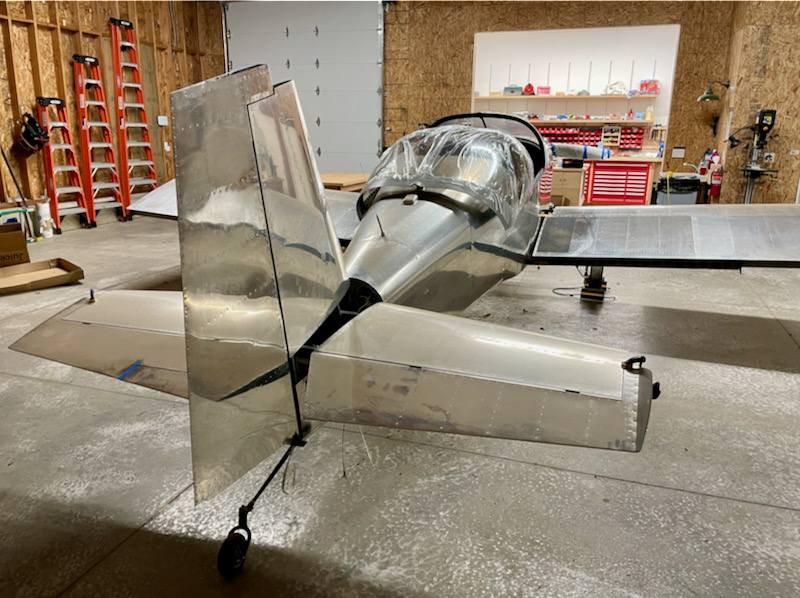
I'm not sure that's correct... I put an RV-14 rudder on my RV-7 and it fits perfectly and flies great.

Edit to add photo:

20220919_rudder21.jpg
 
Last edited:
Back
Top