Van's Air Force

The definitive Van's Aircraft support community! Buying, building or flying an RV? Join our exclusive family of mentors and enthusiasts!

Mel question on passenger warning

Larry DeCamp

Well Known Member
I have an experimental sticker for my tip up canopy and I understand a placard warning is also available. Is one preferred over the other ?
Does anyone have recommended source for placard ?
Is the warning primarily for passenger viewing ?
 
Larry, here is an interesting option for you. Since the RV-4 design is more than thirty years old you are eligible to use the "NX" tail number and eliminate the "Experimental" decal. Your registration won't include the "X" but when it is displayed on the airframe as part of the tail number it signifies an experimental aircraft. Example: NX123LD

Otherwise you must use the Experimental decal.

You still need to use the passenger warning placard that is located where a passenger can see it.
 
I have an experimental sticker for my tip up canopy and I understand a placard warning is also available. Is one preferred over the other ?
Does anyone have recommended source for placard ?
Is the warning primarily for passenger viewing ?
The required wording for the passenger warning is “PASSENGER WARNING—THIS AIRCRAFT DOES NOT COMPLY WITH FEDERAL SAFETY REGULATIONS FOR STANDARD AIRCRAFT”. Older versions added the wording stating that the aircraft is amateur-Built and these are acceptable. Regulations state that the placard must be visible to all occupants of the aircraft.

As Sam said, the RV-3, -4, and -6 are all eligible to use the "X" within the N number. That X does not show up on ANY paperwork and is not to be used in communication.
The "X" simply replaces the 2" Experimental placard otherwise reauired.
 
Hmmmmmmmmmm.... I kind of like the EXPERIMENTAL placard on my canopy! I might just be a little proud that I crafted this work of experimental art! 😊
 
As Sam said, the RV-3, -4, and -6 are all eligible to use the "X" within the N number. That X does not show up on ANY paperwork and is not to be used in communication.
The "X" simply replaces the 2" Experimental placard otherwise reauired.
The LCP issue and bankruptcy pushed my anticipated completion date back to 2025. One of the silver linings is that the RV-8 will turn 30 in 2025 and I’ll be able to use an NX number and not install the large experimental placards on the outside of the plane. :cool:
 
There's just something so cool about an NX registration number :D
True! Almost as cool as flying for and calling "Continental 123" on the radio.

VAF member Mickey posted some interesting info about his super nice looking -8 on his webpage:
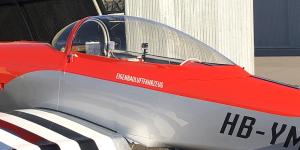
In Switzerland we no longer have the option to label our aircraft Experimental to warn would-be passengers that they are about to get into a contraption that was built by a “crazy” person in their garage. The new terms are either Homebuilt or Eigenbauluftfahrzeug. No French option, for some reason. I chose the German.

Guess that makes it the only aircraft in the wold with the Eigenbauluftfahrzeug as an outside placard 😉


Eigenbauluftfahrzeug-HB-YMM-RV-8.png
 
Larry, here is an interesting option for you. Since the RV-4 design is more than thirty years old you are eligible to use the "NX" tail number and eliminate the "Experimental" decal. Your registration won't include the "X" but when it is displayed on the airframe as part of the tail number it signifies an experimental aircraft. Example: NX123LD

Otherwise you must use the Experimental decal.

You still need to use the passenger warning placard that is located where a passenger can see it.
when you call ATC, do you say anything different when one has a NX number?
 
VAF member Mickey posted some interesting info about his super nice looking -8 on his webpage:
In Switzerland we no longer have the option to label our aircraft Experimental to warn would-be passengers that they are about to get into a contraption that was built by a “crazy” person in their garage. The new terms are either Homebuilt or Eigenbauluftfahrzeug. No French option, for some reason. I chose the German.

Guess that makes it the only aircraft in the wold with the Eigenbauluftfahrzeug as an outside placard 😉
I would have gone with that too! I love how German combines related words into one word. Makes me think of my favorite word from my German studies, Bundesausbildungsförderungsgesetz, which for those that are wondering, is the name of a law relating to educational financial assistance.
 
when you call ATC, do you say anything different when one has a NX number?
No. You have likely already introduced yourself as "Experimental" or as Blow Fire, RV, etc. It is not necessary to include the X and would likely mess them up as they would so rarely hear it they would ask you to "say again". Kind of like if I call in as 232 SuzieQ. Some will call that back, some say Sierra Quebec. What ever floats your boat....:):cool:
 
Thanks for the X concept but the N is already painted !
Mel, I am really confused now. Is the placard an alternative the EXPERIMENTAL sticker or must be in addition to the sticker.
My last RV had experimental ON the canopy skirt ( tip up ) INSIDE.
If a placard is installed, does it go inside or outside.
 
Thanks for the X concept but the N is already painted !
Mel, I am really confused now. Is the placard an alternative the EXPERIMENTAL sticker or must be in addition to the sticker.
My last RV had experimental ON the canopy skirt ( tip up ) INSIDE.
If a placard is installed, does it go inside or outside.
According to AC45-4 "following placard must be displayed in the aircraft in full view of all occupants: “PASSENGER WARNING—THIS AIRCRAFT IS AN EXPERIMENTAL AIRCRAFT AND DOES NOT COMPLY WITH FEDERAL SAFETY REGULATIONS FOR STANDARD AIRCRAFT.”
 
Thanks for the X concept but the N is already painted !
Mel, I am really confused now. Is the placard an alternative the EXPERIMENTAL sticker or must be in addition to the sticker.
My last RV had experimental ON the canopy skirt ( tip up ) INSIDE.
If a placard is installed, does it go inside or outside.
The ‘passenger warning’ placard is in addition to the 2” high ‘experimental’ sticker, and is inside the plane. The ‘experimental’ sticker(s) (not needed with an ‘x’ in the N number) must be visible to passengers entering the plane.
 
Thanks for the X concept but the N is already painted !
Mel, I am really confused now. Is the placard an alternative the EXPERIMENTAL sticker or must be in addition to the sticker.
My last RV had experimental ON the canopy skirt ( tip up ) INSIDE.
If a placard is installed, does it go inside or outside.

I'm definitely not Mel but have been down this road a few times. :)

You need BOTH placards (decals). The passenger warning is customarily placed on the panel in front of the passenger seat. The Experimental decal needs to be located so it is readily visible to someone viewing the aircraft. Mine is on the baggage bulkhead.
 
I'm definitely not Mel but have been down this road a few times. :)

You need BOTH placards (decals). The passenger warning is customarily placed on the panel in front of the passenger seat. The Experimental decal needs to be located so it is readily visible to someone viewing the aircraft. Mine is on the baggage bulkhead.
We can sure make something that is dirt simple, hard.
 
For those that want to know the legal basis of the exterior "experimental" label and how it can be avoided with an "X" number, here you go (edited for relevancy and conciseness and marked for emphasis). Interestingly, I can't find a statutory basis for the interior passenger warning, but it's required nevertheless by FAA order:

FAR § 45.22 Exhibition, antique, and other aircraft: Special rules.​

...

(b) A small U.S.-registered aircraft built at least 30 years ago or a U.S.-registered aircraft for which an experimental certificate has been issued ... for operation as ... an amateur-built aircraft and which has the same external configuration as an aircraft built at least 30 years ago may be operated without displaying marks in accordance with §[45.23 (see below)] ... if:
(1) It displays ... marks at least 2 inches high on each side of the fuselage or vertical tail surface consisting of the Roman capital letter “N” followed by:
...
(ii) The symbol appropriate to the airworthiness certificate of the aircraft (“C”, standard; “R”, restricted; “L”, limited; or “X”, experimental) followed by the U.S. registration number of the aircraft....

FAR § 45.23 Display of marks; general.​


...

(b) When marks include only the Roman capital letter “N” [i.e., with no "symbol appropriate to the airworthiness certificate of the aircraft" per 45.22(b)(1)(ii) above] and the registration number is displayed on ... experimental ... aircraft, the operator must also display on that aircraft near each entrance to the cabin, cockpit, or pilot station, in letters not less than 2 inches nor more than 6 inches high, the word[] “experimental,” ....

 
I'm definitely not Mel but have been down this road a few times. :)

You need BOTH placards (decals). The passenger warning is customarily placed on the panel in front of the passenger seat. The Experimental decal needs to be located so it is readily visible to someone viewing the aircraft. Mine is on the baggage bulkhead.
Viewed by pilot and passenger?? These examples (appreciated) appear to reference side by side seating and visible baggage access surface.
What do the 4/8/Rocket folks do ? Do both signs have to be visible to pilot and passenger or the placard just to the passenger?
 
Mel, I am really confused now. Is the placard an alternative the EXPERIMENTAL sticker or must be in addition to the sticker.
My last RV had experimental ON the canopy skirt ( tip up ) INSIDE.
If a placard is installed, does it go inside or outside.
Sorry for delayed response. We're replacing all windows in our house and my desk has been unavailable all day.

We're talking 2 different placards. One placard - Passenger Warning as stated above. Must be visible to all occupants. No longer required on single place aircraft.

The "Experimental" placard must be at least 2" high, near each entrance to the aircraft, clearly visible to any one entering the cockpit. May be inside or outside the aircraft.
Most RV builders place it on the baggage bulkhead except for the RV-10. I have spoken with many DARs and several FSDOs and we all agree that the baggage bulkhead on the -10 is not really near the entrances. Some DARs will accept it there but some will not.

I hope this clears things up a bit.
 
Where must it be for tandems? Visible at all times? Or just visible when entering?
AGAIN, we are talking about 2 placards. Please specify which one you are asking about. The passenger Warning must be visible to all occupants all the time.

The Experimental placard need only be visible while entering the cockpit.
 
If there was a requirement that registration numbers meet FAA regulations, It would reduce the number of applicants immensely!
45.29..... This is what is ignored the most....
(c) Width. Characters must be two-thirds as wide as they are high, except the number “1”, which must be one-sixth as wide as it is high, and the letters “M” and “W” which may be as wide as they are high.

(d) Thickness. Characters must be formed by solid lines one-sixth as thick as the character is high.

(e) Spacing. The space between each character may not be less than one-fourth of the character width.
 
45.29..... This is what is ignored the most....
(c) Width. Characters must be two-thirds as wide as they are high, except the number “1”, which must be one-sixth as wide as it is high, and the letters “M” and “W” which may be as wide as they are high.

(d) Thickness. Characters must be formed by solid lines one-sixth as thick as the character is high.

(e) Spacing. The space between each character may not be less than one-fourth of the character width.
AND placement (on the fuselage under the horizontal stabilizer). AND size (3" numbers on aircraft that cruise greater than 180 kts.)
 
What do the 4/8/Rocket folks do ? Do both signs have to be visible to pilot and passenger or the placard just to the passenger?
Can't speak for others, but to be careful in my -8A I put the passenger warning both on the panel and on the seat back.
 
I see lots of folks in tandems put it in the back. Ie on the back of the front seat, down by the rear stick boot, or above the rear arm rest. Per the information above that seems like it would be incorrectly placed.
 
I see lots of folks in tandems put it in the back. Ie on the back of the front seat, down by the rear stick boot, or above the rear arm rest. Per the information above that seems like it would be incorrectly placed.
That is where mine is. There is none in the front seat. As I remember from all those years ago, that is all that was required. I might be wrong but it did pass inspection.
 
Most RV builders place it on the baggage bulkhead except for the RV-10. I have spoken with many DARs and several FSDOs and we all agree that the baggage bulkhead on the -10 is not really near the entrances. Some DARs will accept it there but some will not.

I hope this clears things up a bit.
Where is an acceptable/commonly used spot for the "Experimental" placard on the RV-10 in your experience?

Kevin
 
If there was a requirement that registration numbers meet FAA regulations, It would reduce the number of applicants immensely!
The FAA brought this up as a topic during the IA refresher this year. I reccomended they consider a forum at OSH. They've let it go for so long it's hard to deal with now.

Vic
 
Where is an acceptable/commonly used spot for the "Experimental" placard on the RV-10 in your experience?

Kevin
I have discussed this with several DARs and several FAA inspectors and the consistence is that the baggage bulkhead, where most everyone puts it on other RVs, does really not meet the regulations, which state that the placard be placed "near each entrance" to the cabin. To see the baggage bulkhead when entering an RV-10, one would have to look aft past the rear seats and beyond the baggage compartment. This does really comply with the rule.

Suggestions might be on or near each door, on each side of the fuselage or wing, or anywhere it would be obvious to anyone entering the aircraft.
 
Suggestions might be on or near each door, on each side of the fuselage or wing, or anywhere it would be obvious to anyone entering the aircraft.
On my -10 the Experimental placards (2) are on the top (door closed), inside, part of the doors, and upside down. When the doors are open they’re right in front of entering passengers.
 
Reviving this thread because I've been pondering the question about the Passenger Warning. My OLs don't say anything about it and like Ben Ellis above, I haven't found any regulation that calls it out. The only place I can find it is in AC-20-27F, but ACs are not regulatory. Anyone? Of course I display it on my aircraft, just curious.
 
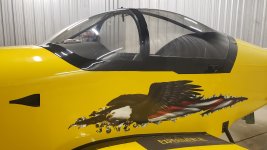
Not a DAR but I was told both are required and my DAR checked. He liked my "Experimental" placard.
He also liked her Screaming Eagle.
20250303_135616.jpg
 
Last edited:
Reviving this thread because I've been pondering the question about the Passenger Warning. My OLs don't say anything about it and like Ben Ellis above, I haven't found any regulation that calls it out. The only place I can find it is in AC-20-27F, but ACs are not regulatory. Anyone? Of course I display it on my aircraft, just curious.
The origin is Appendix D of FAA Order 8130.2K (and previous versions), which is the procedure and "template" that DARs are supposed to follow when issuing OLs. The passenger warning is item #38 in table D-1.

What confuses me is that the "Notes/Applicability" column for some of the items describes what sorts of aircraft the limitation applies to, but other items have "All" or "None" in that column. What does "None" mean...?
 
The origin is Appendix D of FAA Order 8130.2K (and previous versions), which is the procedure and "template" that DARs are supposed to follow when issuing OLs. The passenger warning is item #38 in table D-1.

What confuses me is that the "Notes/Applicability" column for some of the items describes what sorts of aircraft the limitation applies to, but other items have "All" or "None" in that column. What does "None" mean...?

You’re absolutely correct that any new et of Ops Lims issued has to conform to the latest version of 8130.2….but I see that Randalll’s first flight of his RV-6 was in 1999….and I have no idea what the guidance for Ops Lims was back then. Ops Lims don’t expire, so unless you decide to get them updated, later versions of the document don’t technically apply (your plane is “grandfathered” so to speak), or everyone would have to get new Ops Lims every few years when they update the document.

The “none” in the “Notes/Applicability” column means that there are no notes - the column is badly labeled in that regard. Unfortunately, there were enough problems with the table in “K” that there is a memo (not widely circulated) correcting many of the things listed… I spent two full days last week trying to build a CORRECT set of Ops Lims for a Northrop F5 (yup - supersonic fighter - “Experimental Exhibition) and I’m still not sure they meet all the various requirements….
 
  • Like
Reactions: Mel
I agree with Ironflight completely. That requirement was not listed in the order in 1999. I don't remember exactly what our guidance was back then, but I do know that we required the Passenger Warning placard.

Best I can find is that that particular Op Lim was added with FAA Order 8130.2j in October of 2017.

As Paul said, your Operating Limitations are valid until amended. Having said that, I would not remove the placard!
 
As Paul said, your Operating Limitations are valid until amended. Having said that, I would not remove the placard!
Yes no reason to and really it's a badge of honor in my mind. Anyway informing any passengers of the experimental nature of the aircraft is/was in the regs so, there's that.
 
Back
Top