

Many here run WOT and at least 100d LOP or more.
...flying very slowly, with their turn signal on.


Many here run WOT and at least 100d LOP or more.

This. Is. GOLD!!!!I read this tip on VAF. If you have a G3X hit lean find prior to take off. Then as you climb lean to that value.

How did you know what was appropriate for your density altitude if you don’t know where youre setting mixture prior to take off?
I have a Lycoming factory clone Bendix fuel injection system, RSA type. It actually does a pretty good job of automatically leaning out as I go up; I don't need to lean very much, if at all, until I start leaning for cruise.Aren't you leaning for best power before takeoff if you're significantly above sea level? You should know exactly where you're setting the mixture.
All you're doing is tweaking the fuel supply lower to match the lower air density as you climb. If you hold EGT more or less constant during the climb, mixture should be more or less constant too, and if it was correct at the beginning of the climb it'll still be correct at the end of it.
- mark
I have a Lycoming factory clone Bendix fuel injection system, RSA type. It actually does a pretty good job of automatically leaning out as I go up; I don't need to lean very much, if at all, until I start leaning for cruise.

I'm running a Silverhawk fuel injection system, which is also a Bendix clone, and if I don't lean during the climb I see EGT trending downwards. If EGT is trending downwards during a climb that starts at best power, that means the mixture is getting richer during the climb and I'm not at best power any more by the time I get to the top. Progressively leaning to maintain best power mixture means I get a better climb rate and/or a higher service ceiling.
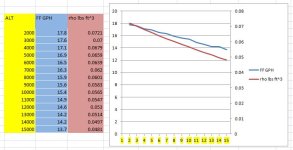

There ya go Dan. Trying to baffle us with facts and real science againIllustration, AFP FM-200, IO-390, WOT and full rich from 200 to 15000 feet. Bendix-type metering is based on velocity and density, so it tracks the density loss due to altitude rather well for a purely mechanical device. However, it's not perfect, and does moderately drift rich as density is reduced.
Progressively leaning in the climb to maintain the EGT noted immediately after takeoff simply makes the blue fuel flow line track the red density line.
Concerned about leaning at WOT? Note the EGT seen immediately after liftoff from sea level is based on a fuel/air ratio necessary to maintain detonation margin, based on certification tests, which are run at worst case temperature. Leaning to keep the blue line matched to the red line merely maintains the same ratio, and thus provides no basis for a detonation concern based on mixture. If CHT's get too hot, it's because cooling system performance is inadequate.
View attachment 57048

Good data, so I should be leaning a little bit during climb. I like real data! ThanksIllustration, AFP FM-200, IO-390, WOT and full rich from 200 to 15000 feet. Bendix-type metering is based on velocity and density, so it tracks the density loss due to altitude rather well for a purely mechanical device. However, it's not perfect, and does moderately drift rich as density is reduced.
Progressively leaning in the climb to maintain the EGT noted immediately after takeoff simply makes the blue fuel flow line track the red density line.
Concerned about leaning at WOT? Note the EGT seen immediately after liftoff from sea level is based on a fuel/air ratio necessary to maintain detonation margin, based on certification tests, which are run at worst case temperature. Leaning to keep the blue line matched to the red line merely maintains the same ratio, and thus provides no basis for a detonation concern based on mixture. If CHT's get too hot, it's because cooling system performance is inadequate.
View attachment 57048

During my full throttle TO, the mixture was full rich. I observed the EGT temp shortly after TO and leaned to this number as I climbed. There's been a lot posted since I did this flight and I'm now reading John Deakin's writings...trying to get educated ;- )How did you know what was appropriate for your density altitude if you don’t know where youre setting mixture prior to take off?
Can you explain this method and what you're seeing with the lean assist on before TO?I read this tip on VAF. If you have a G3X hit lean find prior to take off. Then as you climb lean to that value.

Can you explain this method and what you're seeing with the lean assist on before TO?
What O2 sensor do you use and any long term life results (assuming you use 100LL)?After takeoff & during climb I lean as needed to keep AFR around 12, which is roughly the “best power” region. If power is above about 65%, I avoid the red region on the AFR gauge, which approximates the “Red Box / Red Fin”. Once at cruise altitude, I do the Big Mixture Pull until I’m well into the LOP green region, with AFR approaching 16.
What O2 sensor do you use and any long term life results (assuming you use 100LL)?

