Great thread..... I assume you are on a IFR flight plan?

So we are talking CARB ICE. I have always been suspect that Van's Store off the shelf solution as not sufficient. Temp in carb venture can drop well over 30F. So imagine wet air going in carb, cooling and water condensing out and freezing on cold metal surfaces, butterfly valve and sides of carb venture. Van's started out with simple day / night fun VFR planes that could do loops and rolls, not hard core IFR planes. That was really an odd concept back in the day for a sport plane... But now we have RV's with more avionics than some airliners.
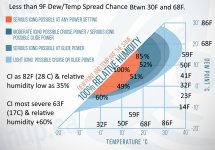
Basically these are Experimental amateur built aircraft and don't met FAR's.... Who knows, but I am sure it does not meet FAR Part 23 for Carb heat.... It may "work" but in the worst conditions would it work? Carb HEAT is preventative, once ice has choked your carb and engine stopped, you are in deep kimchi. Carb heat needs to heat the air up more 70F would ideal. Temp drop of 70F inside venturi is possible but typically at least 35F?
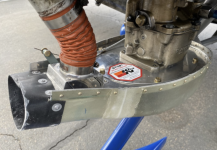
On Certified planes HEAT muff, is much more substantial than Van's standard set up, connected with no gaps connection and ALL air from heat muff goes in Carb throat.
If you want to know my suggestion is CARB INLET TEMP GAUGE.... Partial carb heat may make matters worse than better. Partial heat MAY be worse than no heat. As a CFI I say all or nothing.
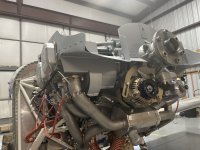
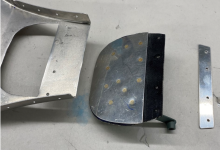
No answer but I have concerns Van's set-up with FAB, with that tiny flapper, and a little tray, with gaps on side is not super effective.
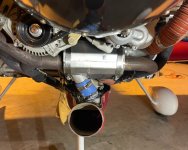
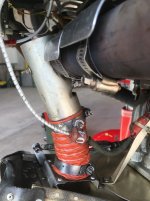
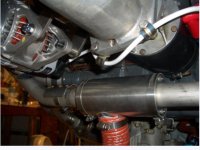
The metal stand tube pipe, notched and strapped to less than half of on cross over exhaust pipe, about 2 inches wide, has VERY little heat transfer and more big gaps. Sure engine compartment is warmer than OAT, but.... Also when you go to idle you have way less heat and Carb ice is more likely as the air is still cooling in the Venturi and water participating out and freezing. possibly.
If you are hard core IFR I would consider something different or at least putting a CAT probe on, if not permanently, as temporary flight test gauge. Otherwise I suggest staying out of carb ice prone temps. Really CI can happen in summer. Winter has advantage of larger dew / temp spread as the air tends to be dryer. Once it gets below freezing outside Carb ice is unlikely to happen. However impact snow might be an issue. The blocker door on Van's FAB as alternate air should do the trick for that condition. However I question flying around in those conditions, single pilot, single engine.
PS Lycoming's are better than Continentals for Carb Ice. Continentals have "cold air induction? which is great for making a few more HP. The Carb is bolted to induction that is not directly connected to engine except at cylinders. Lycoming's bolt the Carb right on the bottom of the HOT oil pan and air goes through oil pan. There is a gasket separating them, but the carb on a Lycoming is warmer normally than TCM. Lycs can get carb ice of course.