Van's Air Force

The definitive Van's Aircraft support community! Buying, building or flying an RV? Join our exclusive family of mentors and enthusiasts!

An idea for a hangar lift....

These things are about 1/10 the price of an Aero Lift and seem like it would be pretty straightforward to modify one. The one drawback I see offhand is needing 240V. My hangar has 120V 20A, which I bet is pretty typical.

So, I'd like to revive this old thread and hear from anyone that knows of one of these things being adapted to lift an airplane?

Steve,
Cheap 110V hydraulic power units are easy to come by, ($259 with prime shipping!) and would nearly bolt right on in place of the existing system. Most of these lifts have mechanical locking features as they go up, so even if your cheap hydraulic unit takes a dive you're plane won't drop.

It'd likely be slower than the original setup, but isn't there some saying about "time to spare, go by air" ;)

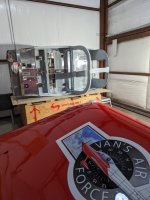
FYI, the RV-5 is currently suspended high in the demo aircraft hangar at Vans, lifted by a harbor freight hoist. Granted it weighs less, but they do offer configurations that would lift a cub in the couple hundred dollar price range.
 
Steve,
Cheap 110V hydraulic power units are easy to come by, ($259 with prime shipping!) and would nearly bolt right on in place of the existing system. Most of these lifts have mechanical locking features as they go up, so even if your cheap hydraulic unit takes a dive you're plane won't drop.

It'd likely be slower than the original setup, but isn't there some saying about "time to spare, go by air" ;)

It appears that the way these work is that there is a hydraulic ram with a pulley on the end, and a chain runs over that pulley and down the post. Somewhere there is a transition to a cable. It seems that the cable acts to synchronize the lifts on the two posts. The floor cover across between the posts seems to have a hydraulic line and the synchronizing cables running in it.

So I suppose a 120V hydraulic unit could be retrofitted.
 
Last edited:
As a regional manager for one of the major automotive lift manufacturers in the USA, I've been mulling this over for a while, but it's a back burner project. I don't think it's anything the company I work for would ever put into production. However... with some materials and a welder, some adaptions may be made. I currently have 1 lift in my hangar and another on the way, but they're to get my cars out of the way of my airplane. Oddly enough, I was planning on stopping by the plant tomorrow and seeing if one of the engineers wanted to help with a side project.

My question is, would you ever want it to convert from auto to airplane and back, or would you prefer to have a single post aircraft lift and save space?
 
Last edited:
As a regional manager for one of the major automotive lift manufacturers in the USA, I've been mulling this over for a while, but it's a back burner project. I don't think it's anything the company I work for would ever put into production. However... with some materials and a welder, some adaptions may be made. I currently have 1 lift in my hangar and another on the way, but they're to get my cars out of the way of my airplane. Oddly enough, I was planning on stopping by the plant tomorrow and seeing if one of the engineers wanted to help with a side project.

My question is, would you ever want it to convert from auto to airplane and back, or would you prefer to have a single post aircraft lift and save space?

Honestly I don't care if it is single post or two post. It would be airplane only, forever. If I bought one of the two-post products, I would modify the lift arms to have paddles for the main wheels and the tail wheel.
The big Issue I see is center of gravity location relative to the posts. This has two implications. The most obvious is the moment reaction to the ground through the base plate and bolt pattern. Most all cars are going to have the c.g. in some modest range fairly close to the post, whereas an airplane is going to have the c.g. as much as 4--5 ft from the post. Will that bolt pattern hold? I think I would plan on a link from the top of the post to the nearest hangar wall to brace it.
The second problem with that much moment is whether the lift shuttles would bind? They have nylon pads to slide on, I don't know if they can tolerate the moment.

This is why I would love to hear from anyone who has done it?????
 
As a regional manager for one of the major automotive lift manufacturers in the USA, I've been mulling this over for a while, but it's a back burner project. I don't think it's anything the company I work for would ever put into production. However... with some materials and a welder, some adaptions may be made. I currently have 1 lift in my hangar and another on the way, but they're to get my cars out of the way of my airplane. Oddly enough, I was planning on stopping by the plant tomorrow and seeing if one of the engineers wanted to help with a side project.

My question is, would you ever want it to convert from auto to airplane and back, or would you prefer to have a single post aircraft lift and save space?

I'm interested. I'm fine with airplane only and would appreciate a free standing unit. The airport authority frowns on renters drilling holes in their nice hangar floors...
 
Instead of lift, hoist. Perhaps a metal frame and cables.

My bifold hangar door uses cables that are spooled around a single drum which is turned by one motor. Same principle.
 
I'm interested. I'm fine with airplane only and would appreciate a free standing unit. The airport authority frowns on renters drilling holes in their nice hangar floors...

Also very interested with the same conditions as Kyle above. I talked to the folks that bought Aerolift and I couldn’t tell if they were really in business. And the basic unit started at $22K IIRC. I regret selling the RV7 but I’m not willing to leave a plane on the ramp due to lack of hanger space.
 
Anything we build will anchor to the floor, so I apologize to the renters. Our lifts are overbuilt, and I planned the seed with engineering. One of our engineers was more interested in going for a ride, so I might be able to do something. A single post will work best for me too since i already have 2 lifts. Like anything... we will have to calculate moment arm, but I don't think that'll be an issue with the design I'm thinking of. I don't see an issue with the carriage binding at this time. I've got another meeting tomorrow about something else, but I'll prod a little more.
 
To avoid drilling anchor holes in the concrete floor, I was thinking of bolting the post(s) to a big steel plate. the footprint of the steel plate would have to extend to a point forward of the airplane c.g. and if a single post, would also have to extend laterally to a point beyond the airplane centerline. This is what Aero Lift does - they have two legs extending from the post forward and laterally.

If carriage binding was a problem, I guess I could ballast the tailwheel lift arms to get the c.g. closer to the post(s).

Keep us posted if you and your engineers want to take on a low-production side project to modify your standard products.
Anything we build will anchor to the floor, so I apologize to the renters. Our lifts are overbuilt, and I planned the seed with engineering. One of our engineers was more interested in going for a ride, so I might be able to do something. A single post will work best for me too since i already have 2 lifts. Like anything... we will have to calculate moment arm, but I don't think that'll be an issue with the design I'm thinking of. I don't see an issue with the carriage binding at this time. I've got another meeting tomorrow about something else, but I'll prod a little more
 
Following... With an RV-12 well under way and a beautiful RV-7 I'd like to keep until I don't fly anymore, I've also been looking at automotive lifts and trying to figure out how to make one work in my rented tee hangar.

I've been told the concrete isn't thick enough for a typical twin-post lift with a bolted base configuration, I also don't think my airport owner would approve of tying it to the wall for stability, so something free standing is going to be required for my situation.

A single column with support legs would be best for me. And I don't have 220V power, so 110V would be another requirement. Doesn't hurt to dream. :rolleyes:

And BTW, Thanks for updating the forum, it's a welcome improvement!


12 on its side.jpg
 
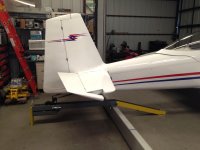
If you are going to park a taildragger below your lift, you may consider this mod. The hardware that holds the plane is a trip hazard in the hangar, so I would raise the lift to park under it. A nosewheel would be no problem, but a taildragger will need a ramp to get the tailwheel aft and the plane fully into the hangar. I built this sturdy one with a rotating fixture to allow you to turn the tailwheel 180 degrees to be able to pull the plane back off the lift easily. The best way to get the tailwheel on the ramp is to tie a rope around the tailwheel mount and pull it up the ramp. I later added a small winch to pull it up and on the ramp.

I had no problem putting the RV10 on the lift. The tailwheel support beam fits right into the tailwheel ramp when lowered.aerolift rv8 tail .jpg
 
Had our RV7A hung for 14 years on a platform built below a dolly/crane.
 

Attachments

  • IMG_0189 (Medium).JPG
    IMG_0189 (Medium).JPG
    114.7 KB · Views: 113
Had our RV7A hung for 14 years on a platform built below a dolly/crane.

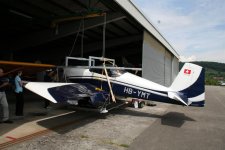
I feel like Switzerland is the natural home of this kind of arrangement, I've seen it in lots of places. It seems completely normalized.

(Here: Flugplatz Birrfeld)
 

Attachments

  • IMG_6362.jpg
    IMG_6362.jpg
    161 KB · Views: 162
Yes please, let's revive this thread with pictures of what's been done during the last decade. I'm reminded of buying a lift (and modifying it for the plane) every time I change the oil in the F150 or change Husqvarna mower blades.
I did find that the auto lifts are available in 120V. I also determined that the floor of my hangar, and most hangars probably, is not thick enough to carry the load if you anchored the lift posts to the floor, so it needs to be free-standing, with one leg that joins the two posts, and then each post has a leg that extends forward on the floor.
With that, the only remaining chore is to design and fab the lifting arms that would support the main wheels and the tail wheel. I also have not figured out yet if my T-hangar is high enough to let me hoist an airplane high enough to get the second one under.
 
I feel like Switzerland is the natural home of this kind of arrangement, I've seen it in lots of places. It seems completely normalized.

(Here: Flugplatz Birrfeld)
Wow! can you say "glue-lam"? Sure, I knew you could! Those are serious beams!!
 
I’m toying with the idea of running an I-Beam across the width of my T-Hangar and getting a 1 ton hoist. I have talked with a structural engeneer and using 50% as a margin of safety he says it’ll work.

We are still working out the details, but the plan is to tie the I-Beam to the wall structure and devise a roll on cradle that has a lift point to coincide with the aircraft CG.
 
I did find that the auto lifts are available in 120V. I also determined that the floor of my hangar, and most hangars probably, is not thick enough to carry the load if you anchored the lift posts to the floor, so it needs to be free-standing, with one leg that joins the two posts, and then each post has a leg that extends forward on the floor.
With that, the only remaining chore is to design and fab the lifting arms that would support the main wheels and the tail wheel. I also have not figured out yet if my T-hangar is high enough to let me hoist an airplane high enough to get the second one under.
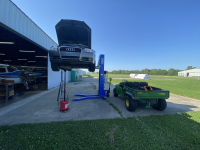
I have a single post lift, rated for 6000 lbs. Have had it for a bit over 10 years. Its awesome. No problem lifting a 1/2 ton pickup. I can roll a vehicle around the shop into a corner out of the way to work on.


It comes with different longer extension pads to offset the center beam from the frame of the vehicle. On my list to do is weld up some much longer feet attached to some webbing to lift a RV.

In the summer I do routine car maintenance outdoors.

1732672036327.png
 
Last edited:
I’m toying with the idea of running an I-Beam across the width of my T-Hangar and getting a 1 ton hoist. I have talked with a structural engeneer and using 50% as a margin of safety he says it’ll work.

We are still working out the details, but the plan is to tie the I-Beam to the wall structure and devise a roll on cradle that has a lift point to coincide with the aircraft CG.
Somehow I think the municipality that I rent the T-hangar from would frown on such mods to the hangar. For those that own their own hangar, your solution is certainly a good option. The folks at the Williams Gliderport in CA have a big hangar and they hoist several gliders up into the rafters almost daily. They have quite a nice winch system set up. For gliders (empty weight 500--900 lb) they use a webbing sling cradle to lift the fuselage.
 
I have a single post lift, rated for 6000 lbs. Have had it for a bit over 10 years. Its awesome. No problem lifting a 1/2 ton pickup. I can roll a vehicle around the shop into a corner out of the way to work on.


It comes with different longer extension pads to offset the center beam from the frame of the vehicle. On my list to do is weld up some much longer feet attached to some webbing to lift a RV.

In the summer I do routine car maintenance outdoors.

View attachment 75194
This is exactly the kind of feedback I was looking for when I renewed this thread. I would love to hear success stories and see pictures of AIRPLANES up on the lift.
 
Somehow I think the municipality that I rent the T-hangar from would frown on such mods to the hangar. For those that own their own hangar, your solution is certainly a good option. The folks at the Williams Gliderport in CA have a big hangar and they hoist several gliders up into the rafters almost daily. They have quite a nice winch system set up. For gliders (empty weight 500--900 lb) they use a webbing sling cradle to lift the fuselage.
Ok. Don’t tie it to the structure. Erect a self standing A-Frame on each end.
 
I have a single post lift, rated for 6000 lbs. Have had it for a bit over 10 years. Its awesome. No problem lifting a 1/2 ton pickup. I can roll a vehicle around the shop into a corner out of the way to work on.


It comes with different longer extension pads to offset the center beam from the frame of the vehicle. On my list to do is weld up some much longer feet attached to some webbing to lift a RV.

In the summer I do routine car maintenance outdoors.

View attachment 75194
what does the lift itself weigh? The link to the spec sheet only says portable. That is an awesome photo Bob!
 
I feel like Switzerland is the natural home of this kind of arrangement, I've seen it in lots of places. It seems completely normalized.

(Here: Flugplatz Birrfeld)
Do they hang their planes under a highway bridge? :ROFLMAO: Those beams are huge !!
 
Last edited:
Our T hangars have 120V outlets on the side walls and again at the rear of the hangar. A few of the clever tenants figured out that the rear outlets are on the other 120V leg from those on the side outlets: thus if you take the one leg from a side outlet and the other leg from the rear you get 240 volts.
 
Our T hangars have 120V outlets on the side walls and again at the rear of the hangar. A few of the clever tenants figured out that the rear outlets are on the other 120V leg from those on the side outlets: thus if you take the one leg from a side outlet and the other leg from the rear you get 240 volts.
Bad idea.
 
Bad idea.
Why? Done properly, this is no different than pulling a 240V wire from the breaker box, except that the breakers for the two legs are not pinned together to trip both if there is a fault. I've seen houses wired this way.
 
Last edited:
Do they hang their planes under a highway bridge? :ROFLMAO: Those beams are huge !!

They're spectacular, aren't they?

The hangar in question has 100% of its weight supported by those timber columns running up the centreline in the photo. The exterior walls are non-structural cladding, and there are no columns or other structural supports getting in the way of the doors.

The lifts for the airplanes are supported on telescopic sliding rails on roller bearings which cantilever outside the hangar doors. Each airplane has a custom cradle to capture its undercarriage or other relevant lifting points, so the lifts themselves can all be the same.

When you want to fly your airplane, you open the hangar doors, slide the airplane outside, and lower it to the ground. Push-button simplicity. Push the plane off the cradle, winch everything back into the ceiling, and go flying. There's no need to disturb the aircraft parked underneath yours.

The whole arrangement is beautiful, and (like just about everything in Switzerland) is very well engineered.

- mark
 
Why? Done properly, this is no different than pulling a 24V wire from the breaker box, except that the breakers for the two legs are not pinned together to trip both if there is a fault. I've seen houses wired this way.
Good way to kill somebody.
“Oh, I shut off the breaker and it shut off…. We’re good”.
 
Good way to kill somebody.
“Oh, I shut off the breaker and it shut off…. We’re good”.
yeah, I guess you are right. That's why they normally pin the breakers together. But I've seen plenty of houses where they aren't. I remember an issue where someone's oven would turn on but only get warm, could not get up to full temperature. One leg of the 240 breaker had tripped, but not the other.
 
yeah, I guess you are right. That's why they normally pin the breakers together. But I've seen plenty of houses where they aren't. I remember an issue where someone's oven would turn on but only get warm, could not get up to full temperature. One leg of the 240 breaker had tripped, but not the other.
That doesn't make any sense. Why would the heater element be connected to neutral? And if it's not, there is no current path if one leg is tripped.
 
Back
Top