Van's Air Force

The definitive Van's Aircraft support community! Buying, building or flying an RV? Join our exclusive family of mentors and enthusiasts!

Aerobatic training in a new RV-7?

Status
Not open for further replies.

birddog486

Well Known Member
I'm just starting to think about doing aerobatics in my new RV-7 (which I've just signed out of phase I, without the aerobatics verbiage) and trying to decide the best course of action.

Would you, as an aerobatics noob, find an aerobatics instructor that will train you in your NEW airplane? (Put the plane back into phase I and use the additional pilot program for aerobatic training/testing)

Or,

Would you rent a plane and instructor and get familiar with all the maneuvers you'd like to fly in the RV and then do the testing in your plane on your own?
 
I chose to start with a course in a Super D and I went on from there before flying acro in my 6 but that's just me. Another consideration is your aerobatic weight with 2 people plus chutes. I also have a lower acro gross weight so two onboard isn't an option with the full 6G margin. Van wrote some good articles about gentleman acro in his planes some years ago worth googling.
 
Last edited:
I chose to start with a course in a Super D and I went on from there before flying acro in my 6 but that's just me. Another consideration is your aerobatic weight with 2 people plus chutes. I also have a lower acro gross weight so two onboard isn't an option with the 6G margin. Van wrote some good articles about gentleman acro in his planes some years ago worth googling.

What he said above, I endorse fully.

1. Get to know your RV.
2. Take a basic aerobatic course.
3. Take an RV experienced aerobatic instructor with you in your plane for a few hours of aerobatic instruction. Unless both instructor and yourself are on the lighter side it will be impossible to stay within the aerobatic weight limits.

Citabria's/Decatlon's and other high drag biplanes can behave quite differently than a slick RV. I recently heard a story about a very highly experienced and well known aerobatic instructor that was surprised by the RV's pitch attitude and rotation rate during a spin.

The RV is an amazing aerobat but performing aerobatics in a new airplane is not to be taken lightly.
 
I'm just starting to think about doing aerobatics in my new RV-7 (which I've just signed out of phase I, without the aerobatics verbiage) and trying to decide the best course of action.

Would you, as an aerobatics noob, find an aerobatics instructor that will train you in your NEW airplane? (Put the plane back into phase I and use the additional pilot program for aerobatic training/testing)

Or,

Would you rent a plane and instructor and get familiar with all the maneuvers you'd like to fly in the RV and then do the testing in your plane on your own?

Hi Travis,

I recently answered similar questions via PM for new RV pilot in Texas. I'll pass some of the same information on to you.

My friend Gordon Penner has a series of videos that you should find interesting. Gordon is a master CFI and aerobatic instructor who has put together a comprehensive series of videos that speak to people just like you. Go to YouTube and search with his full name.

The best reading I have found is "Better Aerobatics" by Alan Cassidy. You should probably see Gordon's videos before reading Alan's book as he gets a lot more technical and you should have some basic understanding of aerobatics before getting immersed in the details.

If you are brand new to aerobatics it is essential that you get some training on spin and unusual attitude recovery before you do anything else. You know that dual instruction is difficult to get in an RV because of the weight and CG limitations with two aboard plus parachutes. Training in an Extra or Decathlon transfers quite well to the RV so I recommend you find someone provide that training before you venture out on your own in your RV. Once you are confident that you can recover from inadvertent spins or lost of control you should practice at altitude to perfect the basic maneuvers. Go high enough to safely recover from a misstep, 6000 AGL is a good cushion.

Perfecting the fine details requires the help of a critique from the ground. Your nearest IAC chapter can help in this regard. The Chicago chapter is IAC Chapter 1 and they are very active and have some of the best instructors in the country.

IAC 1
Greater Chicago, IL
President: Todd Ashcraft
Contact: 630-310-0844 | [email protected]
Meetings: Every Last Friday 6:00 PM
Website: IAC1.eaachapter.org
 
I often read the word parachute/s when aero's are being discussed, is it mandatory to wear them over in the USA!

You can do solo aerobatics without a parachute but when passenger(s) on board everyone must wear a chute.
 
I often read the word parachute/s when aero's are being discussed, is it mandatory to wear them over in the USA!

The regs are a little screwy, actually. Chutes aren't required for aerobatics per se, but are required for bank angles above 60? and pitch exceeding 30?. Full details are at FAR (Federal Air Regulations) 91.307(c). Theoretically, if you can do a spin without exceeding those limits...

So what is aerobatics? FAR 91.303 says... For the purposes of this section, aerobatic flight means an intentional maneuver involving an abrupt change in an aircraft's attitude, an abnormal attitude, or abnormal acceleration, not necessary for normal flight.

But aerobatics per se, according to the regs' definition, does not require chutes.

One former Chief Counsel for the FAA said that the FARs were, "a monument to vagueness." There are many good folks in the FAA, and many of the other kind as well, so...
 
Yeah, I would get an instructor. It's good to have a solid foundation of the fundamentals. RV's aren't the best aerobatic planes to learn in because they are very slippery. You can quickly blow through VNE if you botch a maneuver and aren't on your nose low recovery game.

Re: parachutes, I typically don't wear them if the other person is a pilot as well. Consider them a "crew member" to comply with the reg. Can anyone comment on whether or not that's ok under the FARs?
 
Re: parachutes, I typically don't wear them if the other person is a pilot as well. Consider them a "crew member" to comply with the reg. Can anyone comment on whether or not that's ok under the FARs?

You can consider them a "fruit" if you like, but I wouldn't try to have them for a snack. :D

No single-pilot airplane requires a second crewmember for any operation. Good luck trying to get that one past the FAA and/or the insurance companies (and their lawyers!) should it ever come to that. It's always best to obey both the letter and obvious intent of the regs.

It's simple: if you're doing aerobatics (in the US) with more than one person onboard, everyone must be wearing a parachute. Period.
 
Thread drift

No single-pilot airplane requires a second crewmember for any operation. d.

I can?t let this go. If the pilot is under the hood in vfr, the regs require a second crewmember, a safety pilot. This is a particular sore point for me, because I periodically serve as a non-PIC safety pilot for friends, and the FAA requires me to have a standard medical for this, not Basic Med.

As to parachutes: although not required by the FARs for solo aerobatics, I believe the FAA sometimes insists on parachutes before issuing low altitude waivers. Is there any common sense here?
 
"parachutes, I typically don't wear them if the other person is a pilot as well. Consider them a "crew member" to comply with the reg. Can anyone comment on whether or not that's ok under the FARs?"


Some time ago I watched a youtube vid with two people flying acro with no chutes. Curious, I read the comments and this FAR was mentioned.

As an active CFI, I became curious if I could fly acro with a student in my RV with no chutes. I asked AOPA Legal and an Inspector at my local FSDO for an interpretation.

Both sources said "no" you need chutes. But my Inspector further added that I can teach "unusual attitudes" with no chutes for the purpose of training, but not perform a "full routine". He also reemphasized the importance of logging duel given to prove it was flight training for the unusal attitudes and not a joy ride.

YMMV
 
Last edited:
Re: parachutes, I typically don't wear them if the other person is a pilot as well. Consider them a "crew member" to comply with the reg. Can anyone comment on whether or not that's ok under the FARs?


Some time ago I watched a youtube vid with two people flying acro with no chutes. Curious, I read the comments and this FAR was mentioned.

As an active CFI, I became curious if I could fly acro with a student in my RV with no chutes. I asked AOPA Legal and an Inspector at my local FSDO for an interpretation.

Both sources said "no" you need chutes. But my Inspector further added that I can teach "unusual attitudes" with no chutes for the purpose of training, but not perform a "full routine".

YMMV[/QUOTE]

The actual FAR says that a cfi may give instruction in ?any maneuver required by the regulations? without parachutes. Unusual attitudes are required for an instrument rating, spins are required for a cfi rating, so both these may be taught sans chutes. Inverted flight, no.
 
"The actual FAR says that a cfi may give instruction in ‘any maneuver required by the regulations’ without parachutes. Unusual attitudes are required for an instrument rating, spins are required for a cfi rating, so both these may be taught sans chutes. Inverted flight, no."

FAA inspector widened the definition for training required for an aircraft check out in addition to a new rating. I believe Flight Reviews could also fit the intent of the rule.

All this to be said...It is very hard to legally and safely teach acro in RVs.
 
Last edited:
"The actual FAR says that a cfi may give instruction in ‘any maneuver required by the regulations’ without parachutes. Unusual attitudes are required for an instrument rating, spins are required for a cfi rating, so both these may be taught sans chutes. Inverted flight, no."

FAA inspector widened the definition for training required for an aircraft check out in addition to a new rating. I believe Flight Reviews could also fit the intent of the rule.

All this to be said...It is very hard to legally and safely teach acro in RVs.
As was said the FAR's are vague and clear as mud here. However the caveat I recall (rusty memory alert) is a maneuver for training toward a rating. Example a CFI teaching another pilot for CFI rating can do the three spins to left, three to right without chutes. However our school had an Aerobat and chutes.

FAA Inspector can say what he wants. That is no legal ruling or explicit statement in the Regs. He said is a rumor. There is no aerobatic rating or legit training for a rating that requires, loops, rolls; No Flt review or check out requires Aerobatics (none)... thus I interpreted it as follows:
  • Solo pilot no chute to do aerobatics provided plane & airspace are legal.
  • Two people chutes required to do aerobatics.
RV's are not hard to teach Aerobatics in. Did it many times. If you are talking about gross weight, two bubba's and full fuel yes it might not be legal (within Van's limits). RV-7 and RV-8 have decent allowable crew weight for Aerobatics, if empty weight of aircraft is reasonable, not ridiculously high. RV-6 not so much, harder to say in Acro W&B. Keeping your RV light is always good.

Seriously when I do aerobatics I wear my chute, even solo. If I have a passenger I borrow one.

What ever you do READ everything Van's Aircraft has written about aerobatics in RV's including entry speeds and techniques. I am not going to teach you here, but the RV is very easy to lopp and roll, but screwing up can result in excess speed beyound limits and possible airframe overload. It is not something to take lightly.
 
Last edited:
The regs are a little screwy, actually. Chutes aren't required for aerobatics per se, but are required for bank angles above 60? and pitch exceeding 30?. Full details are at FAR (Federal Air Regulations) 91.307(c). ...


Is pitch with or without AOA? (path of plane or path of plane plus AOA)

Say you're flying a plane straight and level in slow flight and it's capable of flying at an AOA of 31 degrees.

Are you in aerobatic flight?
 
To the original question. You need the signoff for the aerobatics in phase I. You'll need to put the plane back in Phase I and go through each manuver you want to do. The point is to test the airplane.

Things like spins, that vary significant with CG, may be something you want to explore slowly, especially if you have anything not stock (cowl, gear leg fairings etc.). They may be better suited to starting to test with one person aboard. A good spin test series is something that shouldn't be skipped or done without some thought.
 
Is pitch with or without AOA? (path of plane or path of plane plus AOA)

Say you're flying a plane straight and level in slow flight and it's capable of flying at an AOA of 31 degrees.

Are you in aerobatic flight?

Look up FAR 91.303. Here?s a quote ? For the purposes of this section, aerobatic flight means an intentional maneuver involving an abrupt change in an aircraft's attitude, an abnormal attitude, or abnormal acceleration, not necessary for normal flight.? (Notice lack of bank or pitch angles)


Please list the civil aircraft capable of 31+ degrees AOA?
 
I simplified with the 31 degrees.

But I could see 16 AOA with a climb gradient of 15 degrees with a high powered plane
 
In summary...

Despite what the FARs may or may not say, when the airplane comes apart due to your screw up, mechanical malfunction or supernatural forces beyond our understanding the question of the legality of wearing a parachute becomes a rather moot point. Don't wear one, you die. Wear one and you may live to see your grandchildren grow up, go to college, get married, build an RV and offer you a ride and ask you if it's OK to do a little aerobatics. Want a chute grandpa?

 
I simplified with the 31 degrees.

But I could see 16 AOA with a climb gradient of 15 degrees with a high powered plane

You're trying to invent an issue that doesn't exist. This thread past post #5 is redundant to many others here that can be found via search.

OP, don't try to do initial acro training in your airplane. Find someone with a Decathlon to do initial training in. It's all transferable to the RV.
 
Hi Travis,

I recently answered similar questions via PM for new RV pilot in Texas. I'll pass some of the same information on to you.

My friend Gordon Penner has a series of videos that you should find interesting. Gordon is a master CFI and aerobatic instructor who has put together a comprehensive series of videos that speak to people just like you. Go to YouTube and search with his full name.

The best reading I have found is "Better Aerobatics" by Alan Cassidy. You should probably see Gordon's videos before reading Alan's book as he gets a lot more technical and you should have some basic understanding of aerobatics before getting immersed in the details.

If you are brand new to aerobatics it is essential that you get some training on spin and unusual attitude recovery before you do anything else. You know that dual instruction is difficult to get in an RV because of the weight and CG limitations with two aboard plus parachutes. Training in an Extra or Decathlon transfers quite well to the RV so I recommend you find someone provide that training before you venture out on your own in your RV. Once you are confident that you can recover from inadvertent spins or lost of control you should practice at altitude to perfect the basic maneuvers. Go high enough to safely recover from a misstep, 6000 AGL is a good cushion.

Perfecting the fine details requires the help of a critique from the ground. Your nearest IAC chapter can help in this regard. The Chicago chapter is IAC Chapter 1 and they are very active and have some of the best instructors in the country.

IAC 1
Greater Chicago, IL
President: Todd Ashcraft
Contact: 630-310-0844 | [email protected]
Meetings: Every Last Friday 6:00 PM
Website: IAC1.eaachapter.org

OP, don't try to do initial acro training in your airplane. Find someone with a Decathlon to do initial training in. It's all transferable to the RV.

Thanks for the info fellas, Ron I checked out the videos, thanks. I do hold a CFI and have done spin training but My old Cherokee 140 that was rated for spins probably doesn't compare to the RV.

I think I'll try to find an instructor and plane and get some aerobatic time with them. I don't have a chute so hopefully I can find someone that can provide that.

As far as buying a chute I'd like to hold off incase I cant get over any nausea I may have doing acro.
 
OP I see you are in WI. Try these -


DISCOVER FLIGHT LLC
Submitted by Jamie Pittman on Sun, 2017-09-03 06:22

ADDRESS:
Oshkosh Airport (KOSH) , Oshkosh, WI, 54902, USA
CONTACT PERSON:
Jamie Pittman
PHONE:
(920) 515-0880
EMAIL:
[email protected](link sends e-mail)
WEB:
letsdiscoverflight.com(link is external)
AIRCRAFT:
(Airmanship & Stick and Rudder) Piper J-3 Cub // (Aerobatics) Pitts S2B // & Aerobatic instruction in customer-owned airplanes may also be arranged
COURSES:
Spin & Upset Training (1 Hour Flight/1-2 Hours Ground) Aerodynamic Confidence (3 Flight Hours/2-3 Ground) Intermediate Aerobatics Course (5 Flight Hours/3-4 Ground) Advanced Aerobatics Course (10 Flight Hours/6-8 Ground)
AIRPORT:
KOSH - Whitman Regional, Oshkosh, WI
INSTRUCTORS:
Jamie Pittman, CFI
NOTES:
Need a break from the boring? Come learn how to be a safer pilot while having a blast upside down. There are NO unusual attitudes here! Fly our airplanes or bring your own! We have aerobatic experience in a variety of aircraft, including a Pitts, Extra, Citabria, Decathlon, RV, and more.
HSRDLA LLC
Submitted by Anonymous on Fri, 2016-08-19 05:18

ADDRESS:
Kenosha Airport, Kenosha, WI, 53144, USA
CONTACT PERSON:
Hilel Swerdlin, Certified Flight Instructor
PHONE:
262-455-1159
EMAIL:
[email protected](link sends e-mail)
AIRCRAFT:
Super Decathlon
COURSES:
Tailwheel endorsement, CFI spin endorsement, Basic and Intermediate Aerobatics, Upset Training, Emergency Maneuvers, Commercial Maneuvers, Aeronautical Risk Management
INSTRUCTORS:
Hilel Swerdlin, CFI
 
Re: parachutes, I typically don't wear them if the other person is a pilot as well. Consider them a "crew member" to comply with the reg. Can anyone comment on whether or not that's ok under the FARs?

don’t need them for spin training and that exceeds the pitch bank limits, students are considered crew.
 
don’t need them for spin training and that exceeds the pitch bank limits, students are considered crew.
No, students are not crew. But the FARs do explicitly exempt CFI’s and someone (anyone) receiving instruction in ‘a maneuver required by the regulations for a license or rating’ from wearing ‘chutes. So spins are allowed without ‘chutes (required training for a CFI certificate), unusual attitudes (within limits) are allowed (required for instrument rating). Inverted flight requires parachutes (no license or rating requires inverted flight).
 
file:///var/mobile/Library/SMS/Attachments/fd/13/F71E1660-BE04-4CF2-BA6B-06F96A776C9D/SN-00115-An-Aerobatic-Epistle.pdf

This was a good read.
 
A very well known pilot who passed from "natural causes" flew solo and instructed aerobatics for decades simply didn't believe in chutes. He was well known to the FAA and they basically looked the other way. The Brits didn't believe in chutes. British pilot Neal Williams had a partial spar failure in a Zlin, solo no chute. The failure was in the lower spar cap. He got the airplane inverted before the spar failed completely, descended to a very low altitude on final approach, snap rolled the airplane to upright and crashed. Walked away with no injuries. A very well known incident that is well documented.
The problem with a failure on a low or mid wing monoplane, the wing is likely to wrap around the pilot seat and trap the pilot.
I would do aerobatics in a well built RV6. I would not fly a RV7 with the "zip tie rudder".
I find no US registered RV6 that ever suffered an inflight structural failure. There have been 7 RV 7 accidents world wide. One in US went into water and was never recovered. The others all appear to have started with rudder failure due to flutter.
 
No, students are not crew. But the FARs do explicitly exempt CFI’s and someone (anyone) receiving instruction in ‘a maneuver required by the regulations for a license or rating’ from wearing ‘chutes. So spins are allowed without ‘chutes (required training for a CFI certificate), unusual attitudes (within limits) are allowed (required for instrument rating). Inverted flight requires parachutes (no license or rating requires inverted flight).

How better to teach unusual attitude recoveries than aero? Yes, students are crew, remember that silly night currency interpretation?
 
I chose to start with a course in a Super D and I went on from there before flying acro in my 6 but that's just me. Another consideration is your aerobatic weight with 2 people plus chutes. I also have a lower acro gross weight so two onboard isn't an option with the full 6G margin. Van wrote some good articles about gentleman acro in his planes some years ago worth googling.
Same, this is the only way in a 6. Rolls are quite easy to keep <2G once you know what you are doing.
But loops are 3.5-4 which means that technically you can do it at gross, but it is a horrible idea since the limit is 4.4G. So you really need to learn it in a different plane then do it solo in the RV.

A very well known pilot who passed from "natural causes" flew solo and instructed aerobatics for decades simply didn't believe in chutes. He was well known to the FAA and they basically looked the other way. The Brits didn't believe in chutes. British pilot Neal Williams had a partial spar failure in a Zlin, solo no chute. The failure was in the lower spar cap. He got the airplane inverted before the spar failed completely, descended to a very low altitude on final approach, snap rolled the airplane to upright and crashed. Walked away with no injuries. A very well known incident that is well documented.
The problem with a failure on a low or mid wing monoplane, the wing is likely to wrap around the pilot seat and trap the pilot.
I would do aerobatics in a well built RV6. I would not fly a RV7 with the "zip tie rudder".
I find no US registered RV6 that ever suffered an inflight structural failure. There have been 7 RV 7 accidents world wide. One in US went into water and was never recovered. The others all appear to have started with rudder failure due to flutter.
All the 7 crashes I know of were root caused to over speed that led to flutter. I am not sure if the 6 is more robust to overspeed, or if fewer people do acro training in them since the acro weight limit doesn't support 2 people. Either way, if you keep it in the envelope than any RV will be good.
 
acro is serious stuff. i dont know many who love it and do it all the time. get with a pro and see what you think.
 
Point of clarification, although some pilots may do such inside the cockpit so as to be better able to see around and behind them, acrobatics is what gymnasts and carnies do. Aerobatics is what airplanes do.

(As to a parachutist in free fall, which do they do? Maybe a little of both, acrobatic initially before the slipstream builds, then both with acro of the body to manipulate and achieve aero from the air?)
 
Students other than Student Pilots are crew and need no parachutes. Student pilot is a level of certification while a student is someone in the role of trainee or is there for the purpose of learning and these are two distinctly different things.

Student Pilots don’t need chutes for spin training but do for other aerobatics as student pilots are passengers yet are exempted from parachute requirements specific to spins.

Yes, students are crew, remember that silly night currency interpretation?

This is in response to your request for a legal interpretation of 14 CFR §61.57 concerning pilot in command, recent flight experience. We agree that a properly rated instructor and a student are not passengers within the meaning of §61.57(b) and SFAR 73.

The instructor is not a passenger because he is present specifically to train the person receiving instruction. Neither is the person receiving instruction a passenger with respect to the instructor.


Yes, this decision was “rescinded,” but it wasn’t actually rescinded rather the language of the regulation was changed from passengers to persons, the nature of students being considered crew was not altered.


Now

Section 91.307 provides the operating flight rules for parachutes and parachuting. Subsection (c) provides that unless each occupant of the aircraft is wearing an approved parachute, no pilot of a civil aircraft carrying any person (other than a crewmember) may execute any intentional maneuver that exceeds (1) a bank of 60 degrees relative to the horizon; or (2) a nose-up or nose-down attitude of 30 degrees relative to the horizon.

This final rule states that the amendatory language was written to make it clear that, regardless of what certificate or rating the applicant is seeking, an acrobatic maneuver required for any certificate or rating ( even one not presently sought by the applicant) may be performed without parachutes when done by or at the direction of a certificated flight instructor. To provide an abundance of clarity, the 1964 final rule also provided the following example: "a student pilot is not required to have flight instruction for spins; however, his flight instructor, if he considers that such training is necessary, may give the student this training without parachutes since spins instruction is required for certain other certificates or ratings."

but there is confusion with

the term "crewmember" includes a certificated flight instructor and student at any level because 14 CFR 1.1 defines the term "crewmember" as a person assigned to perform duty in an aircraft during flight time; and, therefore, no parachute is required under § 91.307( c ). However, the 1964 final rule preamble states that for the purposes of§ 91. 71 (b) ( currently § 91.307( c )) a student pilot has been interpreted as being a passenger, not a crewmember.

yet this gets countered - a student is distinctly different than a student pilot. Have your PPL? Or even your Sport or Recreational Pilot? Then you are not a “Student Pilot” even while being a “Student” seeking further training. Consider getting a helicopter or glider add-on. You’re never a student pilot throughout and have separate certification requirements. (This means if you’re a glider or helicopter person adding plane, you can do the full aero not merely spins without chutes.)

You can also counter that “currently 91.307” lacks this preamble and with this counter you could even more fully include student pilot though if you honor the interpretation as written, they still honored the now missing preamble.

Implication spin training is good at all levels including student pilot and requires no parachute. Aerobatic training other than spins for those already having a tested rating in any category hence not being “student pilots,” both student and instructor can be viewed as crew hence no parachutes needed. Aerobatic training with a student pilot other than spin training, parachutes needed (despite such training being really good for unusual attitude recovery training).


Consider this - Ag pilots can’t use parachutes as they’re too low for canopy deployment, yet somehow these pilots need to be trained to do their wing-overs which are technically in the aerobatic maneuver pitch and bank considerations yet are not required by any certification…
 
I have a related question.

I have a -7 with a tip up canopy that I have never flown. I have owned it for over a year. It’s getting paint and an IFR panel this month.

I am an A&P and had the canopy on and off a dozen times doing various tasks.

Knowing what it takes to release the canopy, by disconnecting the side struts and raising the tail end of the canopy up to vertical for the hooks to clear the sub-panel.

How in hell am I supposed to be expected to wear a parachute if I could never expect to lose the canopy to leave the cockpit?

I’m not a fan of hitting the silk. But it looks like my only option if I want to fly any aerobatics is to get my training in some other aircraft and fly mine under the solo exception.

Am i missing something?
 
I’m not a fan of hitting the silk. But it looks like my only option if I want to fly any aerobatics is to get my training in some other aircraft and fly mine under the solo exception.

Am i missing something?
Any time you are wearing a parachute, you should remove the struts before flight! When the canopy jettison was designed, the RV did not have the lift struts. Instead it had a single strut that was disconnected to close the canopy.

Also to facilitate canopy jettison, the upper forward skin needs to be slotted above the hinges. Again, this was standard on the original design because the canopy had straight hinges. The slots are covered with tape.
 
Last edited:
I have a related question.

I have a -7 with a tip up canopy that I have never flown. I have owned it for over a year. It’s getting paint and an IFR panel this month.

I am an A&P and had the canopy on and off a dozen times doing various tasks.

Knowing what it takes to release the canopy, by disconnecting the side struts and raising the tail end of the canopy up to vertical for the hooks to clear the sub-panel.

How in hell am I supposed to be expected to wear a parachute if I could never expect to lose the canopy to leave the cockpit?

I’m not a fan of hitting the silk. But it looks like my only option if I want to fly any aerobatics is to get my training in some other aircraft and fly mine under the solo exception.

Am i missing something?
I think you are right on the money...with or without the struts, frankly. I concluded the same thing on my first 6 tip up.
 
Any time you are wearing a parachute, you should remove the struts before flight! When the canopy jettison was designed, the RV did not have the lift struts. Instead it had a single strut that was disconnected to close the canopy.

Also to facilitate canopy jettison, the upper forward skin needs to be slotted above the hinges. Again, this was standard on the original design because the canopy had straight hinges. The slots are covered with tape.
So you are suggesting I cut slots in the skin above the canopy mounting hooks, and plan on removing the struts when I do aerobatics.

Interesting. Thank you for that information.
 
So you are suggesting I cut slots in the skin above the canopy mounting hooks, and plan on removing the struts when I do aerobatics.

Interesting. Thank you for that information.
If you want to have the canopy jettison feature operate as designed; Yes!
 
IMO if you have enough control to safely parachute out without a certified ejection seat, you have enough control to land somewhere. I can see the need for the “nylon letdown” due to a flameout and no suitable place to land but this rule is dumb, as I’m sure has been stated many times.
 
IMO if you have enough control to safely parachute out without a certified ejection seat, you have enough control to land somewhere. I can see the need for the “nylon letdown” due to a flameout and no suitable place to land but this rule is dumb, as I’m sure has been stated many times.
I wouldn’t be in a hurry to hit the silk and throw away an aircraft capable of a landing that I thought I could walk away from.

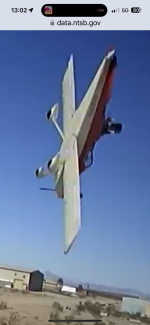
Notice the lack of tail feathers. IMG_7044.png
 
IMO if you have enough control to safely parachute out without a certified ejection seat, you have enough control to land somewhere.
Couldn't be more wrong about that. In the acro world there have been lots of pilots who joined the caterpillar club after some sort of inflight structural/control failure.
 
Couldn't be more wrong about that. In the acro world there have been lots of pilots who joined the caterpillar club after some sort of inflight structural/control failure.
Lots of pilots is a very vague statement. In the period starting in the mid 70's many of the successful bailouts have been from perfectly good airplanes. Many of the Pitts accidents were from perfectly good airplanes- serious lack of knowledge of spins.
Even the most basic stuff can bite. Many decades ago I watched an experienced pilot doing a Cub comedy routine. He did a spin at a reasonable altitude for a Cub. The spin continued to the ground but the last portion flattened out to the point where the pilot survived. He was badly injured and had no recollection of the crash.
Two very experienced pilots in a Pitts. Got in an upright flat spin and recovery efforts were not working. At a very low altitude full power was applied and the rotation stopped and the airplane hit the ground. Both had minor injuries.
Two place Sukhoi: the owner was not competent. The "instructor" was not competent. They were straight and level inverted and were fighting each other on the controls. Decided they had a control failure and bailed out of a perfectly good airplane. One uninjured, one two broken ankles
Rockford EAA in the late 60's. Aircraft was a PJ260. Inadvertent upright flat spin at low altitude. As the airplane got very close to the ground it was in an extreme nose high attitude. With the tailwheel almost touching the ground the rotation stopped, the airplane hung there briefly and flew away. The pilot did not fly at EAA for several years. He also had a T6 and I watched him crash the T6 at Frederick MD. He walked away. He crashed fatally in the PJ at Suffolk NY in late 1977. That one hit me very hard. I don't believe I will ever get over it completely.
 
Post 43 was an RV7 at an airpark near Kingman AZ. Retired airline pilot, active glider pilot. Trying to learn aileron rolls on his own.
 
The spin continued to the ground but the last portion flattened out to the point where the pilot survived. He was badly injured and had no recollection of the crash.
Two very experienced pilots in a Pitts. Got in an upright flat spin and recovery efforts were not working. At a very low altitude full power was applied and the rotation stopped and the airplane hit the ground. Both had minor injuries.

Nice to read vindication of Sammy Mason that if you can’t recover it and can’t get out, flatten it out.

 
Lots of pilots is a very vague statement. In the period starting in the mid 70's many of the successful bailouts have been from perfectly good airplanes.
Totally separate topic that nobody is debating. I was responding to the comment stating that if you're in control of yourself enough to bail out, you're in control enough to land. There have been quite a few that bailed after structural/control failure. I know a few personally.
 
Nice to read vindication of Sammy Mason that if you can’t recover it and can’t get out, flatten it out.
That's a horrible advice and not what anyone is actually suggesting. Power effects notwithstanding, flattening a spin objectively decreases the authority of the rudder and elevator 100% of the time. Regarding adding power, it's not the flattening effect that can help, it's the propwash over the elevator and rudder. In some airplanes the propwash adds more control authority than any ancillary flattening of the spin takes away. And power only flattens a spin if you're (for example) spinning left in a CW-turning Lycoming style engine. Power pitches the nose down if spinning to the right.
 
That's a horrible advice and not what anyone is actually suggesting. Power effects notwithstanding, flattening a spin objectively decreases the authority of the rudder and elevator 100% of the time. Regarding adding power, it's not the flattening effect that can help, it's the propwash over the elevator and rudder. In some airplanes the propwash adds more control authority than any ancillary flattening of the spin takes away. And power only flattens a spin if you're (for example) spinning left in a CW-turning Lycoming style engine. Power pitches the nose down if spinning to the right.

Did you read the whole article? It mentions power steepening as well as flattening. And the Mason referenced advice is specific to too late to recover and too late or unable to get out. Context matters.
 
Status
Not open for further replies.
Back
Top