Van's Air Force

The definitive Van's Aircraft support community! Buying, building or flying an RV? Join our exclusive family of mentors and enthusiasts!

Archer Com antenna in RV-10 Wingtip?

czechsix

Well Known Member
Has anyone tried a Bob Archer VHF Com antenna in the RV-10 wingtip? PIREP? Pictures?

I'm building a -14 but it has the same wingtip as the -10. I'll have dual Coms, and plan to use a belly-mounted bent whip for the primary Com. I'm thinking about the wingtip location to reduce drag for the second Com. I already know the wingtip Com antenna won't perform as well as an external antenna, and there have been mixed reviews from people who have installed them in the 2-seat RVs. Some people found them unacceptable, others seemed satisfied that the performance was good enough for a second radio used primarily for a backup.

The -10 and -14 have a substantially thicker airfoil than the rest of the RV series, so I'm wondering if perhaps the wingtip antenna may do a bit better due to the greater vertical polarization potential, but I could not find any antenna performance reports specific to the -10 in the forums...

Actually there is one thread (found with Google instead of the VAF search engine): http://www.vansairforce.com/community/showthread.php?t=107189

Any others who have tried this antenna?

Thanks,
 
Last edited:
The 10 is a really nice cross-country traveling machine, and because of that you will most likely fly in the weather once in a while, at least we do. I don't fly in any serious weather, but it is nice to have the capability to get up and down through layers or perform an instrument approach or instrument departure when needed. There is nothing worse than not being able to hear ATC when you are in the thick of it. The drag of an external antenna is minuscule and far is far outweighed by the increased clarity and range in communications.
I know you are thinking that you are planning on one external com antenna. Keep in mind that radios do fail. :)

Vic
 
Listen to Walt and Vic. I had one in a wingtip that didn't make it out of phase I over 10yrs ago. It was quickly moved to a "proper" external location.
 
A belly com antenna is sometimes insufficient to reach ground control. If your wingtip com antenna's line-of-sight to the tower is also blocked by the fuselage, you have a problem. A whip antenna for com #2 on the top of the tailcone takes care of both issues.
 
We tried an Archer COM antenna in our first RV-10 and were so disappointed with the performance that we removed it and put another bent ship on the belly. The wingtip Nav Antenna, on the other hand, we have always been happy with.
 
Last edited:
Make your own if you can

I've posted on this before.

My first RV-8A I made a wingtip comm antenna. Flying with someone that had the Archer antenna I had to really coms to ATC as they could not hear my buddy.

Wingtip antennas (bought or made) work only as a well as they are installed and tuned. If you do not have an antenna analyzer like this don't even try: https://www.gigaparts.com/mfj-259c....MI77zovYzc1gIVVLjACh09Kw_gEAQYASABEgKXzvD_BwE

Two things:
- Page 13-16 of the Aero Electric Connection provides the basic wingtip antenna design. Use that to figure out how best to extend out into the full width of your wingtip - and with the most change in vertical placement. Note the first third of the antenna does most of the work, so this is what you want to be as vertical as possible. The tail that runs aft along the outer edge of the wingtip brings the antenna into resonance but does little of the actual work.
- Make the tail a little long so that you can trim it to resonance. Remember the tail length will determine resonant frequency, the Gamma Match (the little stub with an insulator where you attach the feed line) does the impedance matching to your 50 ohm coax.

This antenna will never work as well as a properly installed belly whip - but does just fine for the backup radio. This is also the only VOR antenna I would ever consider putting on an RV. The one in the RV-10 picks up VORs out to 100nmi at altitude.

Carl
 
What I'm doing in my cabin top

worth substantially less than Stein's $.02;)

simply what I'm going with as a first effort...

not flying yet and won't be for a good while...

similar has worked for me and others on ham VHF mobile, so I'm reasonably hopeful.

top pic shows the vee dipole VOR/LOC/GS antenna in the mid-section of the cabin top, with feedline and "bazooka" style balun of RG-400. The ends are about halfway down the doorway B-pillars. Legs are 26".


bottom pic is the 23" quarter-wave foil monopole Com 2 antenna in the right rear cargo area. This will be connected by very short pigtail to a BNC bulkhead fitting in a tab attached to the right top longeron, to use the fuselage side as a ground plane/counterpoise. This antenna is about 3/16 wavelength from the metal of the baggage area turtledeck skin, and fairly close to the right rear seat occupant. Because of the risk of RF exposure, this will be known as the mother-in-law seat. Just kidding - we're way below field strength concerns here.
 
One thing I noticed about Bob Turner's installation is that he attached the antenna ground plane to the top wing skin, and the outboard leg angles downward. This makes the most sense for the RV-10/14 wingtip. However the Aircraft Spruce info for the Archer com antenna says you mount it to the bottom of the wing skin and angle it upward. This is probably because the older horner style tips would have allowed better vertical orientation by attaching it to the bottom skin.

For those of you who were not happy with the installation in the RV-10, did you ground the antenna at the top skin or bottom skin?

Thanks,
 
installing Bob Archer antenna with Zip Tips

I am almost ready to install my zip tips on my rv10 with Bob archer antenna. I have Coax RG400 (I think) that is going to wire my antenna.

My questions is can I wire my zip tips with unshielded tefzel wire (12x 20awg and 2x 16awg)?

I was thinking of running the coax in its own conduit in rear lightning hole through ribs.
I would then run the 14 conductor tefzel wire for zip tips and possibly Go Pro camera power in front counduit.

Would this be okay?? Or would I have issues?

Thoughts
 
Need more info

Are you talking about the Archer com antenna (like this thread)? This requires as much vertical polarization as you can get, even for ‘fair’ performance. I’m not familiar enough with zip tips to make that call.
Second, what are the wires for? If you’re running LEDs that need a pulse-width-modulated power supply, they can be noisy, and your antenna is very close.
 
Yes that antenna correct. The wires are for strobes landing taxi wigwags and Nav.

So
Using shielded wires will eliminate this I presume?!
 
Okay, more specifically: Are any of the lights LEDs driven by a pulsed power supply (often called 'PWM")? If yes you almost surely want shielded wiring, but, that may not be enough. You can't shield the LED itself (no light would get out!) and it is so close to the antenna that it may cause trouble. Only testing will answer your question. Personally, I'd recommend going with something like FlyLEDs (which are not pulsed, but straight dc). But I do not know if they fit the ZipTips.
 
You can have the best radios in the world, but without a good antenna, they are useless. Suggest you rethink using wingtip com antennas.
 
Just a brief followup - my zero-drag vertical quarter-wave antenna embedded in the canopy of the RV-10 works well, as expected. So does the standard under-wing bent whip antenna for Com 1. I can't tell a difference in the performance of the two.

I have yet to test the VOR vee antenna embedded in the canopy top - just haven't played with the Avidyne to test that capability, since I navigate exclusively by GPS these days as I suspect most of us do.
 
One thing I noticed about Bob Turner's installation is that he attached the antenna ground plane to the top wing skin, and the outboard leg angles downward. This makes the most sense for the RV-10/14 wingtip. However the Aircraft Spruce info for the Archer com antenna says you mount it to the bottom of the wing skin and angle it upward. This is probably because the older horner style tips would have allowed better vertical orientation by attaching it to the bottom skin.

For those of you who were not happy with the installation in the RV-10, did you ground the antenna at the top skin or bottom skin?

Thanks,

Listen to the experts and forget the Archer. These birds deserve the best equipment you can afford. Coms is not the place to pinch.
 
It looks like after contacting Aveo I received this email back:

"I just received word back from the engineers at the factory, yes PWM is used for the LED driver"

So I am going to go with another type of com antenna. Are there any recommendations for my 10????

I'm doing the G3X system for my 10. I guess its better to know this now than figure out later there is problems.
 
Just a brief followup - my zero-drag vertical quarter-wave antenna embedded in the canopy of the RV-10 works well, as expected. So does the standard under-wing bent whip antenna for Com 1. I can't tell a difference in the performance of the two.

I have yet to test the VOR vee antenna embedded in the canopy top - just haven't played with the Avidyne to test that capability, since I navigate exclusively by GPS these days as I suspect most of us do.
The COM radios put out significant RF power (10W).
The safe limit in the VHF frequency range is 0.2 mW/cm^2 (see FCC OET Bulletin 65).
The safe distance to a VHF antenna is therefore 2 feet.
If you embed the antenna in the RV-10 canopy, it will be hard to ensure 2 feet.
 
I'll give you one guess why Cirrus decided to clutter up the outside of their aircraft with antennas....
 
I haven't a clue about Cirrus.

Why does the mil use patch or embedded antennas in their warplanes, including subsonic ones? It's feasible.

What is the minimum safe distance from the antenna on my 5 watt comm handheld that I hold an inch from my eyeball when I transmit on it?

Sorry for thread drift. Good VHF antennas on RV's are not hard to come by, nor are they particularly difficult for a home-brew operator to keep hidden out off the slipstream, in my experience.
 
What is the minimum safe distance from the antenna on my 5 watt comm handheld that I hold an inch from my eyeball when I transmit on it?
17 inches for 5 Watts. Keep in mind that the duration of the transmission also plays a role. The FCC limit assumes 30 min transmit.
 
I haven't a clue about Cirrus.

Why does the mil use patch or embedded antennas in their warplanes, including subsonic ones? It's feasible.

I'm pretty sure the military didn't grab something from Archer!
Feasable, perhaps but at what cost? (Millions I would bet for development/engineering)
A Typical jet VHF com radio is also much more powerful than our baby radios so they can have less than ideal com antenna.

From my experience, I've yet to come across an imbedded antenna that works as well as a properly mounted external antenna. I've tested thousands of xpdr's literally, every single one with it mounted internally it's almost impossible to get a good reliable signal, I end up moving all around the airplane with my test antenna in various locations just trying to get a good signal to get it to pass.

If someone with a glass/composite airplane calls me, and they do, and says the comms won't work I tell them to go away, can't be fixed unless you want to install a ground plane and external antenna. I've never heard of a Glassair or Lancair with good coms, but I hear all the time how bad they are. Even with the antenna mounted vertically in the VS they still suc*.

Of course, we may have different opinions or what "acceptable" performance is.

With antennas you can make it pretty, or make it work, can't have it both ways.
 
Last edited:
A Typical jet VHF com radio is also much more powerful than our baby radios so they can have less than ideal com antenna.

A typical jet vhf com radio is much more powerful than our baby radios, because VHF is pretty much limited to line of sight, no matter how powerful your radio is. But you can ‘see’ a lot further at 40,000’ than at any altitude I’ll ever reach.
 
Hi, now 8 years later I was wondering if someone now has some real world experience with the Archer Com Antenna in the RV-10 Wingtips (maybe also with the ziptips)? Are any planes with Archer Com Antenna flying yet?
 
We have tried the Archer Com antenna in the past. It didn't work well. Because the Com antenna would be vertical, it doesn't work well in the RV wingtips. I expect not in the zip tips either. The Nav is horizontal, so it works great in the RV wingtips.
 
This antenna will never work as well as a properly installed belly whip - but does just fine for the backup radio. This is also the only VOR antenna I would ever consider putting on an RV. The one in the RV-10 picks up VORs out to 100nmi at altitude.

Carl
Above post from Carl says it all. I have a -10 so wingtips may be thicker than some other RV models. My #2 com feeds an Archer com antenna in the wingtip. Ground leg and start of leading edge mounted as high as possible where the tip is the thickest, bent down to the bottom of the tip to get as much vertical polarization as possible. I mostly just use it for atis, and on the ground once in a while if atc complains they can’t receive #1 (belly whip antenna). It works for calling the tower (they report ‘loud and clear’) from 15 nm out. In a non-scientific comparison, SL30 (external antenna) always gets usable ATIS signal a few miles further out than the G420 (Archer com antenna). So I think it’s okay for a #2 com, I’ve never installed an external antenna to replace the Archer com.
Again, like Carl, the Archer nav antenna in the other wing tip works perfectly acceptably for me.
 
Great, thank you for the information! Looks like I will go with the Archer NAV and a belly mounted Com Antenna then.
 
I spoke with Bob Archer’s son. I called asking the same questions about the com antenna in the wingtip before buying the archer VOR antenna. He basically said the VOR is horizontally polarised and works well.

The com being vertically polarised needs more inches of vertical than most wingtips have.

I have comm 1 on top and comm 2 on the bottom with the Archer in the wingtip of my -7
 
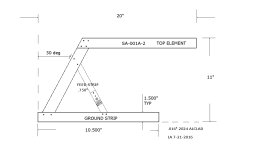
I'm interested in the Archer COM antenna in the wing tip, but it seems that many people find them unsatisfactory. This is said to be due to the requirement for a vertically polarised signal, which can't be achieved in RV wing tips. According to the ACS web site, as far as I can tell, the dimensions of the Archer COM antenna are:

Archer_SA-001A.jpg

I don't know much about antennas in general, or the Archer COM antenna in particular, but I wonder if the top element and ground strip need to be in the same plane as the angled transverse strip, since most of the radiated power comes from the angled strip. If they were bent at near right angles, the vertical height would be about 8", which is the same as the depth of the RV-7/8 etc wing tips. Would a bend like this affect the RF performance?

I know this would put the radiating element very close to the tip rib, but maybe it would be possible to apply a metal foil to the inside of the tip's top skin connected to both the wing skin and the ground strip, putting the ground strip maybe 4 to 6 inches away from the rib. Do any antenna experts know if any of this is possible?

Thanks for any light shed on this
 
I'm interested in the Archer COM antenna in the wing tip, but it seems that many people find them unsatisfactory. This is said to be due to the requirement for a vertically polarised signal, which can't be achieved in RV wing tips. According to the ACS web site, as far as I can tell, the dimensions of the Archer COM antenna are:

View attachment 110362

I don't know much about antennas in general, or the Archer COM antenna in particular, but I wonder if the top element and ground strip need to be in the same plane as the angled transverse strip, since most of the radiated power comes from the angled strip. If they were bent at near right angles, the vertical height would be about 8", which is the same as the depth of the RV-7/8 etc wing tips. Would a bend like this affect the RF performance?

I know this would put the radiating element very close to the tip rib, but maybe it would be possible to apply a metal foil to the inside of the tip's top skin connected to both the wing skin and the ground strip, putting the ground strip maybe 4 to 6 inches away from the rib. Do any antenna experts know if any of this is possible?

Thanks for any light shed on this

Start by reading this. He lists his phone number and email if you’d like more information.
 

Start by reading this. He lists his phone number and email if you’d like more information.
Thank you. I've already read that, plus the antenna section of the AeroElectric Connection book. They have lots of good information, but I'm really hoping for something more specific about effects of bending the antenna arms out of plane and offsetting the ground plane connection outboard of the tip rib. Of course, if anyone has other suggestions about modifications to improve performance I'd be really happy to know more.
 
The 10 is a really nice cross-country traveling machine, and because of that you will most likely fly in the weather once in a while, at least we do. I don't fly in any serious weather, but it is nice to have the capability to get up and down through layers or perform an instrument approach or instrument departure when needed. There is nothing worse than not being able to hear ATC when you are in the thick of it. The drag of an external antenna is minuscule and far is far outweighed by the increased clarity and range in communications.
I know you are thinking that you are planning on one external com antenna. Keep in mind that radios do fail. :)

Vic

I do 100% concurs with Vic regarding “lost comms” while IFR or any time for that fact. I completed my IR ticket last year and had some lost comm issues around regional ATC facilities and early handoffs by Centers. I had two bent whip antennas on the belly of my RV9A and replaced them last month with straight whips. Huge difference with an improved range even when picking up ATIS below 5,000 feet. In the past I needed to be within15-20 miles or our Class D. Last week I picked up ATIS about 30+ miles out.

TD/DR. Don’t “bury” a comm antenna inside anything, fiberglass wingtip included. And vertical vs horizontal position matters regarding to who you communicating with at the time.
 
Last edited:
Well another perspective. I’ve installed 2 bent whip antennas in both wing tips on my 4. They have to be mounted at an angle vertically to fit in the tip. I fastened a sheet of aluminum to the inside top of the tip with the attaching screws sandwiching it to the end rib providing a ground plane for the antenna’s. The old style Hoerner tips are flat on top which helps with the ground plane. I’ve had good reception but do occasionally have reception quality diminished by the airframe shadowing but simply switching radios connected to the opposite tip solves that. We’re talking VFR flying however. For the record I did it for the clean look not for a speed increase but I’m sure it’s a bit of help in that regard.
 
Has anyone tried a Bob Archer VHF Com antenna in the RV-10 wingtip? PIREP? Pictures?

I'm building a -14 but it has the same wingtip as the -10. I'll have dual Coms, and plan to use a belly-mounted bent whip for the primary Com. I'm thinking about the wingtip location to reduce drag for the second Com. I already know the wingtip Com antenna won't perform as well as an external antenna, and there have been mixed reviews from people who have installed them in the 2-seat RVs. Some people found them unacceptable, others seemed satisfied that the performance was good enough for a second radio used primarily for a backup.

The -10 and -14 have a substantially thicker airfoil than the rest of the RV series, so I'm wondering if perhaps the wingtip antenna may do a bit better due to the greater vertical polarization potential, but I could not find any antenna performance reports specific to the -10 in the forums...

Actually there is one thread (found with Google instead of the VAF search engine): http://www.vansairforce.com/community/showthread.php?t=107189

Any others who have tried this antenna?

Thanks,
Has anyone tried a Bob Archer VHF Com antenna in the RV-10 wingtip? PIREP? Pictures?

I'm building a -14 but it has the same wingtip as the -10. I'll have dual Coms, and plan to use a belly-mounted bent whip for the primary Com. I'm thinking about the wingtip location to reduce drag for the second Com. I already know the wingtip Com antenna won't perform as well as an external antenna, and there have been mixed reviews from people who have installed them in the 2-seat RVs. Some people found them unacceptable, others seemed satisfied that the performance was good enough for a second radio used primarily for a backup.

The -10 and -14 have a substantially thicker airfoil than the rest of the RV series, so I'm wondering if perhaps the wingtip antenna may do a bit better due to the greater vertical polarization potential, but I could not find any antenna performance reports specific to the -10 in the forums...

Actually there is one thread (found with Google instead of the VAF search engine): http://www.vansairforce.com/community/showthread.php?t=107189

Any others who have tried this antenna?

Thanks,
I just attended the EAA Sport Air workshop for electrical systems. We talked about com antennas and the Archer antenna. A com antenna needs to be as vertical as possible and perpendicular as possible to the ground plane (airplane body for Vans models) to create a horizontal transmit/receive pattern (think donut with the antenna going through the hole). Getting the Archer oriented vertically in a wingtip is a challenge. You will have to compromise and accept a sort of vertical arrangement that creates a sort of horizontal pattern. I think the main problem with this arrangement is the orientation of the antenna to the ground plane for the antenna (airplane body). Getting the antenna perpendicular to the ground plane and vertical gives the best performance. I don't see how you achieve anything close to that orientation with an Archer com antenna in a wingtip. The instructor talked about the bent whip antennas and pointed out they are a similar compromise in performance to allow them to be installed on the bottom of an airplane.
 
The instructor talked about the bent whip antennas and pointed out they are a similar compromise in performance to allow them to be installed on the bottom of an airplane.
My 2 cents. Pretty much all com antennas designed for small aircraft have compromises, because nearly all of them rely on an ‘ideal’ ground plane. ‘Close enough’ to ideal is something like a wavelength in size. But at 100MHz that’s 3 meters, and there is nothing on the airframe that’s this large in all directions. (Ever wonder why the theoretical feed point impedance is 37 ohms, but we use 50 ohm coax?). Ideal vertical bent (at the halfway point) whips should still radiate 80% of their power vertically polarized. It’s real world complications - like metal landing gear legs extending down into the near field pattern, or, on the ground, steel rebar buried just a few feet down - that’s responsible for most of the diminished performance. When you try to stuff a vertically polarized radiator into a wingtip in close proximity to the end rib the final result depends on so many little things (wires, etc) that getting an acceptable performance depends on having the proper test equipment for each installation, and/or good luck.
 
Back
Top