
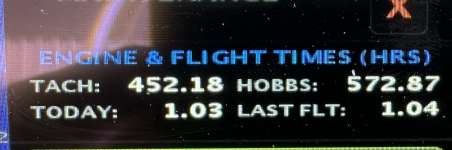
Is there any consensus in the RV12 community as to whether we should use the hours shown on the Hobbs meter vs. the hours shown on the tach for oil changes and Rotax 100 inspections? Checked mine today and we had 288 hours tach time and 389 hours Hobbs time. We've been doing our oil changes and 100 hours inspections based on Hobbs. Maybe we're spending too much money by not using the tach time?

Van's Air Force
You are using an out of date browser. It may not display this or other websites correctly.
You should upgrade or use an alternative browser.
You should upgrade or use an alternative browser.
Hobbs Meter or Tach for Hours
- Thread starter bob1393
- Start date

Is there any consensus in the RV12 community as to whether we should use the hours shown on the Hobbs meter vs. the hours shown on the tach for oil changes and Rotax 100 inspections? Checked mine today and we had 288 hours tach time and 389 hours Hobbs time. We've been doing our oil changes and 100 hours inspections based on Hobbs. Maybe we're spending too much money by not using the tach time?
The FAR's require some inspections and some maintenance to be performed based on Time In Service (TIS), which is further defined as the time from takeoff to landing.
And then there are Calendar requirements, not related to TIS, for example, an annual or condition inspection.
OTOH, Pilot flying time is defined as from engine start to engine shutdown.
Tach time roughly approximates TIS, and Hobbs time roughly approximates Flight Time.
A manufacturer (say, for example, Rotax) could define the oil change interval, and that would be the ruling definition.
I don't know what Rotax specifies.
I'm a bit surprised by the large difference in your two times. Do you spend a lot of time idling on the ground? What causes your Hobbs meter to run, oil pressure switch, avionics master, or master switch?
Last edited:

tomkk
Well Known Member
The Rotax maintenance schedule uses Hobbs time ("All time during which the engine is running is counted towards the total number of operating hours. The time is counted irrespective of the load factor of the engine, such as idling or take-off power.")
There is a Skyview system setting for specifying the Cruise RPM (SETUP MENU > EMS SETUP > ENGINE INFORMATION). If the cruise RPM is incorrect the Tach time will also be incorrect. That might explain the large difference between Hobbs and Tach time.
There is a Skyview system setting for specifying the Cruise RPM (SETUP MENU > EMS SETUP > ENGINE INFORMATION). If the cruise RPM is incorrect the Tach time will also be incorrect. That might explain the large difference between Hobbs and Tach time.
Last edited:
Robert Anglin
Well Known Member
Translation
The old rule of thumb is with privet aircraft and pilots you service engines and log time by the oil switch that turns the hobbs on at start up and shuts it off at shut-down. It is when you get into freight or ATP operations that you get some need to be paid or log time from wheels up to wheels down.
Just kid of the way that is looked at down through the years. The O.E.M. sets the rules for your equipment for the most part. Yours, R.E.A. III #80888
The old rule of thumb is with privet aircraft and pilots you service engines and log time by the oil switch that turns the hobbs on at start up and shuts it off at shut-down. It is when you get into freight or ATP operations that you get some need to be paid or log time from wheels up to wheels down.
Just kid of the way that is looked at down through the years. The O.E.M. sets the rules for your equipment for the most part. Yours, R.E.A. III #80888
PilotBrent
Well Known Member
I'm a bit surprised by the large difference in your two times. Do you spend a lot of time idling on the ground? What causes your Hobbs meter to run, oil pressure switch, avionics master, or master switch?
His TACH number is 74% of his Hobbs. My Hobbs/TACH numbers are 403.7/333.6 i.e. the TACH is 82% of the Hobbs. Probably pretty common ratio with the Skyview/Rotax setup.

tomkk
Well Known Member
From the Skyview installation manual:
"Hobbs time is a simple timer that runs whenever the oil pressure is above 15 PSI or the engine is above 0 RPM. " "RPM is used when calculating tach time." "Tach time is defined as TIME x (CURRENT RPM / CRUISE RPM)."
The cruise RPM that's entered on the engine setup screen determines the ratio between Hobbs and Tach times.
Rules of thumb are sometimes useful but in this case, it's pretty much totally under our control through the Cruise RPM setting.
"Hobbs time is a simple timer that runs whenever the oil pressure is above 15 PSI or the engine is above 0 RPM. " "RPM is used when calculating tach time." "Tach time is defined as TIME x (CURRENT RPM / CRUISE RPM)."
The cruise RPM that's entered on the engine setup screen determines the ratio between Hobbs and Tach times.
Rules of thumb are sometimes useful but in this case, it's pretty much totally under our control through the Cruise RPM setting.
Rotax wants Hobbs. Hobbs usually records when the oil pressure is 15 psi or higher. The tach depending on how it is set up can be influenced by rpm. Low rpms the tach may turn slower and high rpms it may turn faster. The tach can be 15% - 18% different from a Hobbs. Rotax likes maintenance based on engine run hours no matter at what rpm.

az_gila
Well Known Member
From the Skyview installation manual:
"Hobbs time is a simple timer that runs whenever the oil pressure is above 15 PSI or the engine is above 0 RPM. " "RPM is used when calculating tach time." "Tach time is defined as TIME x (CURRENT RPM / CRUISE RPM)."
The cruise RPM that's entered on the engine setup screen determines the ratio between Hobbs and Tach times.
Rules of thumb are sometimes useful but in this case, it's pretty much totally under our control through the Cruise RPM setting.
Only partially true.
Extended taxi time, or sitting at the runway end waiting for lots of landing traffic will both change that Hobbs/Tach time ratio, regardless of what number is set into the Skyview.
If you check the wiring diagram of an older certified mall plane you will probably find that the Hobbs is not wired through the Master Switch. This takes away the temptation for renters to get cheaper flights by switching off the Master in flight.

tomkk
Well Known Member
Only partially true.
Extended taxi time, or sitting at the runway end waiting for lots of landing traffic will both change that Hobbs/Tach time ratio, regardless of what number is set into the Skyview.
If you check the wiring diagram of an older certified mall plane you will probably find that the Hobbs is not wired through the Master Switch. This takes away the temptation for renters to get cheaper flights by switching off the Master in flight.
All true, but I was mostly responding to the rules-of-thumb folks were referring to. Just reminding folks that was adjustable in our Skyview system

flytoboat
Well Known Member
OTOH, Pilot flying time is defined as from engine start to engine shutdown.
Actually, FAR Part 1, Definitions and Abbreviations, defines Flight Time as "Pilot time that commences when an aircraft moves under it's own power for the purpose of flight and ends when the aircraft comes to rest after landing".
So if you start your engine and sit there for 15 minutes to get your oil warmed up, that time wouldn't count. The time taxiing to-from the runway would be included.
I don't know how accurate Foreflight times the flight but I believe the time starts when the airplane starts in motion.
Actually, FAR Part 1, Definitions and Abbreviations, defines Flight Time as "Pilot time that commences when an aircraft moves under it's own power for the purpose of flight and ends when the aircraft comes to rest after landing".
So if you start your engine and sit there for 15 minutes to get your oil warmed up, that time wouldn't count. The time taxiing to-from the runway would be included.
I don't know how accurate Foreflight times the flight but I believe the time starts when the airplane starts in motion.
Thanks for the clarification. I guess if you want to be totally accurate, you should have a stopwatch and start it when you begin taxi, and stop it when you end taxi.

Overcooked
Guys, just take your actual flight time and add your pre and post flight taxi time. Keeping in mind that most folks track time in 10th?s of an hour, (which is 6 minutes), I just round to the nearest six minutes. In the last year, I?ve made 280+ flights and I find that my taxi out, run up and then taxi in average out to about .2 hours. So, if you can?t remember exactly, .2 is a pretty good number to use. The point being, that you only need to be accurate to the nearest 6 minutes...stop watch not really required.
Guys, just take your actual flight time and add your pre and post flight taxi time. Keeping in mind that most folks track time in 10th?s of an hour, (which is 6 minutes), I just round to the nearest six minutes. In the last year, I?ve made 280+ flights and I find that my taxi out, run up and then taxi in average out to about .2 hours. So, if you can?t remember exactly, .2 is a pretty good number to use. The point being, that you only need to be accurate to the nearest 6 minutes...stop watch not really required.
So, my Skyview says my Tach time is 1349 and the Hobbs time is 1607. That would mean that my Tach time is 83% of the Hobbs time. Does that make sense?
I had changed the Skyview Classic to a used Skyview Touch a few years back. I didn't have to update these time values in the setup so does this mean they are stored in the EMS and not in the Skyview?
I also have a mechanical timer on the panel that is hooked up to an oil pressure switch. Interesting that it reads close to the Skyview Hobbs time but not the same.
I had changed the Skyview Classic to a used Skyview Touch a few years back. I didn't have to update these time values in the setup so does this mean they are stored in the EMS and not in the Skyview?
I also have a mechanical timer on the panel that is hooked up to an oil pressure switch. Interesting that it reads close to the Skyview Hobbs time but not the same.
I read somewhere that foreflight started counting flight time after the aircraft reached 40 mph.Actually, FAR Part 1, Definitions and Abbreviations, defines Flight Time as "Pilot time that commences when an aircraft moves under it's own power for the purpose of flight and ends when the aircraft comes to rest after landing".
So if you start your engine and sit there for 15 minutes to get your oil warmed up, that time wouldn't count. The time taxiing to-from the runway would be included.
I don't know how accurate Foreflight times the flight but I believe the time starts when the airplane starts in motion.


Pilot135pd
Well Known Member
That's why when you're a pilot looking to build time you start it and taxi to the runway and if you have to warm it up you do it at the beginning of the runway so that time is counting. Same thing is done by CFIs trying to build those hours to go get a better paying job.Actually, FAR Part 1, Definitions and Abbreviations, defines Flight Time as "Pilot time that commences when an aircraft moves under it's own power for the purpose of flight and ends when the aircraft comes to rest after landing".
So if you start your engine and sit there for 15 minutes to get your oil warmed up, that time wouldn't count. The time taxiing to-from the runway would be included.
I don't know how accurate Foreflight times the flight but I believe the time starts when the airplane starts in motion.

GalinHdz
Well Known Member
FWIW I do the same. Tach for maintenance, Hobbs for flight hours.


Just for clarity in the future since this thread is in the RV-12 forum…
Rotax specifies that all maintenance be referenced to Hobbs time because low rpm operations ( which would clock tach time at a much reduced rate) is actually the most detrimental to a Rotax 912 engine. They don’t want a lot of ground idle operation to artificially skew the recommended maintenance intervals.
It is for this reason that the standard ES configuration for the RV 12 doesn’t even include tach time being configured.
Rotax specifies that all maintenance be referenced to Hobbs time because low rpm operations ( which would clock tach time at a much reduced rate) is actually the most detrimental to a Rotax 912 engine. They don’t want a lot of ground idle operation to artificially skew the recommended maintenance intervals.
It is for this reason that the standard ES configuration for the RV 12 doesn’t even include tach time being configured.

I guess I am just a simple person and aviation is full of multiple definitions and processes to do the same thing. I have a Hobbs meter and use it for everything. Most of my routine maintenance is done based on calendar time (or preflight inspection) anyway and if I do a 500 hour mag inspection at what would be 425 hours of tach time, oh well. As stated above by Scott, engine start up and idle is probably harder on the engine then cruise flight even in Lycomings.
And I would never add another one into the mix that, at least in GA is very subjective and not tracked by an onboard gage, of pilot flight time only being movement. At engine start I am doing something only someone with training [pilot] ought to be doing.
And I would never add another one into the mix that, at least in GA is very subjective and not tracked by an onboard gage, of pilot flight time only being movement. At engine start I am doing something only someone with training [pilot] ought to be doing.
Last edited:

Tankerpilot75
Well Known Member
Not everything in experimental aviation is wired up as it should be. When I bought my RV7A almost ten years ago from the builder I noticed a significant difference between Hobbs hours and Tach hours. Tach hours were just over 150 and Hobbs hours around 380+. Study of aircraft logs strongly indicated Tach hours were correct. The builder had wired the Hobbs meter to the battery bus so that anytime power was applied to the bus Hobbs time was accumulating. Imagine learning and practicing EFIS and G430 operations with power on the aircraft and the Hobbs meter recording your training session.
I installed an oil pressure switch to the “system” and purchased a new Hobbs meter connecting it to a 12v battery until it was within 2 hours of aircraft tach time. I then replaced the old Hobbs meter with the new Hobbs meter and recorded the change in the aircraft log book.
Here’s what else I discovered. This aircraft has the GRT EIS 4000 for engine information feeding two GRT EX EFIS systems. Within the EIS there is a configuration setting called “HOURS” which is where the”user” sets/changes tach hours on the EIS. There is also a configuration setting called “Tim-RPM” which the user sets to activate the RPM that triggers the hour meter/flight timer. Set this configuration setting too high or too low and discrepancies between Hobbs and Tach time can become significant.
Two years ago when I had PMags installed I discovered my older EIS needed its motherboard replaced to accommodate dual PMags. Fortunately before sending my EIS to GRT for the upgrade I recorded all current limits and configuration settings. When I got my unit back not every setting in the returned EIS agreed with the settings in it before motherboard replacement. “Hours” and “Tim-RPM were two of the settings I had to re-enter. On my aircraft I use “600” RPM for the trigger rpm to activate tach time/flight timer tracking. As a result my Hobbs and Tach Time are within 5 hours of each other after almost ten years of ownership and flying - which I personally like.
Point being: I suspect most engine management EIS/EFIS systems have similar designs to the GRT EIS/EFIS setup and support flexible performance and data entry/tracking.
With every aircraft log entry I record three numbers: 1. Tach Time (EIS/EFIS), 2. Hobbs Time (Hobbs Meter), and 3. Prop Time (Computed mathematically using the different previous log entry Hobbs time and current entry Hobbs time added to the previous entry’s prop time). Since Hobbs and Tach time are close - it really doesn’t matter which I use for maintenance or flight time tracking.
I installed an oil pressure switch to the “system” and purchased a new Hobbs meter connecting it to a 12v battery until it was within 2 hours of aircraft tach time. I then replaced the old Hobbs meter with the new Hobbs meter and recorded the change in the aircraft log book.
Here’s what else I discovered. This aircraft has the GRT EIS 4000 for engine information feeding two GRT EX EFIS systems. Within the EIS there is a configuration setting called “HOURS” which is where the”user” sets/changes tach hours on the EIS. There is also a configuration setting called “Tim-RPM” which the user sets to activate the RPM that triggers the hour meter/flight timer. Set this configuration setting too high or too low and discrepancies between Hobbs and Tach time can become significant.
Two years ago when I had PMags installed I discovered my older EIS needed its motherboard replaced to accommodate dual PMags. Fortunately before sending my EIS to GRT for the upgrade I recorded all current limits and configuration settings. When I got my unit back not every setting in the returned EIS agreed with the settings in it before motherboard replacement. “Hours” and “Tim-RPM were two of the settings I had to re-enter. On my aircraft I use “600” RPM for the trigger rpm to activate tach time/flight timer tracking. As a result my Hobbs and Tach Time are within 5 hours of each other after almost ten years of ownership and flying - which I personally like.
Point being: I suspect most engine management EIS/EFIS systems have similar designs to the GRT EIS/EFIS setup and support flexible performance and data entry/tracking.
With every aircraft log entry I record three numbers: 1. Tach Time (EIS/EFIS), 2. Hobbs Time (Hobbs Meter), and 3. Prop Time (Computed mathematically using the different previous log entry Hobbs time and current entry Hobbs time added to the previous entry’s prop time). Since Hobbs and Tach time are close - it really doesn’t matter which I use for maintenance or flight time tracking.
Last edited:

I suspect if Rotax says hobbs, than the OPs answer is in the doumentation.
Mine is a Lycasaurus. I use Tach for all logging, including cheating myself in my pilot log. I have no hobbs meter in my plane *GASP* but it still flies.
Pick your basis... use it consistently... you'll be fine.
Mine is a Lycasaurus. I use Tach for all logging, including cheating myself in my pilot log. I have no hobbs meter in my plane *GASP* but it still flies.
Pick your basis... use it consistently... you'll be fine.
BoydBirchler
Well Known Member
My RV7 has a G3X system and It is set to record time above 40 knots. I have seen a few planes that the Hobbs meter was wired directly to the master switch, with no oil pressure switch: (if the master was on, it recorded flight time, even during maintenance).
Pilot135pd
Well Known Member
The Hobbs meters I've had in all of my aircraft have always been electric. What did yours leak, electrons?Extremely rare but the Hobbs meter senders do sometimes leak. The recording tach never leaks any significant amount of oil. No Hobbs for me.

