

Van's Air Force
You are using an out of date browser. It may not display this or other websites correctly.
You should upgrade or use an alternative browser.
You should upgrade or use an alternative browser.
Service ceiling
- Thread starter CJT
- Start date

I remember Bill Thomasson posting about cruising back from Denver to Atlanta at something like 23k’. He said there was nothing left and his oil temperatures were higher than he liked. I think he was solo, but am not sure about that.

[email protected]
Well Known Member
Yes on a solo trip from Ft Myers to Atlanta I climbed to 22,000. I did not take notes and it was 15 years ago, but climb performance was 100 feet per min and even after leveling out IAS was in the 90s. In the climb was limited due to cooling and low ISA (don’t remember exact figures.) Was on IFR, and ATC questioned me several times when I asked for FL220. Who was that for? What altitude? Please confirm FL220. Never done it again, almost always cruise at 11-12k as that seems to be sweet spot in economy/speed.I remember Bill Thomasson posting about cruising back from Denver to Atlanta at something like 23k’. He said there was nothing left and his oil temperatures were higher than he liked. I think he was solo, but am not sure about that.

CJT
Well Known Member
I too am planning to cross mountains at 16000 or highermax for me 17999 I don't recall the speed, but it wasn't very fast. < 100KIAS I think. Impractical. Did it just to do it.
max cruise for me 16,000, over mountains out West. It's far happier in the 10,000-13,000 range
Can you elaborate on performance?
How long you stayed at that altitude ?
What was MP, RPM, IAS, TAS, GS
CHTs, EGTs
Anything worrisome?

AeroEngineer
Well Known Member
...17999... < 100KIAS I think. Impractical.
...22,000... IAS was in the 90s.
Unless I made a mistake in my math, 100 KIAS at 18000 feet is about 133 knots true, and 90 KIAS at 22000 feet is about 144 knots true, in a standard day. That's a little slower than we like to go, sure, but it's not terrible.

In Phase one on my first RV-10 I took it up to 17.5K’. The plane flew fine, climb rate was good and as I vaguely recall cruise speed was about the same. Note however I was solo and no baggage. The only issue I got was getting yelled at by a United pilot doing his letdown into DCA. The ATC I was talking to did not tell him I knew where he was and that ATC was talking to me.I too am planning to cross mountains at 16000 or higher
Can you elaborate on performance?
How long you stayed at that altitude ?
What was MP, RPM, IAS, TAS, GS
CHTs, EGTs
Anything worrisome?
So assuming you have a reasonable prop, standard engine and tanks, 16K’ should work if you don’t get carried away trying to do this with three passengers and baggage. With that plane I did a few runs at 14+K with two people and full baggage without any issues, LOP cruise was 165-170 kts TAS.
I agree however the RV-10 (like my RV-8) can do 18K’ but the seem happier (as in engine LOP MPG) at 10K’-14K’. Incorporate this into your Phase 1 test program and verify the plane does what you want it to do. Don’t forget to add Oxygen System and Pulse Oxygen Meter testing.
That RV-10 had the James Cowl and a modified air box (taller filter). Measured MP gain was ~1/2”. The new RV-10 will have ~15 extra ponies (cold air sump) and should breathe a little better than the first RV-10, so perhaps some gains will be made.
Carl

My own experience with about 1000 hours of cross-country time in the RV-10 is that fuel efficiency improves with altitude right up to my personal max altitude of 17500'. Looking now at several flights in my data logs at 16500'. Mean true airspeed is 162 kts, mean fuel burn is 8.2 gallons per hour. No unusual temperatures and quite adequate climb to that altitude. Fly high.
Last edited:
PilotjohnS
Well Known Member
I know this is a RV 10 forum, but my RV9A likes 16.5 to 17.5K. The true airspeed is the same as down low, but the burn rate is lower, improving mpg. Also, most of the time it seems to be above any inversion layer, so the ride is smoother with less chance of high winds aloft.
We flew at 15-16K only to get high enough over mountains. Performance and view are better lower. I don't recall the specifics, but at 16k there were no approaching-stall, controllability, or overheating problems . We were two people, with lots in the baggage compartment and in the back seats. We lived out of the thing for 2 months from Tampa to Alaska and back, visiting everyone we knew in between. BTW - I have an AC (used in Fairbanks!) which costs us a few knots (and well worth it).I too am planning to cross mountains at 16000 or higher
Can you elaborate on performance?
How long you stayed at that altitude ?
What was MP, RPM, IAS, TAS, GS
CHTs, EGTs
Anything worrisome?
My experience is similar to Karl’s and Andy’s. With just 2 adults plus bags performance is still good (near 160 ktas) at 17K’ DA. (I’m basic med limited so no data in the flight levels). I’ve experimented a bit with flaps in trail vs full up at these altitudes (same light weight). I ‘thought’ in trail may have gained a knot or two but really hard to tell for sure.
CJT
Well Known Member
ThanksWe flew at 15-16K only to get high enough over mountains. Performance and view are better lower. I don't recall the specifics, but at 16k there were no approaching-stall, controllability, or overheating problems . We were two people, with lots in the baggage compartment and in the back seats. We lived out of the thing for 2 months from Tampa to Alaska and back, visiting everyone we knew in between. BTW - I have an AC (used in Fairbanks!) which costs us a few knots (and well worth it).
That’s exactly I propose to do
CJT
Well Known Member
ThanksMy experience is similar to Karl’s and Andy’s. With just 2 adults plus bags performance is still good (near 160 ktas) at 17K’ DA. (I’m basic med limited so no data in the flight levels). I’ve experimented a bit with flaps in trail vs full up at these altitudes (same light weight). I ‘thought’ in trail may have gained a knot or two but really hard to tell for sure.
CJT
Well Known Member
Oh wowI know this is a RV 10 forum, but my RV9A likes 16.5 to 17.5K. The true airspeed is the same as down low, but the burn rate is lower, improving mpg. Also, most of the time it seems to be above any inversion layer, so the ride is smoother with less chance of high winds aloft.
CJT
Well Known Member
That seems greatMy own experience with about 1000 hours of cross-country time in the RV-10 is that fuel efficiency improves with altitude right up to my personal max altitude of 17500'. Looking now at several flights in my data logs at 16500'. Mean true airspeed is 162 kts, mean fuel burn is 8.2 gallons per hour. No unusual temperatures and quite adequate climb to that altitude. Fly high.
CJT
Well Known Member
ThanisIn Phase one on my first RV-10 I took it up to 17.5K’. The plane flew fine, climb rate was good and as I vaguely recall cruise speed was about the same. Note however I was solo and no baggage. The only issue I got was getting yelled at by a United pilot doing his letdown into DCA. The ATC I was talking to did not tell him I knew where he was and that ATC was talking to me.
So assuming you have a reasonable prop, standard engine and tanks, 16K’ should work if you don’t get carried away trying to do this with three passengers and baggage. With that plane I did a few runs at 14+K with two people and full baggage without any issues, LOP cruise was 165-170 kts TAS.
I agree however the RV-10 (like my RV-8) can do 18K’ but the seem happier (as in engine LOP MPG) at 10K’-14K’. Incorporate this into your Phase 1 test program and verify the plane does what you want it to do. Don’t forget to add Oxygen System and Pulse Oxygen Meter testing.
That RV-10 had the James Cowl and a modified air box (taller filter). Measured MP gain was ~1/2”. The new RV-10 will have ~15 extra ponies (cold air sump) and should breathe a little better than the first RV-10, so perhaps some gains will be made.
Carl

In my experience going up to 17,500, the -10 goes close to the same speed as it does at lower altitudes but just burns less fuel doing it. It does prefer lower altitudes (8-12k) as others have mentioned and is a little more specific with your mixture setting up near the flight levels.
I made a flight from near El Paso to Tallahassee enjoying the reduced fuel flow on standard 60 gallon tanks.
That flight can be seen here:
 n7zk.com
I made a flight from near El Paso to Tallahassee enjoying the reduced fuel flow on standard 60 gallon tanks.
That flight can be seen here:
Roman and Audry to Monterey KMRY January 26 - 30, 2023 - Tim's RV-10 Adventures
A while back I offered to fly to Phoenix and pickup my good buddy Roman and his wife Audry and fly them to their choice of destination on the west coast for a weekend out. As their schedule allowed I...
n7zk.com
Attachments

Traash
Well Known Member
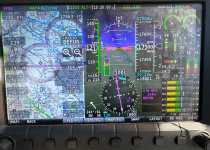
FL250 although conditions were perfect. Light weight (solo, no cargo, 25g fuel), no traffic, low ISA, high to low pressure, 50k tailwinds, smooth air. IAS-100k, TAS-150k, GS-200k. Climb rate was an anemic 100fpm, the definition of service ceiling. Stock engine, 2 mags.
It was only worth it for the tailwinds and to see if it would work.You are a speed bump above FL 180. Need to use the mask which is not as comfortable as the cannula.
For planning purposes, anything below 18,000' is game.... I usually fly wherever the 'good air' is. I define good air as: (in order) no ice, smoothest ride, best winds. The airplane is happiest at ~13,500'.
It was only worth it for the tailwinds and to see if it would work.You are a speed bump above FL 180. Need to use the mask which is not as comfortable as the cannula.
For planning purposes, anything below 18,000' is game.... I usually fly wherever the 'good air' is. I define good air as: (in order) no ice, smoothest ride, best winds. The airplane is happiest at ~13,500'.
Attachments
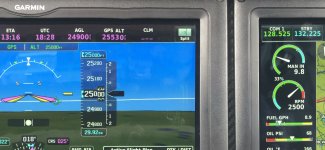

A few years ago flew to 17.5k with two adults. OAT -3 C. Don't remember the winds. Seemed to fly just fine. Here is some of the data: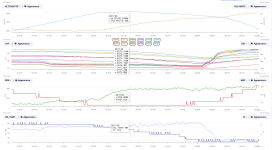
Last edited:
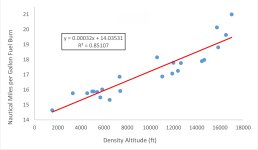
Question for those posting on the altitude their aircraft is "happy" or "prefers" or its "sweet spot"? What are these assessments based on? I don't see much evidence offered up, and I certainly can't read aircraft emotions, but I can download and analyze data from the G3X. My own data on altitude and fuel economy. Each data point is a different cross-country flight and represents fairly constant conditions, 30-minute averages.
CJT
Well Known Member
FL250 although conditions were perfect. Light weight (solo, no cargo, 25g fuel), no traffic, low ISA, high to low pressure, 50k tailwinds, smooth air. IAS-100k, TAS-150k, GS-200k. Climb rate was an anemic 100fpm, the definition of service ceiling. Stock engine, 2 mags.
It was only worth it for the tailwinds and to see if it would work.You are a speed bump above FL 180. Need to use the mask which is not as comfortable as the cannula.
For planning purposes, anything below 18,000' is game.... I usually fly wherever the 'good air' is. I define good air as: (in order) no ice, smoothest ride, best winds. The airplane is happiest at ~13,500'.
ThanksA few years ago flew to 17.5k with two adults. Don't remember the winds. Here is some of the data:
CJT
Well Known Member
Thanks
That’s pretty impressiveQuestion for those posting on the altitude their aircraft is "happy" or "prefers" or its "sweet spot"? What are these assessments based on? I don't see much evidence offered up, and I certainly can't read aircraft emotions, but I can download and analyze data from the G3X. My own data on altitude and fuel economy. Each data point is a different cross-country flight and represents fairly constant conditions, 30-minute averages.
View attachment 76206
CJT
Well Known Member
Thanksmax for me 17999 I don't recall the speed, but it wasn't very fast. < 100KIAS I think. Impractical. Did it just to do it.
max cruise for me 16,000, over mountains out West. It's far happier in the 10,000-13,000 range
CJT
Well Known Member
NiceYes on a solo trip from Ft Myers to Atlanta I climbed to 22,000. I did not take notes and it was 15 years ago, but climb performance was 100 feet per min and even after leveling out IAS was in the 90s. In the climb was limited due to cooling and low ISA (don’t remember exact figures.) Was on IFR, and ATC questioned me several times when I asked for FL220. Who was that for? What altitude? Please confirm FL220. Never done it again, almost always cruise at 11-12k as that seems to be sweet spot in economy/speed.
CJT
Well Known Member
I crossed the mountains at 16,000' in the 160hp -9 years ago. Talk about nuttin' left!

CJT
Well Known Member
That is somethingFL250 although conditions were perfect. Light weight (solo, no cargo, 25g fuel), no traffic, low ISA, high to low pressure, 50k tailwinds, smooth air. IAS-100k, TAS-150k, GS-200k. Climb rate was an anemic 100fpm, the definition of service ceiling. Stock engine, 2 mags.
It was only worth it for the tailwinds and to see if it would work.You are a speed bump above FL 180. Need to use the mask which is not as comfortable as the cannula.
For planning purposes, anything below 18,000' is game.... I usually fly wherever the 'good air' is. I define good air as: (in order) no ice, smoothest ride, best winds. The airplane is happiest at ~13,500'.

If you are flying over a mountain range, consider a not so direct route. Create a route that keeps you close to the mountain pass roads and areas that provide more options for an emergency landing. Mountain ranges are not forgiving and can swallow you up making it sometimes almost impossible for SAR teams to locate you quickly to provide emergency care.

Good advice. Also know that some passes that look good on the chart are not great to fly through. Local pilots would be able to tell you those passes to avoid. If you are going to be crossing The Rocks a lot, consider taking a Mountain Flying course from someone who is versed at venturing into the Mountains. Someone who lives next to them for actual practice, not theory and book-learning. Many of the Colorado peaks and passes have weather-reporting stations and cameras. Before your flight, know everything you can about your route.If you are flying over a mountain range, consider a not so direct route. Create a route that keeps you close to the mountain pass roads and areas that provide more options for an emergency landing. Mountain ranges are not forgiving and can swallow you up making it sometimes almost impossible for SAR teams to locate you quickly to provide emergency care.
Living in the Denver area, everything West of here is tall! We brag about the 14ers for a reason! I learned to fly the Mountains of Montana in a 65hp J-3 Cub which makes one PAY ATTENTION!! I hit a downdraft once between Cody and West Yellowstone that was so hard, fuel was coming out of the nose tank!
 That came as somewhat of a surprise as I was riding an UP wave before hitting that. My 'out' was a gentle turn East. Good rule: always have an OUT. Even with the C-90-8 engine she performs better but is still a challenge.
 I received my Mountain SAR certification in Montana flying a Super Cub 90 with, of course, a passenger. (Ask me sometime about my check pilot turning green....
 ) For our practice SARs we would lay out 'targets' and sometimes, even in the rolling plains, targets were not found! In the Mountains, sometimes all that is visible is the 'scar' through the trees. Yes: SAR in the Mountains is a challenge. It is much better now with the newer ELTs and ADS-B but the best choice is not putting that to the test.....
SuzieQ does much better at altitude......but I still pick my days to do any Mountain flying. With the speed and range of our airplanes, taking the indirect route over lower terrain is, many times, the better thing to do and doesn't increase the flight time by much. And still as scenic! In my test flying, we were at 14k+ without much problem but, with lack of an oxygen system, didn't go much higher. Now that I have an O2 system, I am eager to see what she will do with a 160hp/fixed pitch. Flying anywhere West of here, Mountains are unavoidable. There are days a planned flight is postponed.....
Traash
Well Known Member
NMPG is one factor and yes, fuel burn goes down with altitude quicker than TAS goes down so net result is better mileage (in equal wind conditions).Question for those posting on the altitude their aircraft is "happy" or "prefers" or its "sweet spot"? What are these assessments based on? I don't see much evidence offered up, and I certainly can't read aircraft emotions, but I can download and analyze data from the G3X. My own data on altitude and fuel economy. Each data point is a different cross-country flight and represents fairly constant conditions, 30-minute averages.
View attachment 76206
My report of 'likes it' at 13-14 is that's where the aircraft feels the most solid (rides the bumps best), quietest (don't need higher rpm), most engine parameters near their optimum, descent mpg, etc. On any flight you can pick a parameter to optimize which will result in different altitudes but at the sweet spot the average is the highest.

AdvancedFlight
I'm New Here
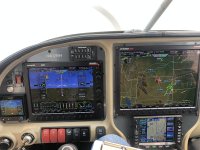
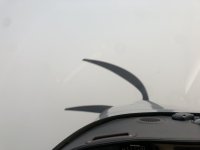

Here is a screenshot I took a couple days ago, my 9A. That wing truly is happy up there. I'm real curious to see how the -10 I'm building now will stack up.I know this is a RV 10 forum, but my RV9A likes 16.5 to 17.5K. The true airspeed is the same as down low, but the burn rate is lower, improving mpg. Also, most of the time it seems to be above any inversion layer, so the ride is smoother with less chance of high winds aloft.
Attachments
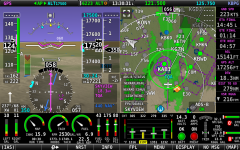
What's your useful load?On the way to Oshkosh in 2021 with 4 people and lots of baggage, IFR in the smoke from forest fires. I have had it at FL200 on an IFR flight from Boulder CO west without passengers.
View attachment 76239
OK.... I took my C-150 (years ago) to 15,500' during the summer of 80. There was really nuttin left!... But, I started off with nuttin.I crossed the mountains at 16,000' in the 160hp -9 years ago. Talk about nuttin' left!
At work I flew with a captain who said the tail we flew on that day was soul less. On the next leg the jet broke.Question for those posting on the altitude their aircraft is "happy" or "prefers" or its "sweet spot"? What are these assessments based on? I don't see much evidence offered up, and I certainly can't read aircraft emotions, but I can download and analyze data from the G3X. My own data on altitude and fuel economy. Each data point is a different cross-country flight and represents fairly constant conditions, 30-minute averages.
View attachment 76206
In the case of the -10 I operate the sweet spot references the area where mixture is not fickle to adjust, and the range ring is as large as it can be. It’s a lot like understanding a woman… all the data in the world is nothing without having some intuition into feeling. While I won’t say the airplane has emotions, it certainly has areas of operation that you can’t graph where it is in better harmony.

My phase I was in 2008. 21,100 feet, rate of climb 100 feet/min. ATC was bugging me to get down since they had given me a 10 mike circle around OGD (vor) and the wind was greater then 100 knots out of the west so every time I turned to the west it looked like I was standing still. I started the flight at max gross. I have flown on an IFR flight plan to Vegas at FL190 but do not like flying with the mask on and would not do it unless I had to (icy cloud tops at 18,000 forced me up there). I have built in O2 with 40 man hours of O2 when the tank is full. I like to cruise at 14,000 to 16,000.Has anyone determined service ceiling for RV 10?
What’s the maximum altitude anyone has climbed to?
What’s the maximum altitude anyone has cruised at?
Not in a RV10 but I did fly high in my 14A and climbed to 21.5K with a friend of mine that weighs about 190-200lb. At that altitude I could still climb at 300FPM but the cruise speed had suffered and did not make any sense to go higher unless the wind was very favorable. One thing that I noticed, the oil temp was much higher than I had expected despite the fact that the OAT was very low. This is most likely due to the fact that the air is so thin that can not carry much heat with it.
I do cruise at 16-17K in my 14A often if wind is favorable.
I do cruise at 16-17K in my 14A often if wind is favorable.
