

Van's Air Force
You are using an out of date browser. It may not display this or other websites correctly.
You should upgrade or use an alternative browser.
You should upgrade or use an alternative browser.
How full is full
- Thread starter Jamesey
- Start date


The design philosophy of the different fuel level indicators (fuel gauge on the EFIS, Site window on the side, or the mechanical float gauge )on the RV 12 is to show you how much below full the fuel level is in the tank.One for the oldies. I have early 12 with the visual fuel window. I later added the fuel gauge. When the gauge says full (bouncing off the top) the tank is still not full. Possibly one for Scott. Where should it show in the window with a totally full tank?
It is not to tell you when the tank is full, because you should know that just by the act of filling it.
Because of variabilities in the adjustment of float arms on the electrical, senders or manufacturing variabilities in the mechanical float gauge, both require some personally done calibration. For the.EFIS gauge, this is easily done by adding measured amounts of fuel during the calibration process. The same thing could be done for the mechanical float gauge if you wanted more accuracy. Just be aware that there is a difference in indicated fuel level whether the airplane is on the ground or in flight. And as you already indicated, the tank holds more fuel than can be actually measured by the mechanical gauge, since the gauge isn’t mounted at the highest point in the tank.(the far after portion). If I remember correctly, I think the difference is only about 1.8 gallons.

The Moler gauge shows full when you have about 16 gallons in the tank, not sure about the visual tank window as I replaced it with an aluminum panel when I build the tank. The tank holds 19.8 gallons, however the gauge(s) max out at 16 gallons (PAP section G8 only calibrates the fuel to 16 gallons). If your tank window is not marked from the PAP calibration procedure, you may want to recalibrate to match up the float gauge, Moler gauge, and tank window levels.
John Salak
RV-12 N896HS
John Salak
RV-12 N896HS
The gauge center for the EFIS is at the very front of the tank. The mechanical float gauge is mounted higher at the midpoint on the tank, so I think it measures a higher fuel level than 16 gallons.The Moler gauge shows full when you have about 16 gallons in the tank, not sure about the visual tank window as I replaced it with an aluminum panel when I build the tank. The tank holds 19.8 gallons, however the gauge(s) max out at 16 gallons (PAP section G8 only calibrates the fuel to 16 gallons). If your tank window is not marked from the PAP calibration procedure, you may want to recalibrate to match up the float gauge, Moler gauge, and tank window levels.
John Salak
RV-12 N896HS
View attachment 70036
I’m pretty sure the comment in the PAP regarding 16 gallons was only meant to relate to the EFIS fuel gauge.
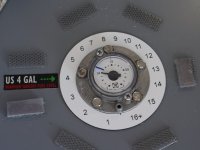
The numbers around the gauge in the photo are calibrated tank levels that were marked at the same time the electric gauge was calibrated. The float tops out and indicator stops moving at 16 gallons. I use 5-gallon jugs to fuel and will fill to the 14-14.5 gallon level, then add a full 5-gallon jug if I want a full tank. The electric gauge tops out (30.6 ohms) at 15 gallons (on-blocks) and 14 gallons (off-blocks). I guess the point is you need a strategy to fill the tank full without overflowing the filler neck.The gauge center for the EFIS is at the very front of the tank. The mechanical float gauge is mounted higher at the midpoint on the tank, so I think it measures a higher fuel level than 16 gallons.
I’m pretty sure the comment in the PAP regarding 16 gallons was only meant to relate to the EFIS fuel gauge.
John Salak
RV12 N896HS
I use a 55 gal oil drum with an electric pump , final filter, hose and nozel. If you start listening at the filler neck while fueling, after the guage needle shows full and stops bouncing, you can hear the sound change as the fuel level reaches the bottom of the neck. Now that's what I call full. Best investment I ever made.....Tom

The manufacturer for the bird I fly for “work“ ( ya, right) states: “The only time the fuel gauges are required to be “accurate” is when they read zero pounds”
