Van's Air Force

The definitive Van's Aircraft support community! Buying, building or flying an RV? Join our exclusive family of mentors and enthusiasts!

Couple Questions about Flightdek

I just bought a 2011 RV12 with the Dynon Flightdek. My first question is where are the tach hours? It only lists Hobbs, so do we just do maintenance by Hobbs on a Rotax

Second question: Is the fuel quantity on the Flightdek an estimation based on the calculated fuel burn or is it actually connected to the float in the tank?
 
The EMS is user configurable so the previous owner apparently removed it. All Rotax maintenance intervals are based upon Hobbs, apparently why they removed it.

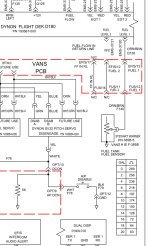
And you have both a float/sender in the tank measuring level, and the computer measures actual burn, at least for the 12iS it does. There’s a fuel-flow counter in the ULS fuel line that attempts to measure as it burns, but someone with a ULS would be more knowledgeable than I on that.
 
….so do we just do maintenance by Hobbs on a Rotax

Second question: Is the fuel quantiy…. actually connected to the float in the tank?
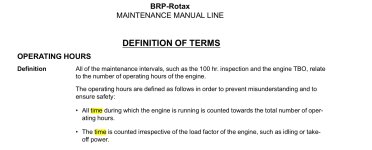
Per the Rotax Light MM, time is “run time”

The D180 fuel quantity gauge is driven by a mechanical tank float and sensor.
 

Attachments

  • IMG_3211.jpeg
    IMG_3211.jpeg
    188.1 KB · Views: 9
  • IMG_3212.jpeg
    IMG_3212.jpeg
    223.7 KB · Views: 9
Adding to the conversation... I have a 2010 RV12 (912 ULS) with a D180 and I've been seeing the fuel burn jump from 5gph to around 7.5-8gph immediately when I approach about 7k DA. At Oshkosh I asked the Vans reps and they're talking about fuel potentially not atomizing completely and trapping vapor at higher DA's so the sensor is picking this up as a density which it displays as a higher fuel load. If that's the case and I run at high altitude for a long period of time I'm assuming I'll vapor lock the engine. They recommended purging with a pure 100LL burn for a bit but I've ran it for 20 hours on 100LL with this problem so I don't think that is helping me. Are you also experiencing this issue with the D180?
 
Adding to the conversation... I have a 2010 RV12 (912 ULS) with a D180 and I've been seeing the fuel burn jump from 5gph to around 7.5-8gph immediately when I approach about 7k DA. At Oshkosh I asked the Vans reps and they're talking about fuel potentially not atomizing completely and trapping vapor at higher DA's so the sensor is picking this up as a density which it displays as a higher fuel load. If that's the case and I run at high altitude for a long period of time I'm assuming I'll vapor lock the engine. They recommended purging with a pure 100LL burn for a bit but I've ran it for 20 hours on 100LL with this problem so I don't think that is helping me. Are you also experiencing this issue with the D180?

I just bought the plane last week and I've not experienced a DA that high yet. My fuel burn so far from my manual calculations has been between 3.8 to 4.5 gph. I've been crusing at around 5000-5050 rpm and getting 100 TAS.
 
I just bought a 2011 RV12 with the Dynon Flightdek. My first question is where are the tach hours? It only lists Hobbs, so do we just do maintenance by Hobbs on a Rotax

Second question: Is the fuel quantity on the Flightdek an estimation based on the calculated fuel burn or is it actually connected to the float in the tank?
Check your DMs
 
I just bought the plane last week and I've not experienced a DA that high yet. My fuel burn so far from my manual calculations has been between 3.8 to 4.5 gph. I've been crusing at around 5000-5050 rpm and getting 100 TAS.
Pretty much exactly the same as me when at low DA altitudes.
 
I have the same incorrect indicated fuel burn when I get above 5-6 thousand feet. After you fly at or above this altitude for a while, it will start indicating correct (4-5 gal./ hr.) As I remember this was discussed on VF several year’s ago and Van’s did a lot of research on this but couldn’t figure out why some Dynon 180 would do this and other's didn’t.
 
I have the same incorrect indicated fuel burn when I get above 5-6 thousand feet. After you fly at or above this altitude for a while, it will start indicating correct (4-5 gal./ hr.) As I remember this was discussed on VF several year’s ago and Van’s did a lot of research on this but couldn’t figure out why some Dynon 180 would do this and other's didn’t.
I just flew today and tested it again, I got a sudden spike of +2 gallons as soon as I hit 7,400' density altitude showing a total of 7.0-7.gph. How long are you staying at a cruise altitude before it regulates? I'm concerned because the Rotax engineers I asked this question to at Oshkosh was saying this was a known problem of high DA flight yielding vaporous fuel burn. I find it incredibly difficult to believe they would design an engine that is incapable of accurately leaning at density altitudes above 7 thousand feet though...
 
Around 15-30 minutes . I found the VF post. It was ,” Crusise performance at altitude “ . Started by Piper J3 , Sept. 20, 2020 . If you fill you tank completely full and fly at what ever altitude that you are getting the high indicated fuel burn for a hour or and see if it comes back to a normal indicted fuel flow. Then land and fill tank full and see what your actual fuel usage was. Also look at your manual float fuel gage on the top of your tank and how it compares. Unless you have a bad fuel leak going on somewhere ?
 
Back
Top