
I recently bought a flying RV-12 completed in 2013. It has a vented fuel cap AS WELL AS the mod to vent the tank with a tube out of the top of the tank. I was told if I buy a new fuel cap I will need to drill a hole in it to vent it. I am wondering why that is necessary if the tank itself is vented? Thanks!

Van's Air Force
You are using an out of date browser. It may not display this or other websites correctly.
You should upgrade or use an alternative browser.
You should upgrade or use an alternative browser.
Confused about the "Vented Fuel Cap"
- Thread starter glenadavis
- Start date


Glen I have the same setup where I needed to vent my fuel cap because I didn’t have the vent tube. Later the vent tube was created and sold as a retro fit, and I installed one. I checked with Vans about having both and they said it would work fine. If you installed a new cap I don’t know why it would need to be vented. Let’s see what others post.
Thanks. That is logical. Lets see what the others have to say.Glen I have the same setup where I needed to vent my fuel cap because I didn’t have the vent tube. Later the vent tube was created and sold as a retro fit, and I installed one. I checked with Vans about having both and they said it would work fine. If you installed a new cap I don’t know why it would need to be vented. Let’s see what others post.
Thank you.I have a 2013 kit and added a locking gas cap, no vent. The filler neck is vented with a line that rises to the inside top of the fuselage then exits to the bottom outside.

scottmillhouse
Well Known Member
I recommend you have both. On my 2015 RV-12 build I initially had problems with low fuel pressure when taking off with a full tank with just the tank vent. Adding the vent to the cap eliminated the issue for me and many others. It appears with a full fuel tank upon climb out the tank vent got blocked by the fuel. It was not an isolated case. Issue was well documented at the time on VAF. A piece of tape covering it or the canopy cover eliminates any chance of water from a storm.

I retrofitted the VANS fuel tank vent kit and have a non-vented cap. Note this is ULS with the higher fill & different plumbing.
Although I haven't seen a pressure drop like Scott has, I have kind of worried about a FULL tank (up into fill pipe) possibly blocking the vent. I countered that worry with the thought that more than a quart is burned during warmup & taxi, which should surely lower fuel well down the fill pipe & into the tank.
Anyway, I tried pushing the tail down (all the way to aft tie down touching the deck) to verify that the tubing is open by observing gas overflow (onto the deck). I figure this also verifies the checklist item (FUEL VENT LINES - CLEAR) ?
Although I haven't seen a pressure drop like Scott has, I have kind of worried about a FULL tank (up into fill pipe) possibly blocking the vent. I countered that worry with the thought that more than a quart is burned during warmup & taxi, which should surely lower fuel well down the fill pipe & into the tank.
Anyway, I tried pushing the tail down (all the way to aft tie down touching the deck) to verify that the tubing is open by observing gas overflow (onto the deck). I figure this also verifies the checklist item (FUEL VENT LINES - CLEAR) ?
Just thinking out loud here.
I wonder if when using the (vent out the bottom of the aircraft only), and the tube exiting the bottom is cut in such a way that at high angle of climb there is a vacuum created on the tube, and in the tank, it causes the fuel pump to work harder to pull fuel, thus lower pressure to the engine. It would only be noticable with a full tank when there is little or now air in the tank. Liquid is not compressible so the vacuum would be immediately noticable.
I wonder if when using the (vent out the bottom of the aircraft only), and the tube exiting the bottom is cut in such a way that at high angle of climb there is a vacuum created on the tube, and in the tank, it causes the fuel pump to work harder to pull fuel, thus lower pressure to the engine. It would only be noticable with a full tank when there is little or now air in the tank. Liquid is not compressible so the vacuum would be immediately noticable.

The protruding portion of the tube is supposed to be cut at a 45 degree angle with the opening facing forward.Just thinking out loud here.
I wonder if when using the (vent out the bottom of the aircraft only), and the tube exiting the bottom is cut in such a way that at high angle of climb there is a vacuum created on the tube, and in the tank, it causes the fuel pump to work harder to pull fuel, thus lower pressure to the engine. It would only be noticable with a full tank when there is little or now air in the tank. Liquid is not compressible so the vacuum would be immediately noticable.
This will cause a slight positive pressure inside the tank.
The only issues I am aware of from the updated vent line were when the T fitting for the anti siphon line got displaced/rotated downward.
Assuming this was not done it could create a suction at different flight conditions. This may be the reasom some people added a vent to the gas cap and solved their "issue".The protruding portion of the tube is supposed to be cut at a 45 degree angle with the opening facing forward.
This will cause a slight positive pressure inside the tank.

Ummm... why does a little fuel in the vent line prevent the two fuel pumps from being able to pump fuel from that tank? Seems to me any fuel in a vent line would just be pulled out as the tank empties.I retrofitted the VANS fuel tank vent kit and have a non-vented cap. Note this is ULS with the higher fill & different plumbing.
Although I haven't seen a pressure drop like Scott has, I have kind of worried about a FULL tank (up into fill pipe) possibly blocking the vent. I countered that worry with the thought that more than a quart is burned during warmup & taxi, which should surely lower fuel well down the fill pipe & into the tank.
Anyway, I tried pushing the tail down (all the way to aft tie down touching the deck) to verify that the tubing is open by observing gas overflow (onto the deck). I figure this also verifies the checklist item (FUEL VENT LINES - CLEAR) ?
Having said that, I must say I never fully understood the need for that second smaller vent line. Explain that one to me.
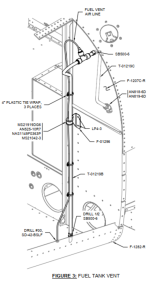
It is an antisiphon lineUmmm... why does a little fuel in the vent line prevent the two fuel pumps from being able to pump fuel from that tank? Seems to me any fuel in a vent line would just be pulled out as the tank empties.
Having said that, I must say I never fully understood the need for that second smaller vent line. Explain that one to me.
View attachment 74893
If the tank is full enough that fuel is covering the outlet of the vent line, or it gets covered because of fuel expansion with temperature change, and in that process fuel gets pushed up the vent line, over the top, and then starts draining down the downward portion of the vent line, it can start a siphon action that will siphon fuel out of the tank until the negative pressure in the tank builds enough to prevent it from happening.
This can actually be a pretty significant amount of fuel.
This will not happen in flight. It is only a potential problem with the airplane, parked on the ground.
With the antisiphon line in place, the siphon action can never start.
