Van's Air Force

The definitive Van's Aircraft support community! Buying, building or flying an RV? Join our exclusive family of mentors and enthusiasts!

Checking the condition after many years: Corrosion?

guidoism

Active Member
Patron
I know that I haven’t treated my airplane very well since moving. My move was last minute, right at the start of the pandemic, and I have to quickly find a place to store it. That place was an unheated storage unit in Indiana. It went through a couple hot summers and cold winters in there. Fortunately I stored it off of the ground so there was no water damage. Later I moved it to a different location and it got a layer of 50-year-old cellulose insulation on top of it. It spent another four years that way with slightly better air quality.

I’m now inventorying everything and checking on the condition. My quick once-over showed that there’s no mechanical damage: No bending, not scratches. But today while attempting to vacuum off the cellulose I decided to finally pull off the rest of the blue plastic wrapping and I noticed that while it was perfect under the plastic, the exposed area was dirty.
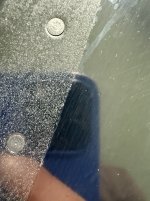
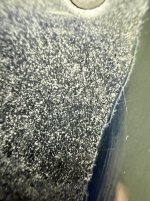
IMG_7909.jpg
IMG_7910.jpg
IMG_7912.jpg

The vacuum didn’t pull it up so I attempted to wash a spot with warm water and dawn dish soap. Still nothing. I tried scraping a bit with my finger nail. Still nothing. I then wanted to see what a maroon scotch bright pad would do. It didn’t take much effort at all but it looks clean under there.

IMG_9D5775AD-048D-422C-97F7-7597E97803BE.jpeg

This last image is what the scotch brighted area looks like.

Is my elevator cooked?

I tried to figure this out from the info in AC 43.13-1B but the black-and-white images weren't much help. I know that taking it to an EAA meeting and getting some tech counselor time out be idea but I'm nervous and I kinda just want to know one way or another.

Opinions?
 
It looks more like something from the materials. I would try some solvents first. Iso Alcohol, Lacquer Thinner. If it doesn't take it off, it's probably corrosion. Scrub with scotch brite.
 
I know that I haven’t treated my airplane very well since moving. My move was last minute, right at the start of the pandemic, and I have to quickly find a place to store it. That place was an unheated storage unit in Indiana. It went through a couple hot summers and cold winters in there. Fortunately I stored it off of the ground so there was no water damage. Later I moved it to a different location and it got a layer of 50-year-old cellulose insulation on top of it. It spent another four years that way with slightly better air quality.

I’m now inventorying everything and checking on the condition. My quick once-over showed that there’s no mechanical damage: No bending, not scratches. But today while attempting to vacuum off the cellulose I decided to finally pull off the rest of the blue plastic wrapping and I noticed that while it was perfect under the plastic, the exposed area was dirty.
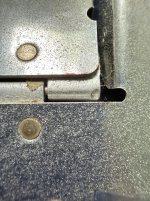
View attachment 120807
View attachment 120808
View attachment 120809

The vacuum didn’t pull it up so I attempted to wash a spot with warm water and dawn dish soap. Still nothing. I tried scraping a bit with my finger nail. Still nothing. I then wanted to see what a maroon scotch bright pad would do. It didn’t take much effort at all but it looks clean under there.
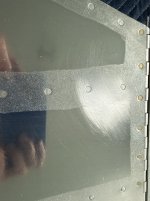
View attachment 120810

This last image is what the scotch brighted area looks like.

Is my elevator cooked?

I tried to figure this out from the info in AC 43.13-1B but the black-and-white images weren't much help. I know that taking it to an EAA meeting and getting some tech counselor time out be idea but I'm nervous and I kinda just want to know one way or another.

Opinions?
Are you sure that isn't some kind of paint overspray or something? Seeing what appears to be the same thing on the piano hinge which is protected by anodizing leads me to believe that this isn't corrosion. Also, parts stored in a corrosive environment with the blue vinyl in place typically have lines or fingers of corrosion leaching under the edges of the vinyl locations which your elevators don't seem to have.

Skylor
 
Last edited:
Agree with Skylor. Some rivet heads are covered and some are perfectly fine. And the first pic has a defined line. Interesting.
Ok, all of that is all a relief and will help me sleep before I have a chance to go back to them and attempt to clean the stuff off. I can't imagine that it's good for the aluminum, maybe something in the cellulose that was making it stick so hard. I'll try a solvent first.
 
Ok, all of that is all a relief and will help me sleep before I have a chance to go back to them and attempt to clean the stuff off. I can't imagine that it's good for the aluminum, maybe something in the cellulose that was making it stick so hard. I'll try a solvent first.
It looks like some sort of overspray wafted onto the parts and the insulation stuck to that. Or it could be some sort of binder in the insulation that stuck to the parts. The fuzzies on the edges are from something adhering the cellulose to the part and it has a different appearance than any corrosion i've seen. Plus the area you scrubbed looks fine so there isn't any loss of material typical with corrosion.

If it were corrosion i would expect for you to see more of it under the blue film. And to see more hazing of the part. This just looks dirty.

What does it feel like?

I'd try water first and then various solvents.
 
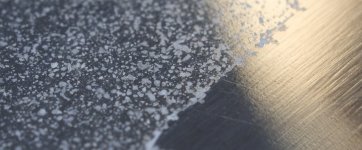
Today I spent some time with some dawn dish soap, warm water, a sponge, and after a few minutes of gentle washing was able to get to the point where it wasn't super rough, but it was still rougher than the area that had been protected by the blue plastic. The isopropyl alcohol did nothing. I also was able to find my macro lens and got this shot which is a little better than my phone photograph.

macro.jpg

It really looks like something is etched into the aluminum. Next step is to bring it to next week's EAA meeting. I wish I could have met everyone there under better circumstances.
 
If it makes you feel better, do the proper prepping with AlumiPrep acid etch and Alodine it as soon as you can. If you use epoxy primer, you can skip the Alodine. The epoxy will keep it safe from the element. I have seen an inside of the 60 years old C182 wings and the unprimed skin was many times worse than your pictures and the airplane is still very much air worthy. These Cessna spent their lived almost 100% outside, rain or shine.
 
Today I spent some time with some dawn dish soap, warm water, a sponge, and after a few minutes of gentle washing was able to get to the point where it wasn't super rough, but it was still rougher than the area that had been protected by the blue plastic. The isopropyl alcohol did nothing. I also was able to find my macro lens and got this shot which is a little better than my phone photograph.

View attachment 120893

It really looks like something is etched into the aluminum. Next step is to bring it to next week's EAA meeting. I wish I could have met everyone there under better circumstances.
Lightly scuff it with 220 grit. If it disappears in a few passes with the paper it is a non issue. Looks to me like very light surface oxidation. You are worried about pitting that takes a lot of sanding to disappear.
 
Back
Top