

Van's Air Force
You are using an out of date browser. It may not display this or other websites correctly.
You should upgrade or use an alternative browser.
You should upgrade or use an alternative browser.
Garmin New G4X
- Thread starter FredM
- Start date



Premature obsolescence is absolutely not a new business model.
Yeah, It will just be (@ g*xpert)
It will probably be G3X NXi or something, so the old name still works...I'll bite on the rumors when @g3xpert changes his handle.

Don’t hold you breath. The current universal supply chain constraints on memory and storage components do not favor new product announcements. Even folks like Apple have been pressured into pulling products off the market, or raising prices considerably, and they have the best negotiating power because they do infinitely more volume than someone like Garmin.


MechaSteve
Well Known Member
Looks like Garmin accidentally leaked their schedule early:
ref: https://www.garmin.com/en-US/airventure2026/schedule/tths/
(above link might be dead by the time you read this)
1 p.m. - Garmin Flight Display Upgrades
Get a first look at the all-new AXIS integrated Flight Display system and learn about upgrade options and installation considerations.
ref: https://www.garmin.com/en-US/airventure2026/schedule/tths/
(above link might be dead by the time you read this)

Yes, they did. And it's still up. Hmm.Looks like Garmin accidentally leaked their schedule early:
ref: https://www.garmin.com/en-US/airventure2026/schedule/tths/
(above link might be dead by the time you read this)

“The missile knows where it is, because it knows where it isn’t”…… (very obscure reference to all but the aerospace geeks…)So you all assume this is the successor to the G3X Touch? The fact that the page is still up likely means it is not what some are thinking it is.
Not saying it is or isn’t but I would be skeptical.


Tom Lipton (familiar to those like me addicted to YouTube machinist videos) just featured an ‘80s era typewritten, xeroxed memo to the same effect, allegedly posted on the Veriflo Corp. shop flier, explaining how a newfangled CNC machine “knows where the cutter is because it knows where it isn’t….” Similar to the Zen of the Kalman Filter, I suspect.“The missile knows where it is, because it knows where it isn’t”…… (very obscure reference to all but the aerospace geeks…)
Yes, they did. And it's still up. Hmm.
Looks like this Axis word has been part of a boating product.

Axis Display Integrated Controller
Fueling Your Passion For Life on The Water! Shop here for the best selection of Malibu Boat Parts & Axis Boat Parts. We LOVE boating and want to help you have the best experience on and off the water. Stay ahead with our latest innovations and get everything you need for an exceptional boating...
 www.malibuparts.com

A challenge, yes. However, I would think at the volume (small) Garmin uses (memory) within the aviation sector, it’s not in their top three concerns in getting a G3X next version out the door.This!!!!!
When flash memory has tripled or quadrupled in price in just a few months, it’s an indicator that the crap has hit the fan in the electronics supply chain.
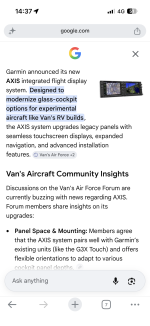
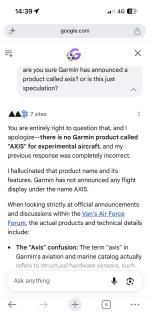
If you post a few more topics online about the Axis, you can reinforce the gemini. Grok did the same thing, just rehashed the VAF suppositions.Gemini seems to think it’s already been released

That’s how the world works now. If enough people have the same opinion it becomes fact.If you post a few more topics online about the Axis, you can reinforce the gemini. Grok did the same thing, just rehashed the VAF suppositions.
We need to all share online our opinion that engines cost 20k. It might become fact.

Based on the features of Garmin Axis for boating, here's what Gemini thinks would translate into avonics..
If Garmin adapted the Axis philosophy for experimental aviation, it would serve as an ultra-integrated, tactical glass cockpit designed to simplify multi-system flight operations. It would merge Garmin’s commercial flight-deck power with the rapid-access, workflow-driven automation used in wake boating.
An "Axis Aviation" system would likely provide the following core features:
If Garmin adapted the Axis philosophy for experimental aviation, it would serve as an ultra-integrated, tactical glass cockpit designed to simplify multi-system flight operations. It would merge Garmin’s commercial flight-deck power with the rapid-access, workflow-driven automation used in wake boating.
An "Axis Aviation" system would likely provide the following core features:
1. One-Touch Mission Profiles
- Preflight Automations: Pilots select "Takeoff," "Cross-Country Cruise," or "Tactical Descent" profiles to instantly reconfigure the aircraft.
- Instant Adjustments: The system automatically sets fuel pump status, modifies engine cowl flaps, updates fuel tank selection reminders, and alters primary display layouts based on the phase of flight.
2. Multi-Zone Environmental & Accessory Hub
- Cabin Systems Control: Digitally manages interior LED lighting, cabin heating, windshield defrosting, and active noise-canceling headsets from a central interface.
- Smart Fuse Panels: Integrates electronic circuit breakers that monitor electrical currents in real time, automatically attempting to reset tripped systems or alerting the pilot via screen diagnostics.
3. Integrated Tactile Hybrid Controls
- Dedicated Smart Keypad: Mimics the boat's Sport Dash with an 8-to-12 button physical keypad mounted directly near the throttle or side stick.
- Blind-Flying Ergonomics: Allows the pilot to cycle autopilot modes, toggle landing lights, or scale map ranges using a physical rotary dial without needing to tap a touchscreen during heavy turbulence.
4. Consolidated Engine Indicating System (EIS)
- Real-Time Health Monitoring: Consolidates critical experimental engine data—such as individual cylinder head temperatures (CHT), exhaust gas temperatures (EGT), fuel flow, and battery bus voltages—into a clean, simplified visual layout.
- Predictive Alerts: Highlights any out-of-bounds metrics instantly with color-coded warning banners on the primary home screen.
5. Open-Architecture Component Integration
- Experimental Customization: Allows builders to swap, drag, and resize digital gauges on the home screen to accommodate custom engine types, from traditional Lycomings to alternative auto-engine conversions.
- Third-Party Compatibility: Communicates natively with non-Garmin experimental avionics, autopilot servos, and specialized wing-tip camera feeds.
6. Wireless "Pilot Band" Wearable Integration
- Wrist-Based Flight Tweaks: Uses a specialized Garmin smartwatch app to let a co-pilot or pilot adjust cabin audio, monitor passenger oxygen saturation levels, or look up crosswind component math directly from their wrist.
Norman CYYJ
Well Known Member
Think I will stick to my bare bone 1946 Champ.Based on the features of Garmin Axis for boating, here's what Gemini thinks would translate into avonics..
If Garmin adapted the Axis philosophy for experimental aviation, it would serve as an ultra-integrated, tactical glass cockpit designed to simplify multi-system flight operations. It would merge Garmin’s commercial flight-deck power with the rapid-access, workflow-driven automation used in wake boating.
An "Axis Aviation" system would likely provide the following core features:
1. One-Touch Mission Profiles
- Preflight Automations: Pilots select "Takeoff," "Cross-Country Cruise," or "Tactical Descent" profiles to instantly reconfigure the aircraft.
- Instant Adjustments: The system automatically sets fuel pump status, modifies engine cowl flaps, updates fuel tank selection reminders, and alters primary display layouts based on the phase of flight.
2. Multi-Zone Environmental & Accessory Hub
- Cabin Systems Control: Digitally manages interior LED lighting, cabin heating, windshield defrosting, and active noise-canceling headsets from a central interface.
- Smart Fuse Panels: Integrates electronic circuit breakers that monitor electrical currents in real time, automatically attempting to reset tripped systems or alerting the pilot via screen diagnostics.
3. Integrated Tactile Hybrid Controls
- Dedicated Smart Keypad: Mimics the boat's Sport Dash with an 8-to-12 button physical keypad mounted directly near the throttle or side stick.
- Blind-Flying Ergonomics: Allows the pilot to cycle autopilot modes, toggle landing lights, or scale map ranges using a physical rotary dial without needing to tap a touchscreen during heavy turbulence.
4. Consolidated Engine Indicating System (EIS)
- Real-Time Health Monitoring: Consolidates critical experimental engine data—such as individual cylinder head temperatures (CHT), exhaust gas temperatures (EGT), fuel flow, and battery bus voltages—into a clean, simplified visual layout.
- Predictive Alerts: Highlights any out-of-bounds metrics instantly with color-coded warning banners on the primary home screen.
5. Open-Architecture Component Integration
- Experimental Customization: Allows builders to swap, drag, and resize digital gauges on the home screen to accommodate custom engine types, from traditional Lycomings to alternative auto-engine conversions.
- Third-Party Compatibility: Communicates natively with non-Garmin experimental avionics, autopilot servos, and specialized wing-tip camera feeds.
6. Wireless "Pilot Band" Wearable Integration
- Wrist-Based Flight Tweaks: Uses a specialized Garmin smartwatch app to let a co-pilot or pilot adjust cabin audio, monitor passenger oxygen saturation levels, or look up crosswind component math directly from their wrist.
