

Van's Air Force
You are using an out of date browser. It may not display this or other websites correctly.
You should upgrade or use an alternative browser.
You should upgrade or use an alternative browser.
Some questions - climb and CHT.
- Thread starter JohnStirling
- Start date


Hmm.. Washer trick. I will look that up.
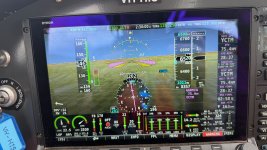
Here is a screen shot from the GoPro. Can't read the numbers, but you can see they hit the yellow.
View attachment 104212
John, the minimum, maximum, and color ranges are generally set by the owner/builder, and reflect only the opinion of that person.
The washer trick is simple enough. There's a baffle attach screw on the front of the #2 head, and the rear of the #3 head. Both lack a clear passage to the lower fins, so those fins tend to be a bit starved for airflow. Pulling the screw and placing a washer or two between the baffle tin and the head allows some flow. Unfortunately, it also creates a big leak that does nothing useful. So, the alternative is a bypass duct which only allows flow where desired. There are easily a half dozen ways to build it, and some which can be copied from certified installations.
I've built them several different ways, and find this one to be easiest, just two holes, four rivets, and some sheet metal. Photos are a #2 cylinder, but there are similar setups for #3.

I was being slightly facetious of course, but there sort of is!There's a consensus?
Check out posts 11, 42, 47, and 61. And that’s just this thread. From what I’ve seen (admittedly not a scientific survey…) it’s quite common for folks here to think of 380 or 400 as meaningful limits for Lycoming cylinders on climb-out—even though the former number seems completely invented and evidence-free, while the latter is, at least per one Lycoming O-360 manual, a longevity-based limit for economy cruise that’s a full 100 degrees below the redline.
This makes sense to me.There is no good/bad line. The failure rate simply rises with temperature.
My thinking is that if we’re nevertheless going to draw a (largely meaningless) mental good/bad line for climb-out—and I guess our EFIS warnings have to start somewhere—that line can be set so low that it causes unnecessary worry and tinkering. Everyone would probably agree that a line set at, say, 300 would fall into that category. My point is that, based on what Lycoming tells us, 400 (much less 380!) also seems so low that it causes unnecessary worry and tinkering.
The issues you describe certainly seem to capture what we are REALLY worrying about. And my ignorance of such matters is truly impressive. Is any of this info new or better-developed since Lycoming came up with their numbers? In other words, are there reasons to think Lycoming’s numbers should be taken with a grain of salt?

I can't believe no one has mentioned this yet in a world of conspiracy theories and planned obsolescence ...are there reasons to think Lycoming’s numbers should be taken with a grain of salt?
Lycoming SELLS cylinders you know. As in if a few heads crack, we just sell more parts, at a profit.
I'm not stating this as fact, or even my belief. But it is a thought.
In other words, are there reasons to think Lycoming’s numbers should be taken with a grain of salt?
Sure. Doug, some of what we see from Lycoming is based on engineering, some is based on marketing, and some is from the legal department, a point I'm sure you understand well. For the most part they don't release the underlying data, and I can't say that I blame them, as the plaintiff's bar has made some impressive dents over the years. So, out here in the world we scramble for whatever real data we can find, and combine it with textbook knowledge. Sometimes the conclusions don't match the official recommendations.
Very basic example...LOP operations. We've seen roughly two decades of back and forth. A big chunk of the community says it's wonderful. Another big chunk says it's awful. Seen any hard data from Lyc?

Get a comfortable chair, place it facing into the corner, and for one hour say SILICONE SEAL over and over. Get rid of the black junk and replace with silicone. Aircraft Spruce #05-00786 is just one of many choices.
I did this recently and summoned the baffling gods. Implemented the baffling cylinder #2,3,and 4 mods as well. We'll see in a few months if it worksGet a comfortable chair, place it facing into the corner, and for one hour say SILICONE SEAL over and over. Get rid of the black junk and replace with silicone. Aircraft Spruce #05-00786 is just one of many choices.
Attachments
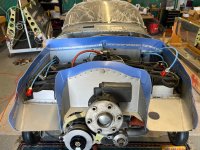
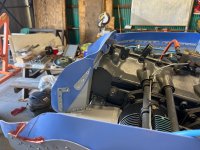
Good point! And these are also the people who think we should rebuild an engine every 12 years regardless of its condition…. Never seen the data for that, either.Very basic example...LOP operations. We've seen roughly two decades of back and forth. A big chunk of the community says it's wonderful. Another big chunk says it's awful. Seen any hard data from Lyc?
But I don’t know how to convert skepticism of Lycoming into degrees Fahrenheit. And we all still need a number that trips the red light on the EFIS, and causes us to post questions and install washers and shine flashlights. We’re pretty sure it’s not 300 or 500. Maybe we’ve picked 400 because it’s a round number in the middle?

Am I correct that there’s no field data available to answer this question? It would be great to pull Savvy CHT data on airplanes presenting with cracked cylinder heads, but that’s probably asking too much in our world.
Looks nice. I do see a lot of light gaps needing silicone, I assume that's on the to-do list.I did this recently and summoned the baffling gods. Implemented the baffling cylinder #2,3,and 4 mods as well. We'll see in a few months if it works
Thats no real help IMO, as heads can just as easilly crack from flaws introduced in their casting, as well as other cooling airflow deficiencies that caused just one area of the head to get hotter than typical. Then there are the guys porting heads that could take off too much meat. And on and on.Am I correct that there’s no field data available to answer this question? It would be great to pull Savvy CHT data on airplanes presenting with cracked cylinder heads, but that’s probably asking too much in our world.
If you really want to get into the weeds, then does the one tiny area of the casting that we are measuring representative of the rest of the head, especially those areas prone to cracking and does this change with different airflow patterns? Climb profile is often different and where we see the real heat.
Yes sir. I have quit a bit of silicon to spread as well as install the black rubber seal on the lower cowl inlets. Thank you, the baffling and silicon was one of the more tedious items to try to get right. Happy with the fit when top cowling is on. I still see a couple small areas around my ring that I need to try to iron out. Hopefully this helps the OP a little. The washer mod on cylinder #2 and #3 was replaced with #2 slit opening to a fabricated pocket right above where the cylinder fins are super thin and #3 has the same but its only a 1/8"-3/16" thick increased opening. We'll see....Looks nice. I do see a lot of light gaps needing silicone, I assume that's on the to-do list.
Good point! And these are also the people who think we should rebuild an engine every 12 years regardless of its condition…. Never seen the data for that, either.
As a general rule, Lycoming doesn't publish background data for recommendations. It's not unusual. We just focus on them because we don't really care about the design of our toasters.
Maybe we’ve picked 400 because it’s a round number in the middle?
Like Tonto said, "What you mean we?"
That is not correct. There are different speeds for different flap/slat configurations while maneuvering prior to final. On final 1.25 x landing configuration stall speed plus wind and gust factor additives.I see that this hasn't been answered yet. DMMS= "defined minimum maneuvering speed" it's an airline thing where you don't fly slower than 1.4 times the clean stall speed until all you turns in the pattern are done and you're established on final.

OK, if I read this correctly... on climb #2 and #4 were 'in green', I suppose that means under 400. And #3 and #1 were hotter at around 410. Have you looked to see if there is either the 'washer trick' or the pounded out bulge on your baffle on the aft side of #3? The 'washer trick' (search the forum) is basically to put a washer between the baffle and the aft side of the #3 jug to allow a bit more air to flow around the rear side of the #3 cylinder.
Still looking for your carb part number. Also, were the ambient temps about the same as your prior report? if it is 10 degrees cooler ambient you can expect cooler CHT numbers....
Morning.
So... My Engine Log book lists the Carb part number as 61C26047
what carb you running? I richened my carb and dropped 25f across the board.
My Carb Part Number is 61C26047
I went up for a fly the other day. Outside air temp was 28, so a warm day. CHTs blew past 420 on a 120kts climb. Had to level out and eas off. Happened pretty quickly after take off.
I did this recently and summoned the baffling gods. Implemented the baffling cylinder #2,3,and 4 mods as well. We'll see in a few months if it works
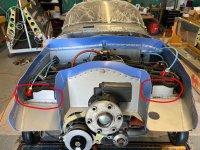
That looks the goods man! Curiously, I don't have these on my airplane - See attached!
Attachments

Contrary advice from the same well-respected A&P:
Mike Busch is probably one of the strongest voices for running LOP out there but also is one of the strongest voices when he says too low of CHT's causes sticking valves. I've seen people here state they don't want to get below 350 F CHT's as this causes morning sickness. My angle valve engine runs very low CHT's LOP (less than 300 F) but for some reason the hottest cylinder seems to develop morning sickness the majority of the time (#2), so I basically ignore half of Mike's recommendation's and run LOP with low CHT's. Since my parallel valve 540 is now well broken in and using almost zero oil
  I've been running LOP almost from departure (above 2,500 AGL throttled back to 65% power and use a cruise climb) to altitude. Performance is good and using 38% less fuel, what's not to like? The issue is now once more my CHT's are going to the low 300's even high 200's. Issue? (I can't really make the baffle cowling less efficient and no cowl flaps) I do take-off with my oil cooler damper closed and open it once the OT gets to 185 F.
From today's flight: (65% power, OAT 55 F)
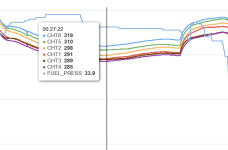
Mike Busch is probably one of the strongest voices for running LOP out there but also is one of the strongest voices when he says too low of CHT's causes sticking valves. I've seen people here state they don't want to get below 350 F CHT's as this causes morning sickness. My angle valve engine runs very low CHT's LOP (less than 300 F) but for some reason the hottest cylinder seems to develop morning sickness the majority of the time (#2), so I basically ignore half of Mike's recommendation's and run LOP with low CHT's.
Since my parallel valve 540 is now well broken in and using almost zero oil I've been running LOP almost from departure (above 2,500 AGL throttled back to 65% power and use a cruise climb) to altitude. Performance is good and using 38% less fuel, what's not to like? The issue is now once more my CHT's are going to the low 300's even high 200's. Issue? (I can't really make the baffle cowling less efficient and no cowl flaps) I do take-off with my oil cooler damper closed and open it once the OT gets to 185 F. From today's flight: (65% power, OAT 55 F)
Last edited:
Those deflectors are often called 'dams'. Otherwise a lot of air hits the front of the front cylinders and a good amount goes down through the front fins. Break out the popcorn... the 'dam wars' are about to start. Some swear to leave them off, others find them useful to get more air to the rear cylinders. Cessna's etc don't have them, so every A&P built plane I've seen have them left off.That looks the goods man! Curiously, I don't have these on my airplane - See attached!
Very interesting!
OK, after some digging, you carb appears to cross reference to the 10-4164-1 which is a 'high flow' carb.
See https://vansairforce.net/threads/ma4-5-10-4164-1-carburetor.226536/

 www.aircraftspruce.com

Thus insufficient full rich fuel flow can probably be struck from the list of possible issues. Assuming you are seeing the expected full power full rich fuel flows....
See https://vansairforce.net/threads/ma4-5-10-4164-1-carburetor.226536/
61C26047 Lycoming Carburetor - Lvc-5-5Bpa Av 10-4164-1 | Aircraft Spruce ®
61C26047 Lycoming Carburetor - Lvc-5-5Bpa Av 10-4164-1 Factory New Lycoming Carburetors.
Carburetor's, Fuel Flow, CHT's
To hopefully help others I want to share my carb replacement experience, even though admitting to buying two overhauled carbs in the space of less than 6 months will probably result in my membership in the CB club being revoked. I had an EDM 830 installed in 11/2017, about a year after I bought t...
mooneyspace.com
Thus insufficient full rich fuel flow can probably be struck from the list of possible issues. Assuming you are seeing the expected full power full rich fuel flows....
At full noise my indicated fuel flow is about 52L on take off.
13.7 GPH, on an o-360? Seems pretty low. I run about that on my 320.At full noise my indicated fuel flow is about 52L on take off.
How far past 420? I’m assuming we’re talking Celsius, so 82-ish F? I wouldn’t be worried about 420.I went up for a fly the other day. Outside air temp was 28, so a warm day. CHTs blew past 420 on a 120kts climb.
420F.How far past 420? I’m assuming we’re talking Celsius, so 82-ish F? I wouldn’t be worried about 420.
It hit 425F when I backed off a little
Even Mike Busch is okay with 420!420F.
I don't agree with 'this is OK'. YES 420F is OK. BUT, BIG BUT: a) the OAT was mid-80's ... IN AUSTRALIA I believe. Certainly gets a lot hotter there. Any RV that is OK in the states when in the mid-80's is not going to be good when it is 95F. b) this is a climb at 120 KNOTS. What CHTs will he get at 110 mph or less trying to do a Vx climb out?
Heck, our forecast high here, winter in Southern California is for 89F tomorrow.
Heck, our forecast high here, winter in Southern California is for 89F tomorrow.
To ne nice I won’t share my opinion on this theory of mikes. 1600 hours on the 320 in my 6. I speculate that almost 25% of those hours had chts below 300 and often saw 270. Zero valve sticking. No build up at all actually, as my guide clearances are on the loose side ot tolerance.Contrary advice from the same well-respected A&P:
Mike Busch is probably one of the strongest voices for running LOP out there but also is one of the strongest voices when he says too low of CHT's causes sticking valves. I've seen people here state they don't want to get below 350 F CHT's as this causes morning sickness. My angle valve engine runs very low CHT's LOP (less than 300 F) but for some reason the hottest cylinder seems to develop morning sickness the majority of the time (#2), so I basically ignore half of Mike's recommendation's and run LOP with low CHT's.
From today's flight: (65% power, OAT 55 F)
View attachment 104348
I don't agree with 'this is OK'. YES 420F is OK. BUT, BIG BUT: a) the OAT was mid-80's ... IN AUSTRALIA I believe. Certainly gets a lot hotter there. Any RV that is OK in the states when in the mid-80's is not going to be good when it is 95F. b) this is a climb at 120 KNOTS. What CHTs will he get at 110 mph or less trying to do a Vx climb out?
Heck, our forecast high here, winter in Southern California is for 89F tomorrow.
This is my thoughts too! I have a mate where I would like to visit, where I will need to "climb" There are trees that I need to get over at the end of the runway. In my LSA (Bristell) not a problem. But I can't afford a shallow climb out in the RV on this runway. I will need to get up there pretty quick.
OK... Just went back and checked my videos. On takeoff fuel burn is around the 58lph mark. It jumped to 60 at one point, and then back to 57 and 59 etc. So average is 58 I reckon. Full noise, fixed pitch prop.
As mentioned by others, that flow is too low should be around ~65 lpr (15.5 -15.7 gph approx for an 0-360) contact the guy I mentioned & he'll probably suggest you go up a size, or 2, for the main jet. HTH.OK... Just went back and checked my videos. On takeoff fuel burn is around the 58lph mark. It jumped to 60 at one point, and then back to 57 and 59 etc. So average is 58 I reckon. Full noise, fixed pitch pitch.
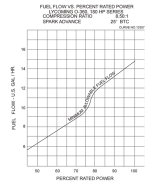
O-360 and FP prop, correct? your 59 lph is just after TO, correct? I am guessing you are doing 2500 RPM at that point, correct? According to the 360 charts, 2500 vs 2700 is about a 10 HP reduction or 5% The chart below gives the bare minimum fuel flow according to Lyc: 14 GPH for the assumptions I made. 59 lph is about 15.5 gph, so would say you are in no danger here.
This is major progress by forum standards!!YES 420F is OK.
Do you see material CHT increases between 80F and 95F OATs? I've never noticed that, but admittedly I haven't paid a ton of attention to it. Should we expect a one-to-one increase, where he would be showing a (still Lycoming acceptable) 435 on takeoff? I truly have no idea and would be interested in the views of others.BUT, BIG BUT: a) the OAT was mid-80's ... IN AUSTRALIA I believe. Certainly gets a lot hotter there. Any RV that is OK in the states when in the mid-80's is not going to be good when it is 95F.
Only one way to know for sure. I think it would really depend on how long he stays at Vx. I also suspect that a lot of people observing the alleged 400 (or 380!) "rule" would see higher than that if they kept climbing at Vx for a while.What CHTs will he get at 110 mph or less trying to do a Vx climb out?
With all that said, it wouldn't shock me if his timing is too advanced.
I can definitely say when the air temp is higher, my MGB runs hotter. It seems intuitive that if the cooling medium is hotter, the heat transfer will be reduced, all things being equal. Furthermore, hotter air is less dense, and so there is actually less air molecules to carry away heat. BTW, that's a problem for turbo normalized planes ... at altitude they make the same power, the air is cooler, but the less dense air can cause cooling problems.This is major progress by forum standards!!
Do you see material CHT increases between 80F and 95F OATs? I've never noticed that, but admittedly I haven't paid a ton of attention to it. Should we expect a one-to-one increase, where he would be showing a (still Lycoming acceptable) 435 on takeoff? I truly have no idea and would be interested in the views of others.
Only one way to know for sure. I think it would really depend on how long he stays at Vx. I also suspect that a lot of people observing the alleged 400 (or 380!) "rule" would see higher than that if they kept climbing at Vx for a while.
With all that said, it wouldn't shock me if his timing is too advanced.
Also, it is all fine and good for the peanut gallery to say 'just climb out flatter'. Yeah, and should you need to do the 'impossible turn'? Now you are further away and lower, stacking the deck against a successful return. I think our goal should be that the fleet should be able to do Vx to 1000' AGL on a 90F day without blowing thru 450F CHT. I bet half the fleet can't do it.

Yes I do.
This was yesterday in a quick flight, at cruise. 150 odd.
You have the best thread going on VAF.
The fuel flow and airspeed suggest you are developing 50% power. The RPM and MAP suggest you are making 70% power.
The other variable not yet considered is the propeller efficiency. What is it ?
I can definitely say when the air temp is higher, my MGB runs hotter. It seems intuitive that if the cooling medium is hotter, the heat transfer will be reduced, all things being equal. Furthermore, hotter air is less dense, and so there is actually less air molecules to carry away heat. BTW, that's a problem for turbo normalized planes ... at altitude they make the same power, the air is cooler, but the less dense air can cause cooling problems.
Also, it is all fine and good for the peanut gallery to say 'just climb out flatter'. Yeah, and should you need to do the 'impossible turn'? Now you are further away and lower, stacking the deck against a successful return. I think our goal should be that the fleet should be able to do Vx to 1000' AGL on a 90F day without blowing thru 450F CHT. I bet half the fleet can't do it.
DanH has shown us the engine cooling is simple convective heat transfer where the heat transferred is proportional to the air mass flow times the temperature difference between the CHT and the air. For my engine and propeller the equation is CHT max = OAT+300F.
That seems like a very reasonable goal to me. Even as a somewhat contrarian "hothead," I'd hate to see more than 435 on climbout.I think our goal should be that the fleet should be able to do Vx to 1000' AGL on a 90F day without blowing thru 450F CHT.
You may well be right! Although with how well RVs climb, it's hard for me to see hitting 450 by only 1000 AGL, at least from sea level. Maybe after a quick turn?I bet half the fleet can't do it.
John I'm not sure if I'll need the cylinder dams or not. I installed them since they came in baffling kit and so they can be removable to trim down or remove altogether. I think every plane/installation is different dependent upon what your CHT's are doing. May not need them. Others can correct me if wrong.That looks the goods man! Curiously, I don't have these on my airplane - See attached!
I suggest you upload your flights to Flysto, Garmin flylog or Savvy for easier analysis of your issue.
Way better than recording your avionics with a cam.
+ You can take a screenshot of your PFD by pressing and holding of the MENU button on your G3X touch.
All it needs is a SD card inserted.
EDIT: my apologies, I looked back and realized that's not Garmin in your aircraft, but I assume Dynon offers similar functionality..
Way better than recording your avionics with a cam.
+ You can take a screenshot of your PFD by pressing and holding of the MENU button on your G3X touch.
All it needs is a SD card inserted.
EDIT: my apologies, I looked back and realized that's not Garmin in your aircraft, but I assume Dynon offers similar functionality..
Last edited:

Please. This is too painful watching the text descriptions of what's happening when *he has an EFIS* that will allow him to download the data and then upload it to Savvy or another tool so we can, you know, SEE WTH is going on.I suggest you upload your flights to Flysto, Garmin flylog or Savvy for easier analysis of your issue.
Way better than recording your avionics with a cam.
+ You can take a screenshot of your PFD by pressing and holding of the MENU button on your G3X touch.
All it needs is a SD card inserted.
ahaha! Wow! It appears I have created a monster with this thread! LOL! But I am loving it. Always lots to learn, and enjoy hearing from people with much more experience than me.
I don't have access to my vids right now, but yes, the RPM on takeoff is lower than 2500, because I am fixed pitch. My CHTs have never run away much past 420 - maybe 425 for what was like 10 to 15 seconds, and it's right after take off and below 100Kts. Once up to speed (120kts) they reduce pretty quick. It is just the initial climb.
I can hit 2500+ RPM but only in level flight and enriched. I was advised to sit between 2350 and 2550, leaned out in the cruise to about 30lph. (about 8gph) which would TAS about 155 (Give or take). At that point CHTs sat around 350 to 380 mark. See attached pic. TAS159, 30Lph, CHTs - hottes is 376. RPM 2530 (LOP 66%)
From everything I am reading, that all looks good - unless I am missing something?
I don't have access to my vids right now, but yes, the RPM on takeoff is lower than 2500, because I am fixed pitch. My CHTs have never run away much past 420 - maybe 425 for what was like 10 to 15 seconds, and it's right after take off and below 100Kts. Once up to speed (120kts) they reduce pretty quick. It is just the initial climb.
I can hit 2500+ RPM but only in level flight and enriched. I was advised to sit between 2350 and 2550, leaned out in the cruise to about 30lph. (about 8gph) which would TAS about 155 (Give or take). At that point CHTs sat around 350 to 380 mark. See attached pic. TAS159, 30Lph, CHTs - hottes is 376. RPM 2530 (LOP 66%)
From everything I am reading, that all looks good - unless I am missing something?
Attachments
ahaha! Wow! It appears I have created a monster with this thread! LOL! But I am loving it. Always lots to learn, and enjoy hearing from people with much more experience than me.
I don't have access to my vids right now, but yes, the RPM on takeoff is lower than 2500, because I am fixed pitch. My CHTs have never run away much past 420 - maybe 425 for what was like 10 to 15 seconds, and it's right after take off and below 100Kts. Once up to speed (120kts) they reduce pretty quick. It is just the initial climb.
I can hit 2500+ RPM but only in level flight and enriched. I was advised to sit between 2350 and 2550, leaned out in the cruise to about 30lph. (about 8gph) which would TAS about 155 (Give or take). At that point CHTs sat around 350 to 380 mark. See attached pic. TAS159, 30Lph, CHTs - hottes is 376. RPM 2530 (LOP 66%)
From everything I am reading, that all looks good - unless I am missing something?
30L/hr is only enough to get you 55% power. Based on this and your takeoff flow of 52L/hr it suggests your fuel flow indication is roughly 17 percent low.
Last edited:
Well - interestingly I spoke to an engineering expert this morning (I won't name and throw him under the bus) but was recommended to me by someone very experienced, and have provided him with all the data, screen shots, info, and numbers etc. His advice was, yes, the carb could be enriched a little, although not likely to improve hugely - but in his opinion, my given setup is perfectly fine.
His advice was to spend time and effort on the baffles, and leave the rest alone - and quote - "fly it and enjoy it"
So... the baffles is where I will focus for now, as I know there is improvements to be had there, and I will do just that! Fly it and enjoy it!
His advice was to spend time and effort on the baffles, and leave the rest alone - and quote - "fly it and enjoy it"
So... the baffles is where I will focus for now, as I know there is improvements to be had there, and I will do just that! Fly it and enjoy it!
I have observed the same CHT differential. This has held true from 0 to 90 degrees, although at lower power settings I can get a little lower than that, but only at lower altitudes. I will tend to fly above 10k especially when weather is hot. Identical to the above points regarding cooling issues with turbo-normalized aircraft and reduced cooling due to lower air density, CHT's tend to run a little bit hotter than the formula would predict due to lower air mass available despite the lower OAT's.DanH has shown us the engine cooling is simple convective heat transfer where the heat transferred is proportional to the air mass flow times the temperature difference between the CHT and the air. For my engine and propeller the equation is CHT max = OAT+300F.
Baffling makes a huge difference. They dropped my CHT's across the board at least 15 degrees. I used McFarlane Cowl Saver PTFE material with good success.
Yes fuel flow is not your issue, though you could throw gobs of wasted fuel to cool things down. You just have inefficiencies in your cooling setup. Need to plug up leaks in the baffling.ahaha! Wow! It appears I have created a monster with this thread! LOL! But I am loving it. Always lots to learn, and enjoy hearing from people with much more experience than me.
I don't have access to my vids right now, but yes, the RPM on takeoff is lower than 2500, because I am fixed pitch. My CHTs have never run away much past 420 - maybe 425 for what was like 10 to 15 seconds, and it's right after take off and below 100Kts. Once up to speed (120kts) they reduce pretty quick. It is just the initial climb.
I can hit 2500+ RPM but only in level flight and enriched. I was advised to sit between 2350 and 2550, leaned out in the cruise to about 30lph. (about 8gph) which would TAS about 155 (Give or take). At that point CHTs sat around 350 to 380 mark. See attached pic. TAS159, 30Lph, CHTs - hottes is 376. RPM 2530 (LOP 66%)
From everything I am reading, that all looks good - unless I am missing something?
If you only get 2500 in level cruise at full throttle and best power, you are over pitched. Addressing this will creat improvement in climb performance. Getting the rpm up to 2700 will increase cruise performance as well, to a smaller degree.
that is how i would cruise your plane for economy. I you want to floor it go to wot and 80* rop.. See attached pic. TAS159, 30Lph, CHTs - hottes is 376. RPM 2530 (LOP 66%)
Those are almost exactly the specs I get at 8000’ in my 6. Though that is a 320. The key is kts relative to fuel flow when running efficient.
That image I posted is wide open throttle. If I richen a little, I can get a bit more RPM, but then I am burning fuel, for probably not a lot of gain. At 155kts, I am happy that I am getting somewhere, and no need to wring its neck.that is how i would cruise your plane for economy. I you want to floor it go to wot and 80* rop.
Those are almost exactly the specs I get at 8000’ in my 6. Though that is a 320. The key is kts relative to fuel flow when running efficient.
Yea, I never cruise at anything bot LOP.That image I posted is wide open throttle. If I richen a little, I can get a bit more RPM, but then I am burning fuel, for probably not a lot of gain. At 155kts, I am happy that I am getting somewhere, and no need to wring its neck.
I normally set my vertical speed to 500 fpm on climbout, resulting in a 130 knot climb speed.You get the best vertical speed (ft/min) at both 100 and 140 MPH at full power?
Hmmm... I was taught never to use VS for climb, as the AP will simply keep pulling the nose back to maintain 500 if it has to. Might not be a problem at 500fpm, but was taught never to get into the habit. Was taught to use IAS mode, so the AP will always keep the aircraft flying fast enough and will lower the nose if it has to!I normally set my vertical speed to 500 fpm on climbout, resulting in a 130 knot climb speed.
Just my thoughts.
