Van's Air Force

The definitive Van's Aircraft support community! Buying, building or flying an RV? Join our exclusive family of mentors and enthusiasts!

Troubleshooting ideas?

Tweetr

Well Known Member
Can anyone look at this video of trying to start the O-360 on my RV-4 and tell what is wrong with this engine? All troubleshooting suggestions welcome. I don't want to bias the suggestions by telling you what I've already tried. If you post a suggestion I've tried, I'll give you my results.
The basics:
RV-4 flying since 2000.
O-360-A1A purchased new from Van's c. 1996.
Modified by Everett Hatch with Airflow Performance fuel injection/purge valve, flow work, cold air induction, tuned induction, tuned exhaust.
Left Ignition: Lightspeed Plasma II Plus with Hall Effect sensor. Right ignition: Slick magneto, without impulse coupling.
1650 mostly trouble-free hours on airframe and engine since new. (Something has changed dramatically!)

Symptoms:
A few months ago it had become cantankerously hard to start when cold (first start of the day, not air temperature), but normal hot starts. Once running everything was perfectly normal: normal power, normal climb rate and speed, normal fuel flow and pressure, normal oil consumption. No observable problem other than the hard first start of the day.

Last week, however, at low altitude cruise (2000 MSL, 24 squared), I was only getting 158 ktas, when I should normally see 170 ktas. On base turn to land, at idle power, both ignitions on, eletric boost pump on:
I added a smidge of power, about 1/4" throttle movement, and the engine coughed and did not accelerate. No problem; I normally fly idle-power patterns, so I just continued to a normal landing. On taxi in the engine stumbled constantly and kept trying to quit on me all the way to parking.

The attached video is trying to start the engine after replacing the mechanical fuel pump (we found the old one leaking from the overboard vent.) She still just tries to start, but never accelerates to idle, and keeps winding back down. Any suggestions for further troubleshooting?

Engine start video
 
Last edited by a moderator:
Three things from the little information provided:
- Air leak in the fuel system.
- The Lightspeed has died. Do you have good mag check on the Lightspeed?
- Do the “shot glass test” to see if each injector is getting the same amount of fuel.

Carl
 
Lots of unknown variables.

There was some initial acceleration, which sounded too lean the way it raced/died. This was followed by the sputtering. The behavior of the PP If you rapidly kill the mixture during any of these “run” phases would be useful data points.

What are your mixture and throttle positions during the video sequence?
 
Certainly sounds and behaves starvation as others are suggesting. Since this is O-360 and modified to FI I’ll guess it is mechanical FI. The focal point for me would be how much pressure is getting to the spider. It need a minimum of pressure to push the diaphragm open enough for any fuel to drip through the lines. It’s not a leak there or you woild be seeing blue streaks somewhere on the spider so possibly lack of pressure.
So, what’s coming out of the servo, and what’s making it to the spider. That doesn’t sound like a single cylinder having a lack of fuel.

I think it fair to guess you’ve checked the obvious pressure/flow on some guage, and hopefully you’ve already opened and cleared filters and gascolator.

Hope that helps.
 
All good suggestions. I agree it looks and sounds to me like fuel starvation. Results to the above in order:
1. Mag check was perfectly normal before the last problem flight. As normal, switching off the magneto at 2000 rpm runup produces a slight audible change in the exhaust note with no rpm drop. Switching the electronic off produces about 150 rpm drop. all normal. I have not gotten it running enough to do a mag check since the problem flight. Engine starts are with the electronic ignition on and mag off.
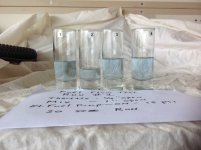
2. Shot glass test looked a little problematic to me. We were methodical. First we disconnected the input fuel line from the mechanical pump to the AFP servo. Good, full flow. Next we disconnected the metered fuel line and ran the boost pump. Good flow, 3.6 gph at full throttle and mixture, 1.5 gph when throttle retarded to idle. Then unscrewed the injectors from the cylinders, reconnected the injectors to the stainless steel fuel lines, and ran the boost pump. Here I would describe the flow at full throttle and mixture full rich as a dribble, not a stream or a mist. Calling Don Rivera at AFP, he said this is correct. When the engine is running, the vacuum and the intake valve opening are what vaporize and mix the fuel flow.

Injector flow before cleaning

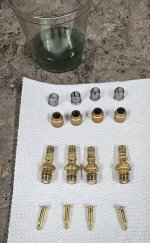
That nonetheless looked suspicious to me, so I took the injectors out and cleaned them:
1000014722.jpg

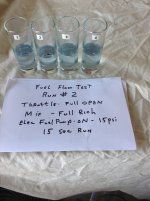
I then ran the shot glass test after cleaning the injectors and found substially increased and cleaner flow (throttle full open and mixture full rich):

Injector flow after cleaning
 
Hopeful after seeing this improved injector flow, we hooked everything back up and tried to start with the same, disappointing results. I do, however, suspect a couple of causes that might explain this. I may have flooded the engine by using the same priming procedure, but with substantially increased flow through the injectors. On the first attempt I got the engine trying to start, but then on subsequent attempts it acted like it might be flooded. Running out of time this evening, I didn't have time to try more starts. I'll try again tomorrow with a freshly charged battery.

But inspecting after the start attempts, I found a loose termination on one of the input wires to one of the two electronic ignition coils! I will try replacing that terminal tomorrow and see whether I had a total of THREE, unrelated problems crop up in a narrow time frame! It certainly seems unlikely, but I'll give it a shot.
 
Two things:
- The video on your shot glass test does not do what you need. Get four shot glasses, disconnect the spider line at the injector and collect the fuel in four shot glasses. You want to measure to see if there is any difference in fuel sent to each injector. We found a problem with the spider doing this. A chunk of crud was bounding around in the spider blocking fuel flow to an injector. Side note - this problem perfectly mimicked the classic stuck valve on startup.
- Do not assume your Lightspeed is working properly based on your mag check. Use a timing light to verify timing. Do not rely on only the LED to time. Lightspeed ignitions have been known to have MAP sensors fail, driving timing to 40+ degrees regardless of MP or RPM. I worked a new RV-7 that had two failed Lightspeed boxes - the pilot reported he was unable to keep CHTs below ~430 regardless of mixture since first flight. He never put a timing light on his engine. The boxes were sent back to Klaus for repair.
 

Attachments

  • IMG_0088 2.jpeg
    IMG_0088 2.jpeg
    1 MB · Views: 69
  • IMG_0089.jpeg
    IMG_0089.jpeg
    1 MB · Views: 68
Last edited:
Two things:
- The video on your shot glass test does not do what you need. Get four shot glasses, disconnect the spider line at the injector and collect the fuel in four shot glasses. You want to measure to see if there is any difference in fuel sent to each injector. We found a problem with the spider doing this. A chunk of crud was bounding around in the spider blocking fuel flow to an injector. Side note - this problem perfectly mimic the classic stuck valve on startup.
- Do not assume your Lightspeed is working properly based on your mag check. Use a timing light to verify timing. Do not rely on only the LED to time. Lightspeed ignitions have been known to have MAP sensors fail, driving timing to 40+ degrees regardless of MP or RPM. I worked a new RV-7 that had two failed Lightspeed boxes - the pilot repssorted he was unable to keep CHTs below ~430 regardless of mixture since first flight. He never put a timing light on his engine. The boxes were sent back to Klaus for repair.
Good info, thanks. I have sent the spider back to AFP many years ago when I found it leaking around the bottom seal. We did also do the flow test as you describe, but without any graduated cylinders handy. In 4 plastic cups of the same size the amount flowed looked the same, but without any great precision of measurement. I agree that is worth investigating further.

I agree on the Lightspeed too. My first thought with the hard starting some months ago was the Lightspeed, because the problem only manifested during start when the electronic ignition was on and the magneto off. I reset the timing using the built-in light on the Hall Effect sensor. Did not find any material change. I've been loath to get up there behind the wirling prop with a timing light, but that may become necessary to verify the timing. Any experience doing that on the 2-seat RVs? How do you minimize danger?
 
Two things:
- The video on your shot glass test does not do what you need. Get four shot glasses, disconnect the spider line at the injector and collect the fuel in four shot glasses. You want to measure to see if there is any difference in fuel sent to each injector. We found a problem with the spider doing this. A chunk of crud was bounding around in the spider blocking fuel flow to an injector. Side note - this problem perfectly mimic the classic stuck valve on startup.
- Do not assume your Lightspeed is working properly based on your mag check. Use a timing light to verify timing. Do not rely on only the LED to time. Lightspeed ignitions have been known to have MAP sensors fail, driving timing to 40+ degrees regardless of MP or RPM. I worked a new RV-7 that had two failed Lightspeed boxes - the pilot reported he was unable to keep CHTs below ~430 regardless of mixture since first flight. He never put a timing light on his engine. The boxes were sent back to Klaus for repair.I would strongly advise a test flight at this time to verify mags/emags here is wha
Although I would strongly not recommend a flight test now, I use the Savvy Aviation airborne ignition test for both the mechanical and electronic ignitions systems. On our RV-9A the connector to the MAP sensor had a broken locking clip and vibrated out enough to give erratic data to the EIS module while airborne. A strip of black gorilla tape got me home to Montana.

As in flying the “big iron”, I suggest studying all the systems manuals you have for your aircraft. Understanding their flow charts, operations and theory (even just general 4-stroke engine ops) will help you troubleshoot issues, especially enroute as the ability to browse the Vans forums is hindered bouncing across the Midwest. - cappy

 
Although I would strongly not recommend a flight test now, I use the Savvy Aviation airborne ignition test for both the mechanical and electronic ignitions systems. On our RV-9A the connector to the MAP sensor had a broken locking clip and vibrated out enough to give erratic data to the EIS module while airborne. A strip of black gorilla tape got me home to Montana.

As in flying the “big iron”, I suggest studying all the systems manuals you have for your aircraft. Understanding their flow charts, operations and theory (even just general 4-stroke engine ops) will help you troubleshoot issues, especially enroute as the ability to browse the Vans forums is hindered bouncing across the Midwest. - cappy

Thanks for the article. I read it closely. No, I've never done a mag check in cruise conditions. That would help localize the problem if it's in the ignition. I don't have an engine monitor on the old -4, but I could look for operation on each ignition separately.

Once I get it back in the air, of course! I won't try a takeoff until I'm satisfied with the engine.
 
Just curious why you leave the Slick magneto off when starting. While an impulse coupling is needed to give it the extra "snap" required for starting from low RPM, it won't hurt anything to have your mag without the impulse coupling switched on. There are plenty of two magneto engines out there with the impulse coupling mag on the left and the non-impulse mag on the right. With a key switch, only the left one is helping it for that initial start, but they both chime in after that. With that said, what you describe still sounds like a fuel problem to me.

By the way, that's a mighty fancy shirt for flying in an RV-4! :D
 
Just curious why you leave the Slick magneto off when starting. While an impulse coupling is needed to give it the extra "snap" required for starting from low RPM, it won't hurt anything to have your mag without the impulse coupling switched on. There are plenty of two magneto engines out there with the impulse coupling mag on the left and the non-impulse mag on the right. With a key switch, only the left one is helping it for that initial start, but they both chime in after that. With that said, what you describe still sounds like a fuel problem to me.

By the way, that's a mighty fancy shirt for flying in an RV-4! :D
Oh, it's kind of a composite procedure. Originally the engine came from Van's with 2 Slick mags, impulse-coupled on the left, and non-impulse on the right. Following Bob Nuckoll's toggle switch design, I wired the starter power through the Left Mag On/Right Mag Off switch positions. Then, when the left mag failed at 500-ish hours (long ago), I replaced it with the LSE Plasma II-Plus. Because the mag is timed at 25 degrees BTDC, I don't want it firing prematurely during start. The LSE starts at zero degrees. So I left the starter wiring the way it is.

I had just gotten home from a six-day trip at work and headed right out to my friend's hangar to continue troubleshooting! Naturally the engine did not fail on me at the home 'drome. No, just as when the impulse mag failed, I was out away from home. Of course. I also got oil and grease stains on the ol' pilot uniform, so that one is toast! That's okay. I have lots more work shirts.
 
Last edited:
I had one reply (since deleted, which is fine) offended that I asked for suggestions without telling what I had already done in troubleshooting. I'm not being a jerk. I just wanted to check whether my troubleshooting method is on the right track without influencing replies in one direction or another. Ideally I hoped that somebody would see the start attempt video and say, "I had the same symptoms and traced the problem to X." Obviously it has to be one (or more) of three items: fuel, air, or ignition. When I found the mechanical fuel pump dumping fuel overboard through the pump vent line (a sudden change as of this last flight) I was confident I'd found the problem. That start attempt video was after replacing the mechanical fuel pump, so apparently the original problem lies elsewhere. I'm starting to run out of ideas! All suggestions where and how to look are welcome.
 
i never trust suppliers, have you checked to see that you got the right pump? ive heard of people getting a low pressure pump in a high pressure pump box.
 
All good suggestions. I agree it looks and sounds to me like fuel starvation. Results to the above in order:
1. Mag check was perfectly normal before the last problem flight. As normal, switching off the magneto at 2000 rpm runup produces a slight audible change in the exhaust note with no rpm drop. Switching the electronic off produces about 150 rpm drop. all normal. I have not gotten it running enough to do a mag check since the problem flight. Engine starts are with the electronic ignition on and mag off.
2. Shot glass test looked a little problematic to me. We were methodical. First we disconnected the input fuel line from the mechanical pump to the AFP servo. Good, full flow. Next we disconnected the metered fuel line and ran the boost pump. Good flow, 3.6 gph at full throttle and mixture, 1.5 gph when throttle retarded to idle. Then unscrewed the injectors from the cylinders, reconnected the injectors to the stainless steel fuel lines, and ran the boost pump. Here I would describe the flow at full throttle and mixture full rich as a dribble, not a stream or a mist. Calling Don Rivera at AFP, he said this is correct. When the engine is running, the vacuum and the intake valve opening are what vaporize and mix the fuel flow.

Injector flow before cleaning

That nonetheless looked suspicious to me, so I took the injectors out and cleaned them:
View attachment 96097

I then ran the shot glass test after cleaning the injectors and found substially increased and cleaner flow (throttle full open and mixture full rich):

Injector flow after cleaning
I would time, say 30-secs, per Spyder / injector, try and use a graduated cylinder.
What did you use to clean injectors?
Chemical? Is ultrasound a viable medium? (I don’t know) I use it for other motors, carbs etc.
 
I had one reply (since deleted, which is fine) offended that I asked for suggestions without telling what I had already done in troubleshooting. I'm not being a jerk. I just wanted to check whether my troubleshooting method is on the right track without influencing replies in one direction or another. Ideally I hoped that somebody would see the start attempt video and say, "I had the same symptoms and traced the problem to X." Obviously it has to be one (or more) of three items: fuel, air, or ignition. When I found the mechanical fuel pump dumping fuel overboard through the pump vent line (a sudden change as of this last flight) I was confident I'd found the problem. That start attempt video was after replacing the mechanical fuel pump, so apparently the original problem lies elsewhere. I'm starting to run out of ideas! All suggestions where and how to look are welcome.
I saw the post. I can relate when I am sans coffee. I hate everyone before then…
 
I would time, say 30-secs, per Snyder/ injector.
What did you use to clean injectors?
Chemical? Is ultrasound a viable medium? (I don’t know) I use it for other motors, carbs etc.
I used the method given to me by an old-timey A&P-IA: Hoppes #9. I let 'em soak for a while, then brushed and blew them out, then used 100LL as a final solvent to wash out any remaining bore cleaner. I did find some black particles in the solvent bowl after soaking, so maybe that did some good. The injector flow is substantially improved after cleaning.
 
Just curious why you leave the Slick magneto off when starting. While an impulse coupling is needed to give it the extra "snap" required for starting from low RPM, it won't hurt anything to have your mag without the impulse coupling switched on. There are plenty of two magneto engines out there with the impulse coupling mag on the left and the non-impulse mag on the right. With a key switch, only the left one is helping it for that initial start, but they both chime in after that. With that said, what you describe still sounds like a fuel problem to me.

By the way, that's a mighty fancy shirt for flying in an RV-4! :D
Maybe I learned it wrong. Not a mag guy. Yes, the impulse coupling gives a better (not great) spark than the fixed points. It also provides the correct retard point for starting. Aren't the fixed points grounded to prevent the PP from trying to kick back? Please reeducate me if I'm wrong.
 
I saw the post. I can relate when I am sans coffee. I hate everyone before then…
I have coffee in hand right now as I read through your suggestions! It's my own roast: Columbian Cauca Manos, natural-processed, roasted to a medium for good fruity notes over a chocolaty base. Yum!
 
Last edited:
Maybe I learned it wrong. Not a mag guy. Yes, the impulse coupling gives a better (not great) spark than the fixed points. It also provides the correct retard point for starting. Aren't the fixed points grounded to prevent the PP from trying to kick back? Please reeducate me if I'm wrong.
According to Bob Nuckolls (reporting from memory; I don't have his text handy), the traditional key switch internally grounds the non-impulse mag when it rotates to the Start position (if the installation has one impulse and one non-impulse.)
 
i never trust suppliers, have you checked to see that you got the right pump? ive heard of people getting a low pressure pump in a high pressure pump box.
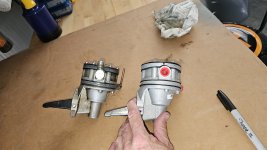
Well, dang it, I think so! I ordered a "Fuel Pump, Dual Diaphragm, LW-15473"
Rebuilt Tempest unit from Aircraft Specialties here in TUL. I thought I had taken pictures of the part number printed on the pump, but looking through my pictures, I guess I didn't. That's probably worth snaking a bore scope in there to make sure. During start with the electric boost pump on I'm showing 22.5 psi, so that should be sufficient.
 
Well, dang it, I think so! I ordered a "Fuel Pump, Dual Diaphragm, LW-15473"
Rebuilt Tempest unit from Aircraft Specialties here in TUL. I thought I had taken pictures of the part number printed on the pump, but looking through my pictures, I guess I didn't. That's probably worth snaking a bore scope in there to make sure. During start with the electric boost pump on I'm showing 22.5 psi, so that should be sufficient.
1000014735.jpg
This is the best picture I have, but it doesn't show a part number. Hm.
 
While an impulse coupling is needed to give it the extra "snap" required for starting from low RPM, it won't hurt anything to have your mag without the impulse coupling switched on.
Not sure if you are referring to starting or running here. It is strongly discouraged from starting with a non impulse mag on. The impulse coupler doesn't just add the snap for the required energy, it also retatrds the timing. Without this retard, the risk of kickbacks during starting goes up exponentially. Suggest that the OP leave the mag off during starts, assuming it is a non impulse as stated in first post.
 
Symptoms:
A few months ago it had become cantankerously hard to start when cold (first start of the day, not air temperature), but normal hot starts.
Cold engines need a much richer mixture to start than hot engines; Think Choke. Your symptom here loosely points to a lean mixture scenario. Many different issues can cause the mixture to be too lean, including inadequate priming.
 
Cold engines need a much richer mixture to start than hot engines; Think Choke. Your symptom here loosely points to a lean mixture scenario. Many different issues can cause the mixture to be too lean, including inadequate priming.
I think so too. It sure looks and sounds to me like starving for fuel. I keep banging my head against a brick wall and so far have only a bruised forehead to show for it. Frustrating!
 
I think so too. It sure looks and sounds to me like starving for fuel. I keep banging my head against a brick wall and so far have only a bruised forehead to show for it. Frustrating!
Fuel starvation during start can easilly be overcome with priming. If it runs and idles well after it starts, you should be able to overcome starting issues with priming. What is your cold start sequence. If it catches, but fails to run, either too much or too little fuel in idle and possibly main circuit.
 
Last edited:
Fuel starvation during start can easilly be overcome with priming. If it runs and idles well after it starts, you should be able to overcome starting issues with priming. What is your cold start sequence. If it won't run after catching, I would be looking for issues in the idle circuit and fuel starvation is the top of the list. Have you cleaned the servo strainer?
Sorry. See that it is a carb. Debris in needle seat is high on the list if overly rich is the cause. Turn on the boost pump for 2 minutes and see if fuel starts leaking out of the carb with engine off. If too lean, accel pump problems are possible. Too rich vs too lean is tough to distinguish without a trained ear. Not sure I could easilly put it in words. carbs typically have a small strainer. have you checked and cleaned it? This would give symptoms similar to a failing fuel pump.
 
all right. now totally confused. orig post says O-360, but you have pics of injectors.
Yep. Originally an O-360-A1A, but modified with Airflow Performance fuel injection. I drop-shipped my brand new Lyc from Van's straight to Everett Hatch to work his magic. 200 hp on his air brake dyno with 8.5-to-1 compression. All that gain is from cylinder flow work and cold air, tuned induction.
 
i never trust suppliers, have you checked to see that you got the right pump? ive heard of people getting a low pressure pump in a high pressure pump box.
Okay, confirmed. Part number stamped on the mechanical fuel pump is 15473. The serial number matches the paperwork that specifies LW-15473.
1000036594.jpg
 
all right. now totally confused. orig post says O-360, but you have pics of injectors.

...
O-360-A1A purchased new from Van's c. 1996.
Modified by Everett Hatch with Airflow Performance fuel injection/purge valve, flow work, cold air induction, tuned induction, tuned exhaust.
Left Ignition: Lightspeed Plasma II Plus with Hall Effect sensor. Right ignition: Slick magneto, without impulse coupling.
1650 mostly trouble-free hours on airframe and engine since new. (Something has changed dramatically!)
 
I rewatched your engine start video. You are priming the snot out of the engine.

Try (for a cold engine):
- Boost pump on, mixture at cutout, throttle cracked open.
- With the boost pump still on, mixture to full rick for a count of four then back to cutout.
- If the engine does not start, try another four seconds of prime.
- Start the engine with the boost pump still on, easing in mixture as it starts to fire.

If this works it would indicate to me that you have a fuel system sucking air someplace.

Carl
 
Since it's not backfiring, I think it's unlikely to be a lean event and with the black smoke coming out of the stacks, seems more likely you are in fact suffering an ignition problem with un-combusted fuel.

If you want to test, then prime, then FULL THROTTLE, Mixture off...and crank and show those results.

Steve
 
I rewatched your engine start video. You are priming the snot out of the engine.

Try (for a cold engine):
- Boost pump on, mixture at cutout, throttle cracked open.
- With the boost pump still on, mixture to full rick for a count of four then back to cutout.
- If the engine does not start, try another four seconds of prime.
- Start the engine with the boost pump still on, easing in mixture as it starts to fire.

If this works it would indicate to me that you have a fuel system sucking air someplace.

Carl
Actually what you're hearing is purge valve operation, not priming. Purge valve operation fills the lines with cool fuel all the way up to the spider, thence back into the right tank. The prime is the short 3-second run just before hitting the starter.
 
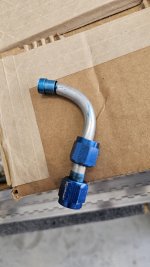
I may have found it, though! While starting I just happened to catch fuel drips in the cockpit. Investigating, I found blue staining around the output tube from the fuel selector forward to the electric boost pump. Pulled if off and found fuel dripping from a crack around the AN nut ferrule. I am making a new part. Fingers crossed!

1000036602.jpg
 
A fuel leak, with the boost pump on, should leak out, which needs to be fixed, but should not cause that sort of situation, assuming that aluminum line is fuel, not air.

Induction leaks, allowing air IN...would be a lean event and backfires are common. You seem to be suffering from either too much fuel (hence the black smoke) or ignition problem...plug, wire, ignition module, coil pack, broken wire...I took the Plasma3 off, replaced it with Surefly and have never looked back. One Bendix, One SF...

S.
 
I don't know but one thing that came to my mind... make sure the tank is venting so it's not trying to suck fuel from a vacuum.
 
A fuel leak, with the boost pump on, should leak out, which needs to be fixed, but should not cause that sort of situation, assuming that aluminum line is fuel, not air.
not when the leak is upstream from the pump; from there it can suck in air when the pump is on. Upstream is negative pressure and downstream is positive pressure.
 
I may have found it, though! While starting I just happened to catch fuel drips in the cockpit. Investigating, I found blue staining around the output tube from the fuel selector forward to the electric boost pump. Pulled if off and found fuel dripping from a crack around the AN nut ferrule. I am making a new part. Fingers crossed!

View attachment 96189
Seems unlikely that leak would cause anything more than barely detectable leanness. Hope for your sake i am wrong but have repaired several leaks in that area and none produced noticeable symptoms. Maybe very slight hesitation/misses in climb. Nothing to the extent of your issue.
 
Seems unlikely that leak would cause anything more than barely detectable leanness. Hope for your sake i am wrong but have repaired several leaks in that area and none produced noticeable symptoms. Maybe very slight hesitation/misses in climb. Nothing to the extent of your issue.
Hm. Well, we'll see shortly. I have the new part fabricated.
 
A big follow on test you can do: insert a clear section of tube after the fuel pump but before the fuel servo. Do a ground run and watch for air bubbles in that line.
 
I may have found it, though! While starting I just happened to catch fuel drips in the cockpit. Investigating, I found blue staining around the output tube from the fuel selector forward to the electric boost pump. Pulled if off and found fuel dripping from a crack around the AN nut ferrule. I am making a new part. Fingers crossed!

View attachment 96189
Well, that did not work at all! I'm starting to tear my hair out. I need all possible help here. At each step I seem to have made it worse, not better!

First I replaced the leaking mechanical fuel pump. Starting behavior remained the same, trying to run, but never coming up to idle. That's the starting video above.

Second I cleaned the injectors. The two injector videos above show the results: from a dribble to a smooth stream. Start attempts after that step just pop once, then nothing. Restart attempts don't even pop.

Third I found blue staining and fuel dripping from the outlet tube from the fuel selector to the electric boost pump. I remade that tube and installed it yesterday. Now it is definitely bone dry, no stains or leaks. But now on start attempts it never pops even once! Just spins.

In each case I've made it worse, not better. There are a couple of directions I'm thinking. I invite all suggestions. Am I on the right track?

1. Every fix I've tried would tend to make the mixture richer, not leaner. If it had been an over-lean problem, these steps should have improved matters. As it didn't, am I actually too rich? Flooding immediately? Could the failing mechanical pump have flung debris into the fuel servo? The flow numbers look about right, 3.6 gph at full throttle and mixture, while retarding throttle to idle gives 1.6 gph. 23 psi with the electric boost pump on, about 10 psi while cranking on only the mechanical fuel pump. Those seem about right to me.

2. Or perhaps, as some suggest above, it's really the LSE ignition failing in some mode that makes the timing erratic, and the leaking fuel pump was just ancillary. I began testing the electronic ignition IAW LSE instructions.
A. Checked the timing on the Hall Effect sensor. By our best estimate, using a laser line along the case split line, it may have been set a few degrees early. We reset it very accurately using the laser line and the integral timing LED. No change on starting: it doesn't even pop.

B. Checked the coils as instructed. Disconnected the spark plug wires from the coils and rocked the prop past both trigger points at TDC 1 and 3. Definitely jumping a spark all the way across that gap, a good 3/4" to 1" between them! The spark is jumping right at zero degrees as it should.

What else?
 
Did you set the Lightspeed timing at TDC, not 25 degrees BTDC?

Check the Lightspeed timing with a light. If that is too hard, borrow an impulse mag to temporary replace the Lightspeed and resolve the ignition as the source of your problems.

Pull the Hall Effect sender, remove the cover and look for oil in the sender. I assume Klaus still tells you to do this from time to time. The seals on these are known to leak.

But reminder to do the shot glass test as I described. Easy so do that first.

Disconnect the fuel line at the fuel manager. Connect a jumper hose to direct the gas to a gas can. Run the boost pump and measure the fuel flow rate by timing how long it takes to pump 3-4 gallons.

Did you try engine start with the boost pump running?

Carl
 
Did you set the Lightspeed timing at TDC, not 25 degrees BTDC?

Check the Lightspeed timing with a light. If that is too hard, borrow an impulse mag to temporary replace the Lightspeed and resolve the ignition as the source of your problems.

Pull the Hall Effect sender, remove the cover and look for oil in the sender. I assume Klaus still tells you to do this from time to time. The seals on these are known to leak.

But reminder to do the shot glass test as I described. Easy so do that first.

Disconnect the fuel line at the fuel manager. Connect a jumper hose to direct the gas to a gas can. Run the boost pump and measure the fuel flow rate by timing how long it takes to pump 3-4 gallons.

Did you try engine start with the boost pump running?

Carl
1. Yes, set at zero TDC 1.

2. I've decided I need to get the timing light and brave the whirling prop. Have to eliminate that as a possibility .

3. I saw that in the LSE manual. I'll do that.

4. I bought some shot glasses of several different sizes last night. That's on my list.

5. I'll try that just to verify my flow. The flow transducer is upstream of the mechanical pump, so just conceivably there could be a difference in the metered flow. We flowed the metered line into a bucket, and it looked about right, but did not measure it.
 
1. Yes, set at zero TDC 1.

2. I've decided I need to get the timing light and brave the whirling prop. Have to eliminate that as a possibility .

3. I saw that in the LSE manual. I'll do that.

4. I bought some shot glasses of several different sizes last night. That's on my list.

5. I'll try that just to verify my flow. The flow transducer is upstream of the mechanical pump, so just conceivably there could be a difference in the metered flow. We flowed the metered line into a bucket, and it looked about right, but did not measure it.
While I am slightly leaning in the direction of ignition at this point, I do feel like I'd go back to the known condition prior and retrace my steps, meaning re-install the leaking fuel pump, just to rule out that the new pump is not the culprit...Since you raised the issue of timing...I know this is obvious mostly, but have you 100% guaranteed you aren't 180 degrees off on timing...being a lost spark system, the Lightspeed WILL fire 180 degrees off and does so, by design...you wouldn't be the first to make this mistake...

Again from the video, it seems possible too much fuel may be flooding plugs...that being said, when I first installed Lightspeed, I had several starts much like yours, that turned out to be the wrong ring mounting position for the magnetic pickups. That got resolved, but I just never had faith in the system as a whole. It's far to tinkertoy-ish for my taste in aviation for something we rely on. Hard to beat Bendix, SureFly, E-mag. too many failure points in the LS for my taste. just my fat opinion. Lots of guys love them.

You mentioned debris into the spider and while not likely...it is possible. The fact that this seems to have gotten progressively worse, to me seems like something failing in process...which I wouldn't even rule out plugs, wires, anything and everything has to be inspected. If you're fuel sumps are clean...the debris in the injector might be a telling clue of an upstream blockage.

I try to stick to only ever change one thing at a time, when fixing or troubleshooting. Otherwise you're just guessing. Right now you have too many variables to guess at...

Pull and inspect all plugs
Inspect Air Filter
Timing Light is pretty dangerous. Be damn careful.


Steve
 
On the plugs and wires, Did you check resistance of both?

On your start attempt did you aggressively lean before the engine stopped? Did you pomptly take your ignition switch to both before the engine stopped?

A few side notes:
- The fuel flow sender should be downstream of the mechanical fuel pump.
- Look at the AFP idle mixture adjustment. Look right (as in nuts tight, linkage not loose, etc.)?
- Did you send the video to Don Rivera at AFP to get his thoughts?

Carl
 
How about induction leak? Or in Automotive terms, vacuum leak. Just an idea.
All things equal, the simplest solution is usually the correct one.
I haven’t seen a response to this post. Examine the intake runners for cracks or joint leaks. One technique I’ve witnessed is to have an assistant stand behind the engine, with an aerosol can of butane (used to refill lighters), and when the engine starts to run, spray the butane on suspected areas of the intake pipes. Stay away from the prop! If the engine starts to run smoother you’ve found a leak.
 
Back
Top