Van's Air Force

The definitive Van's Aircraft support community! Buying, building or flying an RV? Join our exclusive family of mentors and enthusiasts!

High oil temp on relatively new engine

Bavafa

Well Known Member
Patron
I am helping a friend with his new RV14 that has a really high oil temp and I am wondering what sort of things could play a role. Here is the circumstance, the engine will get to 220F range in about 10-15 minute run on the ground, they saw a 235F at the runup and thought it would cool down if flown, one turn in the pattern the oil got to 245F when they decided to land. Oil pressure has been good and the scat tubing to the cooler has been checked as well as anything sucked into the oil cooler.
Besides, the usual suspect of oil temp sensor, Vernatherm, ignition timing and possibly a clogged oil cooler, what other things should be checked? Is there any relatively easy way of checking the oil cooler for restriction?
I have not seen the plane yet but have agreed to go and help him troubleshoot as he is not very knowledgeable in these regards.

Thanks in advance for any suggestions
 
What engine?
What oil cooler?
Existing problem or new problem?
Is there an oil cooler air control butterfly valve or such?
Oil cooler exit air path clear?
Oil cooler lines connected in the normal places?
CHT temps good or high as well?

Carl
 
I helped an rv 7 owner with a similar problem. Went from 7 row to 9 row cooler , new VT and OT sensor and still got to 220+ within a couple of minutes from takeoff. I told him the only thing that makes sense is piston squirters , even though they are not typical on PV 360’s. 4 months later we pulled the cylinders to re-ring and sure enough there were squirters installed. Removed them and now cools great. Engines with squirters need significantly greater cooling capacity for oil than those without.

Might be worth looking into, as I suspect the 390 has them. The standard 7 row cooler found on most planes will be seriously inadequate if it has them.
 
Last edited:
This is a RV14A with a IO390-EXP119 engine and all is setup based on standard installation which uses Airflow performance oil cooler with a 5" scat tubing. I have not seen the CHT but all indication is that it is normal temp. This engine has piston squirters and those are standard on this engine and the oil cooler is a 13 row but the temp is not normal based on my experience. There is very little verified info about the past behavior/temp of the engine as the 40 hours fly offs was done by another pilot and he has provided little info other than 'all was normal'
 
This is a RV14A with a IO390-EXP119 engine and all is setup based on standard installation which uses Airflow performance oil cooler with a 5" scat tubing. I have not seen the CHT but all indication is that it is normal temp. This engine has piston squirters and those are standard on this engine and the oil cooler is a 13 row but the temp is not normal based on my experience. There is very little verified info about the past behavior/temp of the engine as the 40 hours fly offs was done by another pilot and he has provided little info other than 'all was normal'
My next steps would be to test the OT sensor and the vernatherm. You are looking for the minimum specified expansion of the vt at 184*. You should also examine the cone and the seat looking for witness marks of 360* seating of the cone into the seat. The closing of the vt seals the bypass and forces oil to the cooler. If it doesn’t close fully, cooling efficiency is compromised.
 
Mehrdad, does this plane have a G3X or avionics where you can download past flight history and see what the oil temps were doing on past flights (possibly back in those phase 1 flights)? Www.flysto.net is a good place to upload and view this data. I know this won’t fix the problem but it might aid in troubleshooting.
 
Wouldn’t t be better to have additional lubrication at
I helped an rv 7 owner with a similar problem. Went from 7 row to 9 row cooler , new VT and OT sensor and still got to 220+ within a couple of minutes from takeoff. I told him the only thing that makes sense is piston squirters , even though they are not typical on PV 360’s. 4 months later we pulled the cylinders to re-ring and sure enough there were squirters installed. Removed them and now cools great. Engines with squirters need significantly greater cooling capacity for oil than those without.

Might be worth looking into, as I suspect the 390 has them. The standard 7 row cooler found on most planes will be seriously inadequate if it has them.
a slightly higher temp? My IO360 angle valve tends to run about 200-210. Slightly higher than I’d like. The angle valves have squirters. I actually had to put two oil coolers on my plane to keep the temps below 210. I have a 13 row oil cooler and a smaller cooler on top of the engine.

Why do the oil squirters add temperature? Is it because of a higher oil pressure?

Seems like good intel, I’ve just never heard that before. I’d love to understand it better.
Thanks
X
 
This is a RV14A with a IO390-EXP119 engine and all is setup based on standard installation which uses Airflow performance oil cooler with a 5" scat tubing. I have not seen the CHT but all indication is that it is normal temp. This engine has piston squirters and those are standard on this engine and the oil cooler is a 13 row but the temp is not normal based on my experience. There is very little verified info about the past behavior/temp of the engine as the 40 hours fly offs was done by another pilot and he has provided little info other than 'all was normal'
Do you mean it has the standard AirFlow Systems 2006X cooler? This is a good cooler that I use on my IO-540 engines.

Right now, as already commented, the vernatherm is the prime suspect but engine data is needed to rule out other potential causes. Data on CHTs and such, along with the ignition setup would be beneficial. For example a common mistake is use of aftermarket electronic ignitions with timing set too far advanced.

Carl
 
For 17 years I never saw over 210 in extreme conditions until arriving at KOSH. When I got there it was about OAT of 90. For over 30 minutes I was taxing and holding until they finally got me to parking. My oil temp got to 250f. The point being taxing and holding for long periods really heats things up. Lots of vapor lock too. Had to keep my fuel pump on.
 
Wouldn’t t be better to have additional lubrication at

a slightly higher temp? My IO360 angle valve tends to run about 200-210. Slightly higher than I’d like. The angle valves have squirters. I actually had to put two oil coolers on my plane to keep the temps below 210. I have a 13 row oil cooler and a smaller cooler on top of the engine.

Why do the oil squirters add temperature? Is it because of a higher oil pressure?

Seems like good intel, I’ve just never heard that before. I’d love to understand it better.
Thanks
X
The squirters send a much greater amount of oil to the bottom of the piston compared to a splash oil system. This oil pulls heat from the piston and therefore, due to the greater volume, the oil heats up much faster. Has nothing to do with pressure.

Because the oil is doing more of the heat shedding work, air cooling load is reduced. There is a given amount of combustion heat generated at any given power level and two different ways to get rid of it. It is then an exercise in trade offs as to how you do it.
 
Last edited:
The IO-390-EXP119 tends to have hotter oil temps than the earlier 390's and they had OT issues even at 210 hp. The 5 in SCAT was meant to help vs the original 4 in SCAT. I have an early 390 with the stock oil cooler and going to SKEET helped. Hopefully the original pilot had a SD card in the EFIS that will help you troubleshoot. Holding on the ground really heats the oil up very quickly and the only way to bring it down is to get up to a decent altitude and it should come down. I found going to 24 square and 1,000 fpm worked best. Tried all kinds of combination of lower power lower climb rates, higher power lower climbs rates but the 24 sq and 1,000 fpm seems to work best to get the OT's to start to decline quicker. I would not exceed 225 F. If possible, start and get in the air ASAP.
 
I helped an rv 7 owner with a similar problem. Went from 7 row to 9 row cooler , new VT and OT sensor and still got to 220+ within a couple of minutes from takeoff. I told him the only thing that makes sense is piston squirters , even though they are not typical on PV 360’s. 4 months later we pulled the cylinders to re-ring and sure enough there were squirters installed. Removed them and now cools great. Engines with squirters need significantly greater cooling capacity for oil than those without.

Might be worth looking into, as I suspect the 390 has them. The standard 7 row cooler found on most planes will be seriously inadequate if it has them.
Piston squirters DO cool the pistons but this results in higher oil temps. Personally I'm ok with temps below 220°F but above that would prompt me to look into a larger capacity cooler. Assuming the current cooler is not partially clogged
 
Yet another variable is that factory-built 390's have bigger piston squirters than 360's. And the 390 squirters have the next size up NPT threads, so you can't easily swap one type for the other.
 
Piston squirters DO cool the pistons but this results in higher oil temps. Personally I'm ok with temps below 220°F but above that would prompt me to look into a larger capacity cooler. Assuming the current cooler is not partially clogged
The 220 was just after TO. they would climb toward 240 at top of climb and that was winter. I am also OK with 220, but knew his system would cause problems once summer came around.
 
Hoping to answer all questions here as i am on my phone. They dud not have a SD card to collect the data so no info of the past is available. the CHT is not bad mid 300 and oil pressure in the normal range 70s. Oil cooler is the 2006x. The sensor was tested and it was reading a bit high (about 5F) the actual. We are going ti replace that as well as checking ther Vernatherm for expansion rate and evidence on the cone. I am not sure how to test the oil cooler for restrictions other than getting the temps at different locations in the cooler. The ignitions will be checked for timing as well as spark plug wires. I am also planning on borescope the cylinders for sins of glazing but not sure if that will cause higher oil temp

Any thing else i can check that anyone can suggest?
 
Any thing else i can check that anyone can suggest?
Check to make sure the 5 in SCAT tube is not deformed and transitions are smooth. I've seen a couple that were buckled. It's a tight fit. Since CHT temps doesn't seem as critical in an angle valve (They tend to run cooler than a parallel valve) make sure gaps are well sealed. The more pressure on the top of the engine the better. I reduced the 2 in intakes for my 2 heat muffs to 3/4 inch to increase top cowling pressure. These 390's in Florida summer need all the help they can get. Good luck !
 
Check to make sure the 5 in SCAT tube is not deformed and transitions are smooth. I've seen a couple that were buckled. It's a tight fit. Since CHT temps doesn't seem as critical in an angle valve (They tend to run cooler than a parallel valve) make sure gaps are well sealed. The more pressure on the top of the engine the better. I reduced the 2 in intakes for my 2 heat muffs to 3/4 inch to increase top cowling pressure. These 390's in Florida summer need all the help they can get. Good luck !
Will be checking all of that, thanks. But I am guessing since the oil temp gets high on the ground, that is less of a culprit as not a whole lot of air will be going thru the scat tubing.
 
After making sure the Pmags are spoofed enough (jumpered and clocked retarded) to work on an angle valve, consider the addition of a viscosity valve to bypass and rule out the vernatherm.
 
After making sure the Pmags are spoofed enough (jumpered and clocked retarded) to work on an angle valve, consider the addition of a viscosity valve to bypass and rule out the vernatherm.
I am not familiar with the viscosity valve, is that one that you install in place of the vernatherm that blocks it without needing for expansion?
I will be checking the PMAG setup completely. I have seen some people use the marking on the front of the flywheel and match that to the case split instead of the hole on the starter. If that was the case, I am not sure even if the engine will start since the timing would be so much off.

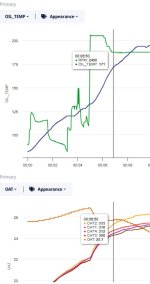
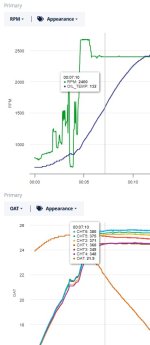
Edit: I received the latest engine data from the run that they did last night. Temp have gone to 205F in 12 minutes but it is running at the higher RPM (2200-2500) then would would see as a normal taxing and run up.
1747955237789.png
 
am not familiar with the viscosity valve, is that one that you install in place of the vernatherm that blocks it without needing for expansion?
I will be checking the PMAG setup completely.
The viscosity valve can be installed in addition to the vernatherm to save time, but yes.

And just to make sure the Pmag timing comment is understood:. It's more nuanced than setting to the right set of marks on the ring carrier. You certainly want that, yes, but for the AV engines you want to mechanically retard the housing a few degrees to help take the edge off the aggressive Pmag curve.
 
Hoping to answer all questions here as i am on my phone. They dud not have a SD card to collect the data so no info of the past is available. the CHT is not bad mid 300 and oil pressure in the normal range 70s. Oil cooler is the 2006x. The sensor was tested and it was reading a bit high (about 5F) the actual. We are going ti replace that as well as checking ther Vernatherm for expansion rate and evidence on the cone. I am not sure how to test the oil cooler for restrictions other than getting the temps at different locations in the cooler. The ignitions will be checked for timing as well as spark plug wires. I am also planning on borescope the cylinders for sins of glazing but not sure if that will cause higher oil temp

Any thing else i can check that anyone can suggest?
Glazed cylinders do not increase OT, just increases oil consumption.

On timing being too advanced. If too much advance was your problem, you would see elevated chts in addition to the OT imho. If you are getting 350* chts with maps above 25” I would say timing is not the source of your high OT. Getting 200* OTs with normal chts while on the ground points more towards a cooler flow problem (either within the cooler or the channels leading in or out) and not an airflow or excessively high engine heat output. Also, too much advance at idle rpms doesn’t really add much more heat output like it does at high power levels. I run 35* advance at idle on my 320 and temps are very low during ground ops. Generally when all other temps are normal, but the OT is excessively high, you have inadequate oil cooling. Restrictions in the cooler and defective thermostat/VT are the top two culprits, with cooler airflow a third potential. This is more true with squirters, as the oil is taking more of the heat load. The rest of us can get away with a lot more issues.
 
Last edited:
Glazed cylinders do not increase OT, just increases oil consumption.

On timing being too advanced. If too much advance was your problem, you would see elevated chts in addition to the OT imho. If you are getting 350* chts with maps above 25” I would say timing is not the source of your high OT. Getting 200* OTs with normal chts while on the ground points more towards a cooler flow problem (either within the cooler or the channels leading in or out) and not an airflow or excessively high engine heat output. Also, too much advance at idle rpms doesn’t really add much more heat output like it does at high power levels. I run 35* advance at idle on my 320 and temps are very low during ground ops. Generally when all other temps are normal, but the OT is excessively high, you have inadequate oil cooling. Restrictions in the cooler and defective thermostat/VT are the top two culprits, with cooler airflow a third potential. This is more true with squirters, as the oil is taking more of the heat load. The rest of us can get away with a lot more issues.
Those two, Vernatherm and oil cooler are my primary suspect. I know how to test/verify VT but not sure how to do the oil cooler, perhaps other than getting temp at different section of the cooler to see if there is any discrepancies (i.e one side hotter than other side).
 
Those two, Vernatherm and oil cooler are my primary suspect. I know how to test/verify VT but not sure how to do the oil cooler, perhaps other than getting temp at different section of the cooler to see if there is any discrepancies (i.e one side hotter than other side).
Look into the viscosity valve mentioned above. I have used that in the past confirm the vt was not the issue. A new cooler shouldn’t have restrictions, but never know. Could also be a defective hose. Could even be something off the wall, like a problem with the gasket on the filter assembly blocking something.
 
Last edited:
Another quick thought but low probability. Verify the cooler orientation is such that the outlet would allow any air to be purged.
 
Look into the viscosity valve mentioned above. I have used that in the past confirm the vt was not the issue. A new cooler shouldn’t have restrictions, but never know. Could also be a defective hose. Could even be something off the wall, like a problem with the gasket on the filter assembly blocking something.

Sorry but just noticed the 2006x cooler. Is that a 7 row cooler. Iirc that is the less efficient style as well. If that is a 7 row cooler, that is likely the problem. As I mentioned on just a 360 with squirters i could not keep OT low enough, even with a 9 row cooler, also the inefficient design. Iirc, the bar and plate is much more efficient than the cheaper drawn cup style. The 390 is bigger, so more heat and apparently it has bigger squirters, so more heat being transferred to the oil. Pretty sure that will never work with a 7 row cooler.
The 2006X is a 13 row, and is the exp119 fwf kit cooler from van's, so is that really a possible issue?
 
The 2006X is a 13 row, and is the exp119 fwf kit cooler from van's, so is that really a possible issue?
Not if it is not defective or some how clogged. I have the same cooler in my existing and last RV and did not have any issues like this.
 
Not if it is not defective or some how clogged. I have the same cooler in my existing and last RV and did not have any issues like this.
Got it, was concerning me a bit as I have my fwf kit and that cooler, so was thinking, should I be looking at upsizing for my 14 with the exp119.
 
Multiple builders have had issue with the 13-row cooler from Vans or at least marginal results. That is one reason Vans went with 5 in SCAT replacing 4 in SCAT when they went with the EXP119. Thankfully I was lucky to break my 390 Thunderbolt in Ohio winter, only time I was thankful to be in Ohio in the winter ;) Even after 600 hrs. and long ground runs temps get to 215 F in the summer.
 
Multiple builders have had issue with the 13-row cooler from Vans or at least marginal results. That is one reason Vans went with 5 in SCAT replacing 4 in SCAT when they went with the EXP119. Thankfully I was lucky to break my 390 Thunderbolt in Ohio winter, only time I was thankful to be in Ohio in the winter ;) Even after 600 hrs. and long ground runs temps get to 215 F in the summer.
Not doubting that, but the same 13 row cooler with 4" scat is used on the 10, with a 540, producing quite a bit more heat. That said, most 540's do not have piston squirters, but would have expected similar heat loads - 390 w/squirters & 540 without. I have never seen the math on exactly how much more heat goes to the oil with squiters, so probably not appropriate for me to make that statement. Lot of mystery here.
 
Last edited:
Thankfully I was lucky to break my 390 Thunderbolt in Ohio winter, only time I was thankful to be in Ohio in the winter ;) Even after 600 hrs. and long ground runs temps get to 215 F in the summer.
You're not stuck with canned advance. When it gets hot outside, dial your EFII system back to 20 for takeoff and 23 for cruise, and tell us what you see.

On timing being too advanced. If too much advance was your problem, you would see elevated chts in addition to the OT imho.

A 390 at 27~28 BTDC will exhibit 10 to 15F higher oil temperature. A -14 will also exhibit higher CHT, but not so much that owners consider them elevated.

Not guessing. I've been experimenting with timing using a dual map system for more than 600 hours. There just isn't any practical benefit to an advanced timing schedule with the 390. You can go faster with a bit of drag reduction.

True story. A few years ago Bill Kervaski brought some friends down from Birmingham and we all flew over to Falcon. One of the friends was a nice kid with a new-to-him 390 powered RV-8, pro-built as I recall. P-mags, but no jumpers, no clocking. We literally flew side by side, and he was burning twice the fuel (full rich for "cooling") while struggling to keep temperatures in line. I understand why folks like the self-generating feature, but hey, you gotta set 'em up for the engine.

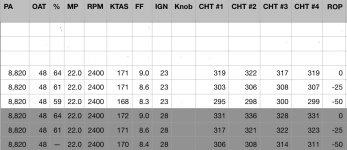
Even clocked, the advance is pointless. Here's an old data set from Marvin McGraw, RV-14, 23 vs 28 degrees, back to back at peak, 25 LOP, and 50 LOP. My trends match. We've both gone to switched 20/23. No loss in cruise, and 20 works better hot and slow.

Marvin Comparison.jpg
 
You're not stuck with canned advance. When it gets hot outside, dial your EFII system back to 20 for takeoff and 23 for cruise, and tell us what you see.


A 390 at 27~28 BTDC will exhibit 10 to 15F higher oil temperature. A -14 will also exhibit higher CHT, but not so much that owners consider them elevated.

Not guessing. I've been experimenting with timing using a dual map system for more than 600 hours. There just isn't any practical benefit to an advanced timing schedule with the 390. You can go faster with a bit of drag reduction.

True story. A few years ago Bill Kervaski brought some friends down from Birmingham and we all flew over to Falcon. One of the friends was a nice kid with a new-to-him 390 powered RV-8, pro-built as I recall. P-mags, but no jumpers, no clocking. We literally flew side by side, and he was burning twice the fuel (full rich for "cooling") while struggling to keep temperatures in line. I understand why folks like the self-generating feature, but hey, you gotta set 'em up for the engine.

Even clocked, the advance is pointless. Here's an old data set from Marvin McGraw, RV-14, 23 vs 28 degrees, back to back at peak, 25 LOP, and 50 LOP. My trends match. We've both gone to switched 20/23. No loss in cruise, and 20 works better hot and slow.

View attachment 88357
great input thanks.
 
I dropped 2 deg out of my LS and got a few deg cooler. I then changed out my oil temp sensor and got another 12 or 13 deg cooler.
 
Dan -

What do you mean by switched 20/23? 20 BTDC for takeoff and 23 BTDC in cruise?

Correct, more or less. I have switched choice of two ignition maps. I've run 23 fixed for years; works fine. I loaded the stock setting (20) into Map2 after deciding advanced maps were not worth much. Adds margin given adverse conditions, like a hot turn, or a high DA takeoff. Page AZ, for example, conga line with friends after a fuel stop. It's 91F and 7400 DA as I write this, so mass flow would be down about 20%.

IMG_8664.jpg
 
Not doubting that, but the same 13 row cooler with 4" scat is used on the 10, with a 540, producing quite a bit more heat. That said, most 540's do not have piston squirters, but would have expected similar heat loads - 390 w/squirters & 540 without. I have never seen the math on exactly how much more heat goes to the oil with squiters, so probably not appropriate for me to make that statement. Lot of mystery here.
Yes, the same oil cooler in my IO-540 same climate conditions and on the ground takes longer to get the oil temp to get to 120 F where I like to take off. It seems the thermodynamics very different. The 390 with oil squirters oil temp increases very easily while CHT's come up slowly. The 540-oil temp is slow to rise but CHT's come up more quickly. There have been flights when I close the oil cooler door on take-off on the 540 to push more cold air to the cylinder heads. On the left is the 390 and, on the right, the 540. same oil cooler. Both very nice motors.

Screenshot 2025-05-23 182016.jpgScreenshot 2025-05-23 180858.jpg
 
Yes, the same oil cooler in my IO-540 same climate conditions and on the ground takes longer to get the oil temp to get to 120 F where I like to take off. It seems the thermodynamics very different. The 390 with oil squirters oil temp increases very easily while CHT's come up slowly. The 540-oil temp is slow to rise but CHT's come up more quickly. There have been flights when I close the oil cooler door on take-off on the 540 to push more cold air to the cylinder heads. On the left is the 390 and, on the right, the 540. same oil cooler. Both very nice motors.

View attachment 88395View attachment 88396
So clearly there is a trade off here. There is a set amount of heat that needs to be removed by a combination of air cooling and oil cooling. Seems as though the 390 may have swung a bit too far to the oil side. Gerhardt mentioned above that the 390 uses squirters larger than typical. Maybe you guys may want to experiment with downsizing them to better balance the cooling. Though that requires pulling jugs, so probably a job for someone during an O/H. I find the 540 pretty well balanced in this regard. Climb is the biggest heat producer and find that in the worst conditions, i hit 400* cht right around the time OT reaches 200. If that engine in that plane had squirters, I don’t think my cooler would get the job done.
 
So clearly there is a trade off here. There is a set amount of heat that needs to be removed by a combination of air cooling and oil cooling. Seems as though the 390 may have swung a bit too far to the oil side. Gerhardt mentioned above that the 390 uses squirters larger than typical. Maybe you guys may want to experiment with downsizing them to better balance the cooling. Though that requires pulling jugs, so probably a job for someone during an O/H. I find the 540 pretty well balanced in this regard. Climb is the biggest heat producer and find that in the worst conditions, i hit 400* cht right around the time OT reaches 200. If that engine in that plane had squirters, I don’t think my cooler would get the job done.
I think that would be trying to fix something that is not broken, if all is working as they are designed to be. Admittedly, the balance between CHT temp and oil temp could be a bit better in the RV14 equipped with a 390, but it is not all the function of oil cooler size or squirters size. Suffice to say that I can and have many times climbed straight to 10k from sea level and not have any oil or CHT issue. Once at 10k the air is cool enough and engine produces less power that keeping on climbing would not be any issues.
 
Lycomings paper on oil flow:

I wonder if the oil cooler has a flow problem; someone mentioned air and that's a good thought but not likely after some run time. I wonder if there is a restriction of some kind. Pressure might go up if the cooler is blocked a lot, but you might not notice a 20% blockage. Same with the hoses... Any chance too much sealant was put around the edges of the cooler when it was fitted to the scat assembly? Is there a bunch of engine debris in the oil sump screen (I hope not!). Does a new filter help? Any chance a restrictor fitting was accidentally put on one of the hose connections (weird but heard of it once). Or a too-small hose with small hose fitting/NPT adapter?

I'm very interested in what this turns out to be....
 
I think that would be trying to fix something that is not broken, if all is working as they are designed to be. Admittedly, the balance between CHT temp and oil temp could be a bit better in the RV14 equipped with a 390, but it is not all the function of oil cooler size or squirters size. Suffice to say that I can and have many times climbed straight to 10k from sea level and not have any oil or CHT issue. Once at 10k the air is cool enough and engine produces less power that keeping on climbing would not be any issues.
You’re probably right. I have no experience with 14’s, just reacting to the posts here indicating some 14’s struggle with oil temps.
 
For sure check for a twisted/pinched hose..... agreed.
As for 14's... I've a 390 with the 2006X cooler, not the EXP but the thunderbolt 210 HP version. My oil temp is around 190 in almost all conditions of temp or altitude. It might go to 185 if I'm really low power for a while. It might go to 195 sometimes when things are hot or I'm slow. But only the slowest hottest days do I cross 200. That's with the original size 4" scat. When the 215 HP EXP came out the oil cooler scat was made somewhat bigger to 5" for more air flow but the airbox on the filter is much the same.
 
Last edited:
I will report back all my findings and if any thing fixes the issue but it is going to be in a week or so.
 
I think we are doing ourselves a disservice when we spec an oil cooler based upon "row count" and very little else -- Not all 6/7 (or 9 or 11 or 13) are the same in efficiency.

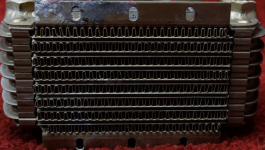
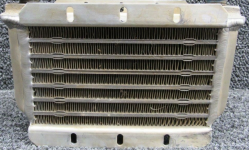
For grins and giggles - here're some pictures of identically sized units ; Which one do you think would cool more effectively? (answer below)...

Screenshot 2025-05-24 at 1.58.19 PM.png
Screenshot 2025-05-24 at 1.53.22 PM.png

No surprise - the unit in the last picture "cools" more effectively - with one less "row". It cools an IO-360-A1B6D w/piston squirters, operating in a ~144Ktas airframe...

I don't ever recall seeing a side by side comparison of heat exchangers from the various suppliers: Southwind/Stewart-Warner/Meggitt et al, AirFlow, Niagara-NDM, Aeroclassics, Mishimoto, Sertrab... Maybe I missed it..
 
Last edited:
Not doubting that, but the same 13 row cooler with 4" scat is used on the 10, with a 540, producing quite a bit more heat. That said, most 540's do not have piston squirters, but would have expected similar heat loads - 390 w/squirters & 540 without. I have never seen the math on exactly how much more heat goes to the oil with squiters, so probably not appropriate for me to make that statement. Lot of mystery here.
One piston cooling nozzles on my engine flow about 450 ml of 185 degree f, 20/50 weight oil at 70 lbs. of oil pressure in one minute. That's four quarts per minute. All most a gallon per minute just for the oil cooling nozzles.


Edit... Dan poinded out that it is about 1/2 of a gallon per minute. Two quarts per minute for four nozzles. My mistake.
 
Last edited:
Back
Top