exactly what I did with the O360 in my RV4
Thanks for the response. From my testing today, it took more than "slightly lean" to get the stumble to be reduced. I aggressively leaned to the point of engine roughness then enrichened slightly. This reduced the stumble quite a bit but it was still there.
 
1. The main jet is wrong. Causes the engine to be too rich at full throttle and idle ... hence the reason I lean out before takeoff because if I don't it's blubbering rich
this is probably by design though to help cool cylinders and prevent detonation at full power. do you have a way to measure fuel flow at take off? it should be in the specified range for the engine. our lycomings are liquid cooled at low airspeed.. despite what they say
 
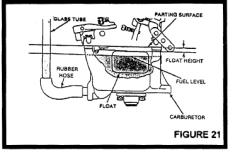
You can see the carb fuel level if you screw a fitting with clear plastic tube into the drain hole and route it vertically up. AI says it should be just below the mating/parting surface of the bowl and casting.
 
this is probably by design though to help cool cylinders and prevent detonation at full power. do you have a way to measure fuel flow at take off? it should be in the specified range for the engine. our lycomings are liquid cooled at low airspeed.. despite what they say
So you think the float level might need adjusting?
 
I said I'd report back. Here it is and what I found out today.

I called Temepst on Monday. They said to return it and they will bench test it. I have a trip planned this weekend and Summer has finally hit Canada so I don't want to pull the plane out of service for weeks. I may send it later. I have a 2 year warranty.

I pulled the carb apart before I re-installed it on the plane today. Things looked clean. The main jet is 47-830. I fly out of 3400 msl as a reminder. The accelerator pump is all internal and non-adjustable as far as I could see. There are no extra holes with which to change the fuel "shot"

I flew today and did as Larry suggested and did a bunch of testing.

Summary:

- idle mixture screw does nothing. I had it down to 1/2 turn out. Still starts, idles smooth but makes no change to the stumble

- inflight rapid advance of throttle with full rich - definite stumble !
- inflight rapid advance of throttle with aggressive lean - slight stumble. Much better !

- inflight slow advance of throttle with full rich - stumble still at 1500 RPM
- inflight slow advance of throttle with aggressive lean - slight stumble

- full Rich EGT's at 1500 RPM = 1235
- aggressive Lean EGT's at 1500 RPM = 1350

Ok so please share thoughts.

My 2 cents:

1. The main jet is wrong. Causes the engine to be too rich at full throttle and idle ... hence the reason I lean out before takeoff because if I don't it's blubbering rich

2. The float level is too high ... causing the engine to be too rich at both ends.

But what do I know ? I don't mind pulling the carb off again and adjusting the float level, but only if that is the consensus. Easy to do.

Thanks everyone.
Send it back. My guess is float level is too high or needle seat is flawed and not sealing properly. Both can raise the fuel height; your possible issue. Engine should be choking at 1/2 turn out on idle mixture. 1-1/2 - 2 turns is generally pretty close. this problem is making everything too rich. Should have seen at least upper 1400’s at cruise with aggressive leaning. Jets won’t make the idle too rich at 1/2 turn out. Has to be fuel height or issues in the bleed system.
 
Last edited:
Ahhh. Good idea. Easy way to check. Thanks
Don’t do that. This is a precision adjustment and 1/64” can make a difference. This must be done with the top removed and layed on the bench. Then a straight edge is used with a ruler. You need a drawing, like posted above showing the measuring reference point and the specified distance.
 
You can certainly check the float height if you have the correct drawings, but likely different specs for different variants. While float height is a logical culprit here, it is not the only thing that could be causing your symptoms. If you find it is out of spec, good chance that is your problem. Fix it then test it. There is a tiny little tab on the float arm that touches the needle base. Adjust that with pliers to get the correct height.
 
this is probably by design though to help cool cylinders and prevent detonation at full power. do you have a way to measure fuel flow at take off? it should be in the specified range for the engine. our lycomings are liquid cooled at low airspeed.. despite what they say
Disagree. He leaned all the way to peak and still got a stumble. That implies the carb balance system is out of spec and delivering too much fuel across the board.
 
You can see the carb fuel level if you screw a fitting with clear plastic tube into the drain hole and route it vertically up. AI says it should be just below the mating/parting surface of the bowl and casting.
Suggest avoiding ai to help solve engine issues. This is not how professionals measure fuel height, with the exception of carbs like holleys that have externally adjustable heights.
 
This may be completely unrelated, but I recently had an engine failure in flight and on the ground, some stumbling was observed going from idle to high power applications (simulated takeoffs). One day it happened consistently, the next day it did not.

Culprit was a combination of tired mechanical fuel pump (diaphragm was VERY loose but not cracked) and a gascolator leak from the plugged inlet hole that was likely sucking in air. We had no way of seeing this on the ground with the fuel evaporation on the blue gascolator. Ended up seeing the leak when my mechanic had his head in the engine compartment with the engine running.

Mech pump replaced and gascolator plug resealed with Sealube+tightened, no issues 10 hours flight time since. RV-9 IO-320-B1A.
 
I think you are experiencing an Idle transition flat spot. Or you might have a slight restriction in the idle circuit. The flat spot is quite common in MA4-5 carbs and I am surprised that others haven't chimed in and said they have or are experiencing the same thing to some degree. It happens on both 540's and 360's that use that model carb. It sounds insane but the only way I ever found of fixing it was to keep trying to exchange carbs until you found one that worked acceptably with the particular engine you had issue with. Believe it or not, then you could put the supposed bad carb on a different engine and guess what, no noticeable flat spot.... I found that the flat spot was always there but it's intensity was different with each installation. It might be so strong that it was scary and then on another engine so slight that you wouldn't notice it unless you were looking for it. Inspecting the carbs never turned up any defects whether they were overhauled by us, factory new or reman or even overhauled by other shops. The idle screw not having much effect can indicate problems with the idle tube being restricted and if its slightly restricted it might cause these issues as it fuel supply at idle then it transitions to air bleed at above the idle speeds. When its transitioning is when you are having your hesitation. Hope you solve your issue but if it were me, If the carb shop doesn't find any obvious defects in your existing carb upon inspection, I would ask for a different one and hope for the best.
Thinking about it maybe it has to do with the amount of load on the engine when you transition. That would effect the MP and it turn effect the way the fuel was being drawn from the carb. Different props, different loads. Don't know how you would prove or disprove that but maybe??? maybe not!
Hope you solve your issue!
Good Luck, Mahlon
 
Suggest avoiding ai to help solve engine issues. This is not how professionals measure fuel height, with the exception of carbs like holleys that have externally adjustable heights.

I have no knowledge of how "professionals" check fuel height. I do know that the external tube method is required by the SA4-5 Service Manual.

See section Test Procedure General, Float and valve Seat Test, which includes this Figure 21 -

figure 21.PNG
 
Last edited:
The flat spot is quite common in MA4-5 carbs and I am surprised that others haven't chimed in and said they have or are experiencing the same thing to some degree.

Yes, about 1,000 hours in the PA-28-180 that I used to own and that hesitation with rapid throttle advance was always there even after a carb overhaul. Only seen with rapid throttle advance so learned to advance the throttle at more moderate rates.

I formed the impression that the OP's hesitation was more severe than that.
 
You can see the carb fuel level if you screw a fitting with clear plastic tube into the drain hole and route it vertically up. AI says it should be just below the mating/parting surface of the bowl and casting.
DITCH AI! You are just asking for troubles. Pay someone that knows what they are doing and does this for a living. The little bit that it costs you is insignificant compared to what it could end up costing you. Two things you don't screw with...the fuel system and the ignition system.
 
DITCH AI! You are just asking for troubles. Pay someone that knows what they are doing and does this for a living. The little bit that it costs you is insignificant compared to what it could end up costing you. Two things you don't screw with...the fuel system and the ignition system.
I WHOLEHEARTEDLY AGREE!
 
The OP was warned really early on in this thread that he was out of his league and should consult a professional. This type of online troubleshooting by a non-professional, receiving non-professional and AI generated advice on such a critical component as a carburetor is crazy. His problem could be the carburetor or it could be something entirely different and a professional knows that. A professional also knows that the opportunity for MIF (maintenance induced failure) with this type of troubleshooting is incredibly high and if there is a failure it could be fatal to the OP. Not only is the OP out of his league, but any non-professionals continuing to throw “suggestions” out there need to reconsider their role in this thread and any similar threads that come along later. (The OP may come along in a few minutes and say “hey, that fixed it” which is potentially even more harmful bc that would then fall under the category of Normalization of Deviance which is another problem entirely.) I’m done, good luck.

 
The OP was warned really early on in this thread that he was out of his league and should consult a professional. This type of online troubleshooting by a non-professional, receiving non-professional and AI generated advice on such a critical component as a carburetor is crazy. His problem could be the carburetor or it could be something entirely different and a professional knows that. A professional also knows that the opportunity for MIF (maintenance induced failure) with this type of troubleshooting is incredibly high and if there is a failure it could be fatal to the OP. Not only is the OP out of his league, but any non-professionals continuing to throw “suggestions” out there need to reconsider their role in this thread and any similar threads that come along later. (The OP may come along in a few minutes and say “hey, that fixed it” which is potentially even more harmful bc that would then fall under the category of Normalization of Deviance which is another problem entirely.) I’m done, good luck.
Sorta like leading a horse to water.
 
The OP was warned really early on in this thread that he was out of his league and should consult a professional. This type of online troubleshooting by a non-professional, receiving non-professional and AI generated advice on such a critical component as a carburetor is crazy. His problem could be the carburetor or it could be something entirely different and a professional knows that. A professional also knows that the opportunity for MIF (maintenance induced failure) with this type of troubleshooting is incredibly high and if there is a failure it could be fatal to the OP. Not only is the OP out of his league, but any non-professionals continuing to throw “suggestions” out there need to reconsider their role in this thread and any similar threads that come along later. (The OP may come along in a few minutes and say “hey, that fixed it” which is potentially even more harmful bc that would then fall under the category of Normalization of Deviance which is another problem entirely.) I’m done, good luck.

I am one of “the non professionals” that “should reconsider their role in this thread” who suggested checking the fuel level with clear plastic tube and what AI indicated the level should be.

VAF is about mostly amateurs and some professionals discussing various aspects of building and maintaining experimental aircraft. VAF has threads with suggestions on all sorts of “professional” topics such as removing/replacing cylinders, modifying/reinforcing structures and installing/troubleshooting electrical and fuel systems. Assumed in these threads is that the amateur participants are inquisitive sensible people who like to first figure things out and who will consider the various suggestions so they can make a decision about what they can do and when a “professional” is required.

Two points regarding my specific suggestion.
1. Temporarily installing a fitting with a plastic tube to check the fuel level is a simple procedure that can even be done without removing the carb or starting the engine.
2. I specifically mentioned the fuel level was an AI suggestion because to my mind this implies caution and any sensible inquisitive person would do further research.
 
Last edited: