Frog Hobson
Active Member
Any updates?


That said, Here’s a few of the things a modern DeltaHawk engine provides:
Mechanical FI (fuel injection) and no EI (electronic Ignition). It’s a robust and simple system. And, yes - no mixture knob. Maybe that’s not a big deal to some, but I find it liberating (I fly both a lycoming RV14 and the DeltaHawk14). Would you be happy continually fiddling w the mixture knob in your modern car engine?
Water cooling vs air cooling: Allows for more consistent operating temps and closer tolerances in the build. My IO-390 burns about 1qt of oil for every 5 hours of operation - not unusual according to Lycoming. The DeltaHawk does much better. No shock cooling worries. No worries about managing temps on climb-out on hotter days.
No spark plugs or mags. Having just dealt with a misfiring plug on my Lycoming, and previously having to overhaul the PMags (after only 500 hours) I won’t miss this or the related costs.
Native Forced Air - the DeltaHawk is supercharged and turbo-charged as part of its basic design. The ability to produce full power regardless of the density altitude (to 17k’) is a huge benefit. I primarily fly in the mountains - where the benefit is obvious. But, even flat-landers can appreciate this when taking off on a hot day at gross weight.
How ‘bout that fuel efficiency. I’ve consistently seen 35-40% better fuel efficiency in the DH vs my IO-390. Even if one only flies 100 hours a year here’s some math:
Lycoming: 100 hrs x 10 gph = 1000 gals. $6/gal. $6000 on fuel.
DeltaHawk: 100 hrs x 7 gph = 700 gals. $5.50/gal. $3850 on fuel.
$2150/ year savings. Not to mention you’re probably burning less oil and have less maintenance (plugs, cost of annual, etc).
Note: I only used a 30% fuel savings in the example. Also, I generally find diesel $.75 to $1.00 cheaper than 100LL. Although the past couple months both have been horribly pricey.
All this said, will the DeltaHawk be a true alternative to the Lycoming? I don’t know - but, based on my experience w the engine and the company so far, I believe it will be. Will all this happen overnight. Clearly not. But, a lot of progress has been made to date and I’m excited for AirVenture to show this.
Finally, we’re working w SynergyAir on a true apples-to-apples comparison on the cost of purchasing and installing the DeltaHawk engine on the 14. I think most will be surprised at how price competitive the DH will be. DeltaHawk is planning to provide a complete, assembled, tested, and mounted engine with all the associated components (forced induction, radiators, starter, alternator, cowling, etc, etc.). I suspect when one actually compares the price of the lycoming with all the bits and pieces to achieve the same end result, the DeltaHawk may come out equal or less costly.
CJS

Rv10inOzHi Craig,
I do appreciate your commitment and enthusiasm, however I believe some comparisons are not entirely accurate or not mainstream equipment. Anyway just some food for thought.
1. Mechanical injection and no EI, well that's every stock Lycoming. Mind you Slick mags have been extremely low quality in the last 8 years, sadly. If you went modern with say an SDS system and it was properly set up (most are not) it will fly with zero mixture input if that is what you want, just like a car, hit the LOP button in the cruise....job done. And no moving parts in the ignition. No Pmag problems.
2. Holy oil burn Batman, 5 hours per quart! You have a problem there, I retired my 2400 hour IO540 (50% more cylinders and oil burn) when it got to 7 hours/qt. 13-15 hours or better is what I see in 390's.
3. No spark plugs.... that's a good point I guess.
4. Forced induction is a handy thing. A TN-IO390 would also be handy, I know where to find one or more.
5. Fuel efficiency. I keep reading this 40% less fuel. So that means 6 GPH vs 10 GPH. I conceded they will be less by volume and by mass, but can I run some numbers as "back of a beer coaster comparison". Using the DHK200 at 75% power with a claimed 8.3GPH and compared that to an IO390 at 150HP also, which should be 9.9 GPH, we have 16.16% less fuel by volume and by mass that is 55.61 vs 59.4 lbs per hour which is 6.38% less.
The big benefit is forced induction with altitude and getting a higher TAS, and yes you can, with a lot of effort turbo normalise any Lycoming/TCM if you wish, but I am keen to learn what the typical TAS is in the 8-12,000' range. Any higher and oxygen is really required and while that is cheap it is not free either. I would advocate using O2 above 8K for longer than an hour anyway, but those levels are quite common I guess. So what do you get?
All the best,

Rv10inOz
My comments are accurate and I stand by them. As for comparisons to mainstream equipment - my comments are generally directed to a ‘stock’ RV14 (although, that’s a moving target). But, I’d wager an SDS system is not all that common, certainly not as much as E-mags or Surefly.
As for your particular points above:
1. I agree, a quart every 5 hrs seems like a lot to me, but Lycoming told me to not worry unless it gets to 1quart every two hours. It’s been this way from zero hours (900 and counting right now).
3. Fuel efficiency. You may have a napkin, but I’ve put a lot of hours on both the DeltaHawk RV14 and the Lycoming RV14. I’ve published the numbers in this thread. They’re real, as is the generally lower cost of JetA vs 100LL. The DH fuel economy, and comparisons to the lycoming, varies based on a lot of factors - power setting and altitude being the two biggest. That’s why in my example above I used a 30% savings as a rough stand-in for overall gains.
4. On the benefits of forced induction and altitude - again I’m not sure if you had a point to make, a question for me, or both. On the latter, I did publish some numbers quite a ways back on performance at 10/11k msl (can’t recall which off the top of my head). The DH KTAS was approx 170 at 65”MP (approx 85” is full throttle). Fuel burn was approx 7.2 gph. I’d get about this same speed from my Lycoming just lean of peak, 2400 rpm, burning approx 10.0 gph.
The DH numbers improve with altitude.
As for oxygen - yes, it’s a cost. I use Pure Meds Inogen O2 generator. About $2k for the unit and one gets unlimited O2 (there are no bottles to refill) to 18k msl. I do mostly XC trips, mostly over mountains, so this set-up was a no brainer for me.
All the best.
Thanks for the info re the oil consumption. I hadn’t asked around enough to know whether mine is abnormal - but, it appears it isn’t.It seems it hit and miss with oil consumption with a 390-angle valve engine or some are not remembering the oil added. Having piston squirters I was told has some bearing on oil consumption but yes, I've talked with several owners of RV's with the 390 av engines and yes 5 hrs. per qt is not unusual. I don't get to much more than that (7-8) and after over 800 hrs compression is still 78+/80 cold. My hangar mates 14 got around 5 and he was convinced he must have glazed his cylinders but after multiple borescope inspections did not see anything. His airframe now has over 1,500 hrs. on it and still has excellent compression. Now if we can only figure out the sticky valve issue.
Congrats on flying this airframe as much as you do. I saw a few months ago one of your longer XC's (Over 7 hrs. West Texas to South Florida non-stop) with a slight tailwind and getting over 180 knots ground speed! Not sure if you have ER tanks but that seems quite a feat! Remarkable. I believe your 30% and thanks for being one of the first to test this engine in RV's.

Didn't mean to be a lurker just nice to see someone flying (over 50 hrs. last 2 1/2 months) and gathering data on a new engine design! I am looking forward to when more complete data will be posted. (As others are I am sure)Thanks for the info re the oil consumption. I hadn’t asked around enough to know whether mine is abnormal - but, it appears it isn’t.
Side note - I have ICAO ‘masking’ so supposedly my flights are anonymous. I’m guessing not so much!
No worries - I was more meaning I apparently haven’t sorted out the whole ICAO protocol as I’m never sure whether it’s actually masking or not.Didn't mean to be a lurker just nice to see someone flying (over 50 hrs. last 2 1/2 months) and gathering data on a new engine design! I am looking forward to when more complete data will be posted. (As others are I am sure)
How many hours have this engine flow in total? Looks like it's been fairly reliable for a new engine set-up.
Rv10inOz
My comments are accurate and I stand by them. As for comparisons to mainstream equipment - my comments are generally directed to a ‘stock’ RV14 (although, that’s a moving target). But, I’d wager an SDS system is not all that common, certainly not as much as E-mags or Surefly.
As for your particular points above:
1. I agree, a quart every 5 hrs seems like a lot to me, but Lycoming told me to not worry unless it gets to 1quart every two hours. It’s been this way from zero hours (900 and counting right now).
2. Not sure what your point is on the TNIO-390? I’m not aware they’re generally and readily available. But, even if they were the DeltaHawk has significant advantages in fuel economy and simplicity.
3. Fuel efficiency. You may have a napkin, but I’ve put a lot of hours on both the DeltaHawk RV14 and the Lycoming RV14. I’ve published the numbers in this thread. They’re real, as is the generally lower cost of JetA vs 100LL. The DH fuel economy, and comparisons to the lycoming, varies based on a lot of factors - power setting and altitude being the two biggest. That’s why in my example above I used a 30% savings as a rough stand-in for overall gains.
4. On the benefits of forced induction and altitude - again I’m not sure if you had a point to make, a question for me, or both. On the latter, I did publish some numbers quite a ways back on performance at 10/11k msl (can’t recall which off the top of my head). The DH KTAS was approx 170 at 65”MP (approx 85” is full throttle). Fuel burn was approx 7.2 gph. I’d get about this same speed from my Lycoming just lean of peak, 2400 rpm, burning approx 10.0 gph.
The DH numbers improve with altitude.
As for oxygen - yes, it’s a cost. I use Pure Meds Inogen O2 generator. About $2k for the unit and one gets unlimited O2 (there are no bottles to refill) to 18k msl. I do mostly XC trips, mostly over mountains, so this set-up was a no brainer for me.
All the best.
RV10inOz,Hi Craig,
I will wager there are more SDS systems that never have the problems and failures the E-mags and Surefly have if not by volume by far by percentage.....I get the pleasure of seeing dozens and dozens across experimental and certified aircraft. Those in the know would back me on this. The folk at Superior Airparts here in Australia had a 40% failure rate of Surefly and that lines up with my smaller sample size too. They may be better now, I would SUREly hope so.
Point 2 was merely if you wanted high DA performance you could do exactly that. The TN version does exist but it is not published, and it is a large powerful 4 letter group paid for by your taxes. ;-) I expect it will be available later because it solves that aircrafts DA performance problems.
Point 3........ The sense of humour was lost here I see. Sorry about that. You can take my numbers to the bank. For clarity "Using the DHK200 at 75% power with a claimed 8.3GPH and compared that to an IO390 at 150HP also, which should be 9.9 GPH, we have 16.16% less fuel by volume and by mass that is 55.61 vs 59.4 lbs per hour which is 6.38% less."
Please explain how that is at odds with 30-40% claims? I know how you could fake the numbers for publicity, use the IO390 at full rich and that is a definite 40% saving. For clarity, at a BSFC of 0.56-0.58 and 150HP the fuel burn is 14.1-14.6 GPH, compared to the 8.3 then that is 41-43% saving in GPH for sure. It is not hard to use the red knob and achieve a BSFC of 0.39-0.395 range (commonly called appropriately LOP) and that is what I posted above.
As my dear friends Walter Atkinson and John Deakin would often say, the data has no opinion. In God we trust, everyone else must bring data and it needs to be honest data.
Have a good day.
PS new post today, yet another one https://vansairforce.net/threads/surefly-sim4p-failure.244228/
Just ignore him, Hang in there and test on!!RV10inOz,
Wow. Its not every day one gets called out as being a liar - especially in a large public forum. I ask that you retract that inference.
Have a good day.
Never called you a liar at all. If I did I would apologize in a heartbeat. Play the ball not the man.RV10inOz,
Wow. Its not every day one gets called out as being a liar - especially in a large public forum. I ask that you retract that inference.
That request aside, the numbers I published are accurate, and obtained from my personal flight tests in the prototype DeltaHawk RV14. Should you actually read my posts, you will find I generally noted the conditions of the flights (speed, altitude, mixture setting, etc) that generated the data. Different conditions yielded varying results. Its why I used the 30% fuel efficiency gain for my overall calcs. You might want to reach out to DeltaHawk regarding thier published numbers - I dont have insight, nor control, over them. Possibly, they were conservative on them?
That said, I am not sure what you think my motivation is to 'fake numbers for publicity'. I have no financial interest in DeltaHawk. Quite the opposite, this project has cost me significantly in actual out-of-pocket costs and personal time. My motivation is the same as it always has been - to find an alternative to the Lycoming, and hopefully one that is more fuel efficient, runs on fuel that isn't in danger of being regulated out of existence, is less costly to maintain, and performs better (than the Lycoming) at higher density altitudes (where most of my flying happens - due to either dealing with mountains, hot OATs, or both). BTW - I don't dislike the Lycoming. But, maybe there could be something better - at least for my personal flight preferences. Beyond that, it would be nice to see some competition in the space. We have precious few options right now and that doesn't tend to development incentives and competitive pricing.
On your other points:
SDS vs e-mags, SureFly, etc. I couldn't care less. You introduced the comparison and I am not sure why you're going on about it. My point was to say I was comparing the DH set-up to a typical RV14 config - even though its hard to nail down exactly what that config looks like. Basically, the comparision numbers I have published have been based largely against my IO-390 Thunderbolt (compression bumped .5), with dual P-Mags, that has an estimated Hp of just over 220. It also has a modified Sam James cowling that improved top speed (or efficiency if you like) from 214 to 221 mph (189 KTAS to 192 KTAS) down close to sea-level. The point being that the Lycoming RV14 that I am using for comparision is probably in the ballpark of being a typical RV14. Folks can insert thier own numbers based on thier own plane's performance for comparison. Again, I've been very transparent on mine.
TN IO-390. Personally, I don't 'merely' desire DA (density altitude) performance improvement. Implying this as a prime motivation under-values the efficiency and simplicity of the DH design. And, it uses readily availble diesel or JetA. Regardless, if the Lycoming TN's are available its always good to have another engine option. Though, my experience the past 5 years is wait times for Lycomings suck, and I suspect if a TN was available it'd be priced much higher than the DeltaHawk.
Yes, the data has no opinion - it appears those presenting it do, though. I believe the DeltaHawk numbers will become apparent to everyone soon enough. Both the RV14 and the Piper twin should be at AirVenture this year. And, DH says they will begin shipping engines later this year - so, we should start to see others generating data.
Have a good day.
OZ,As I said in my previous post I can see perfectly how you would operate an IO390 and achieve a ridiculously high fuel burn, that is not saying you or anyone is telling lies at all. But it is a dit disingenuous when not comparing apples with apples don’t you think?
"""" Using the DHK200 at 75% power with a claimed 8.3GPH and compared that to an IO390 at 150HP also, which should be 9.9 GPH""" This is posted above by RV10inOzRV10inOz,
Wow. Its not every day one gets called out as being a liar - especially in a large public forum. I ask that you retract that inference.
That request aside, the numbers I published are accurate, and obtained from my personal flight tests in the prototype DeltaHawk RV14. Should you actually read my posts, you will find I generally noted the conditions of the flights (speed, altitude, mixture setting, etc) that generated the data. Different conditions yielded varying results. Its why I used the 30% fuel efficiency gain for my overall calcs. You might want to reach out to DeltaHawk regarding thier published numbers - I dont have insight, nor control, over them. Possibly, they were conservative on them?
That said, I am not sure what you think my motivation is to 'fake numbers for publicity'. I have no financial interest in DeltaHawk. Quite the opposite, this project has cost me significantly in actual out-of-pocket costs and personal time. My motivation is the same as it always has been - to find an alternative to the Lycoming, and hopefully one that is more fuel efficient, runs on fuel that isn't in danger of being regulated out of existence, is less costly to maintain, and performs better (than the Lycoming) at higher density altitudes (where most of my flying happens - due to either dealing with mountains, hot OATs, or both). BTW - I don't dislike the Lycoming. But, maybe there could be something better - at least for my personal flight preferences. Beyond that, it would be nice to see some competition in the space. We have precious few options right now and that doesn't tend to development incentives and competitive pricing.
On your other points:
SDS vs e-mags, SureFly, etc. I couldn't care less. You introduced the comparison and I am not sure why you're going on about it. My point was to say I was comparing the DH set-up to a typical RV14 config - even though its hard to nail down exactly what that config looks like. Basically, the comparision numbers I have published have been based largely against my IO-390 Thunderbolt (compression bumped .5), with dual P-Mags, that has an estimated Hp of just over 220. It also has a modified Sam James cowling that improved top speed (or efficiency if you like) from 214 to 221 mph (189 KTAS to 192 KTAS) down close to sea-level. The point being that the Lycoming RV14 that I am using for comparision is probably in the ballpark of being a typical RV14. Folks can insert thier own numbers based on thier own plane's performance for comparison. Again, I've been very transparent on mine.
TN IO-390. Personally, I don't 'merely' desire DA (density altitude) performance improvement. Implying this as a prime motivation under-values the efficiency and simplicity of the DH design. And, it uses readily availble diesel or JetA. Regardless, if the Lycoming TN's are available its always good to have another engine option. Though, my experience the past 5 years is wait times for Lycomings suck, and I suspect if a TN was available it'd be priced much higher than the DeltaHawk.
Yes, the data has no opinion - it appears those presenting it do, though. I believe the DeltaHawk numbers will become apparent to everyone soon enough. Both the RV14 and the Piper twin should be at AirVenture this year. And, DH says they will begin shipping engines later this year - so, we should start to see others generating data.
Have a good day.
True, but to be fair HP to make a speed in similar airframes is a fair comparison."""" Using the DHK200 at 75% power with a claimed 8.3GPH and compared that to an IO390 at 150HP also, which should be 9.9 GPH""" This is posted above by RV10inOz
CJS is running the numbers for the DH180 and RV10inOZ is running the number for the DH200.
CJS posted his numbers toward the bottom of page 8.
75% of 180hp is 135hp and the fuel consumption list on Deltahawks page that is 7.3gph. The numbers for 30% more fuel are this: 7.3X1.3=9.49.
It seems to me that at altitude the Deltahawk would run better with a super charger and turbocharger. But I am far from a mechanic.
""""I am curious as to how anyone can be appropriately LOP as mentioned above at 12,000' and running 9.9GPH. I get that on IO540 RV10's, so it sounds ROP to me or around 55% power say 116HP. But like Craig above I am using my memory and maybe that's fuzzy.""""True, but to be fair HP to make a speed in similar airframes is a fair comparison.
Craig has stated he gets 7.3 vs 9.9 and that is what I wanted to know. Maybe the DH webpage data is far too conservative. But now we have an answer to my enquiry.
I am curious as to how anyone can be appropriately LOP as mentioned above at 12,000' and running 9.9GPH. I get that on IO540 RV10's, so it sounds ROP to me or around 55% power say 116HP. But like Craig above I am using my memory and maybe that's fuzzy.

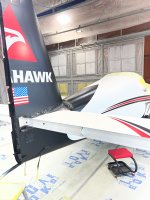
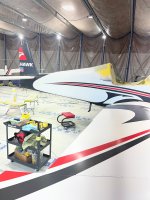
Cutting it close - but, Fulltron should have the paint completed in a few days.

Twice as good.DeltaHawk Twin
This is what has been stealing some bandwidth from the RV14 project recently. It’s the first flight (yesterday) of the DH Piper Twin. Sounds about as good as the RV14!
Love the black smoke on start up..........DeltaHawk Twin
This is what has been stealing some bandwidth from the RV14 project recently. It’s the first flight (yesterday) of the DH Piper Twin. Sounds about as good as the RV14!

And more on climb out than I would have expected. Don’t recall seeing that much smoke on the 14. Any ideas Craig?Love the black smoke on start up..........
It was in B-52 mode.And more on climb out than I would have expected. Don’t recall seeing that much smoke on the 14. Any ideas Craig?
Guess so.It was in B-52 mode.
I noticed it as well, the only reason a diesel should smoke is if it's getting more fuel than it can burn completely. I'd guess the fuel metering needs an adjustment.Guess so.
It’s more than a passing interest, as I am hoping to install the DH on the RV-15 I’m trying to build.
I wish you luck with that. I also have a DH deposit but I am guessing that the DH will not be available for purchase and delivery in the time it takes to build the -15…Guess so.
It’s more than a passing interest, as I am hoping to install the DH on the RV-15 I’m trying to build.
I’m going to need a lot of luck. Between my desire to flush rivet this plane, getting the right parts and kits delivered, finding an acceptable and affordable CherryMax replacement plus the DH challenges - I figure it’s less than 50/50 that I’ll get this done.I wish you luck with that. I also have a DH deposit but I am guessing that the DH will not be available for purchase and delivery in the time it takes to build the -15…

No skills or talent? Obviously, he hasn't seen your previous work!I’m going to need a lot of luck. Between my desire to flush rivet this plane, getting the right parts and kits delivered, finding an acceptable and affordable CherryMax replacement plus the DH challenges - I figure it’s less than 50/50 that I’ll get this done.
And I’ve been told by an RV “expert” that I have no skills and no talent - so there’s that
Thanks. Hoping to flush rivet the entire plane. I will have help bucking/riveting.No skills or talent? Obviously, he hasn't seen your previous work!
You planning on flush riveting spar forward or trying to do the whole thing?
I will tell you that riveting/bucking those -12 rivets was...challenging. Not sure it would be as successful trying to do it solo.
Not sure how you would buck the rivets along the aft flange in the first four bays of the wing; there is zero access there. This would be the line of rivets that is between the front side of the fuel tank and the aft side of the spar web.Thanks. Hoping to flush rivet the entire plane. I will have help bucking/riveting.