I partially agree, as we will address some of the planes I discussed:
RV-4 with Rotax 915 engine = At least two examples are flying in Germany, and the adaptation kit is available for sale.
RV-4 with Rotax 912 engine = At least one example exists in Italy, but there is no further information about it.
RV-9 with Rotax 915 or 916 engines has been an ambitious project being worked on in the USA.
An RV-12 with a 120hp engine already has several examples with the Jabiru 3300; I just added the idea of a smaller wing, or perhaps a wing from the RV-4 (if possible), and a more aerodynamic plexiglass.
OK. What’s your point? You aren’t treading new territory. There’s also an RV-8 with a radial engine, quite a few of various models with automotive conversions, diesels, and a turboprop RV-10. Are you looking for some kind of moral support or validation of a potential build decision?
 
OK. What’s your point? You aren’t treading new territory. There’s also an RV-8 with a radial engine, quite a few of various models with automotive conversions, diesels, and a turboprop RV-10. Are you looking for some kind of moral support or validation of a potential build decision?
Well, I want to have an RV — that's my first and main point.
But I need to reduce costs as much as I can.
An RV-8 with 200 hp and an inverted flight system would be a dream, but I need to be more economical.
An experimental RV-12 with the original design and a 912 engine would be an interesting alternative, but I’d like a bit more speed.
I think the RV-4 is wonderful, but as people have already told me here on the forum, it’s not possible for two people weighing 100 kg (220 lbs) each to fly together in one. And my wife and I weigh more than that.
My alternative would be to try an RV-12 with a bit more power — and maybe new wings.
That's my point.
 
Well, I want to have an RV — that's my first and main point.
But I need to reduce costs as much as I can.
An RV-8 with 200 hp and an inverted flight system would be a dream, but I need to be more economical.
An experimental RV-12 with the original design and a 912 engine would be an interesting alternative, but I’d like a bit more speed.
I think the RV-4 is wonderful, but as people have already told me here on the forum, it’s not possible for two people weighing 100 kg (220 lbs) each to fly together in one. And my wife and I weigh more than that.
My alternative would be to try an RV-12 with a bit more power — and maybe new wings.
Well you do realize that you could fly an RV-8 with an IO-360 more economically by just using less throttle and/or LOP in cruise, right? The bonus is you have max power when you need it. Plus no rolling your own FWF package required. Which by the way is more involved than you probably realize. IMO better to select a standard kit or a proven aftermarket solution that meets the majority of your mission requirements vs holding out for the perfect option. Of course you could opt to create that one-off design, like the aforementioned radial RV-8, but it’s something that the average builder, myself included, would never attempt because of the time, effort, and lack of necessary skills. Most of us would rather settle and be flying than spend countless hours in the shop chasing the end of a rainbow.
 
Last edited:
From my perspective your ideas have some merit, but only with a Rotax engine. Please research the reliability of Jabiru products vs Rotax before thinking of using their engines.
There are a couple of factors to be aware of when trying to scale existing designs, people don't scale and neither do handling qualities. The cockpit must be as large as an RV-8 to contain RV-8 size people. If you are aiming at RV-4 sized people then start with an RV-4 sized airframe. The back end will have to be the size it needs to be to provide adequate flying qualities - which will have to be calculated in the first instance and then flight tested - and is likely to be larger than 10% less than an RV-8. Then the structure and fore-aft wing position needs to the thought about. No point in using an RV-8 sized spar if the loads are 10% less (are they, really?). If the engine is 100lb lighter then it makes sense to move the wing back rather than engine forward, and if the fuel burn is less the tanks can be smaller, and perhaps a different wing section might be worthwhile... and so on, but two people weigh the same and want the same amount of baggage. Quite soon there isn't much RV-8 remaining and the parts that are just constrain what you really want to do. Perhaps an RV-4 wing and back end with a new fuselage might be a better way to achieve your aim? Either way a lot of time from aeronautically smart people will be required to make a the project a reality. If you want to lead such a project, brilliant! Start setting your design goals and gathering a team around you, but don't underestimate the challenge you have set yourself.
Pete
 
From my perspective your ideas have some merit, but only with a Rotax engine. Please research the reliability of Jabiru products vs Rotax before thinking of using their engines.
There are a couple of factors to be aware of when trying to scale existing designs, people don't scale and neither do handling qualities. The cockpit must be as large as an RV-8 to contain RV-8 size people. If you are aiming at RV-4 sized people then start with an RV-4 sized airframe. The back end will have to be the size it needs to be to provide adequate flying qualities - which will have to be calculated in the first instance and then flight tested - and is likely to be larger than 10% less than an RV-8. Then the structure and fore-aft wing position needs to the thought about. No point in using an RV-8 sized spar if the loads are 10% less (are they, really?). If the engine is 100lb lighter then it makes sense to move the wing back rather than engine forward, and if the fuel burn is less the tanks can be smaller, and perhaps a different wing section might be worthwhile... and so on, but two people weigh the same and want the same amount of baggage. Quite soon there isn't much RV-8 remaining and the parts that are just constrain what you really want to do. Perhaps an RV-4 wing and back end with a new fuselage might be a better way to achieve your aim? Either way a lot of time from aeronautically smart people will be required to make a the project a reality. If you want to lead such a project, brilliant! Start setting your design goals and gathering a team around you, but don't underestimate the challenge you have set yourself.
Pete
Pablo---I see where you are coming from. All great ideas come from collecting little ideas from others. YES, you can do what you are saying, IF you have the talent and resources. I certainly didnt with my crazy idea, other than the plumbing. So, for me the consensous of opinion was that I had bumped my head. One well respected aeronautical engineer actually took more than 2 minutes while thinking about it. Out of that crazy idea came something that several others can use. So while I get what youre doing, sometimes its out of our range to be able to make it happen.
As for the Rotax thing, Rotax is the go-to engine in Europe, not necessarily in the US--YET. With new Lycomings pricing, builders are looking to find alternatives.
 
we have a saying here that goes something like this:‘Intelligent people talk about ideas, average people talk about daily events, and mediocre people talk about other people’s lives.’

Wasn't it Eleanor Roosevelt who said "Great minds discuss ideas; average minds discuss events; small minds discuss people"...

Strange engagement strategy for what? For what reason? I'm sensing a tone of mockery in this thread.

I think it's for two reasons.

One: VAF never gets too deep into airplane design. Some people have created amazing mods for their RVs - unusual engines, tapered wings, retractable gear, jump-seats, open cockpits - but they don't really talk about them here during the design phase, they usually just do it and reveal it when it's almost done.

The other reason is the AI-generated images. Let's face it, the internet is currently drowning in AI slop, so when many of us look at an AI image, we imagine that the person behind it has no idea what they're talking about and is either too lazy or not knowledgeable enough to communicate their ideas using more traditional means. Because I personally also enjoy thinking about franken-planes and theorizing about super-modified RVs (and EZs and other models), I'm working to see past the AI slop that you're posting, and to look at your ideas, which are... mostly not good, in my opinion, but interesting to think about (and a couple of them are borderline good). So, if instead of posting AI pictures, you drew 3-views of your proposed designs, that would help people see that you're thinking about these things seriously. Lots of people, myself included, get turned off by statements like "I asked the AI to generate a top view of an RV-12 with RV-4 wings" and by the crappy result: an airplane that has no flaps and that has a conventional stabilizer+elevator tail instead of a stabilator, tapered instead of rectangular, etc. Would it have taken so long to find a top view of an RV-12 and change the wings in the image? (The wings are rectangular! So easy!)

And that's just the most recent example. The RV-10 with the push/pull configuration was impossible to take seriously... because of how you presented it. Now, if you had a modified side-view line-drawing of an RV-10, showing where both engines go, and showing how you moved the location of the fuselage relative to the wings and gear to keep the CG in the right place given the modified engine layout, THAT would be far easier to take seriously, as opposed to AI slop. (And then you posted a side view of an engine mounted inside a cowling... and a second engine basically hovering in the air in front of the first one, without even a sketch of the mounting tubes that would be needed to hold it there). Again, I know that your posts are in good faith and that your ideas are interesting, but it's hard to see that when you post AI-generated images.

Start off by tracing the side views and top views of the airplanes that you are interested in (RV-12 and RV-4 to start, maybe), you can do it in PowerPoint or Paint or pencil-and-paper or whatever, and then make copies of the files (or of the papers) and modify those. That would be my recommendation for being taken seriously. (And if the images are very hard to modify - if this wing doesn't really fit into that airplane, if this engine doesn't really fit into that cowling - then this is one way to know that your idea would not be easy to do). Or, for extra credit: use CAD!

And keep in mind where the CG goes. No, you can't simply move RV-12 seats aft or the CG will get too far aft... unless you have a heavier engine up front, in which case it helps to move the seats aft. And for bonus points, remember where the spar goes through the fuselage: Is it behind the seat like an RV-12 or are you sitting on it like on all the other RVs? If you move the RV-12 seats aft, where do you put the spar? Maybe buy the PDFs of the plans/drawings so that you see how these airplanes actually go together. The RV-12 wing is attached to the fuselage in a way that is completely different from all the other RVs. You'd have to redesign a massive amount of structure if you wanted to put the wing of another RV into an RV-12 (or vice versa).

Have fun...

 
Last edited:
Wasn't it Eleanor Roosevelt who said "Great minds discuss ideas; average minds discuss events; small minds discuss people"...
This is one of those quotes that goes back a long way, and various people have said it in various forms.

It's a good line, but don't fall into the fallacy of affirming the consequent. Perhaps great minds discuss ideas, but that doesn't mean that discussing ideas makes someone a great mind. Nor does it mean that a discussion purely about ideas ("what if this airplane existed?") is better than a discussion about things or events ("I built this airplane"). Here at VAF, we tend to be much more interested in the latter.

Well, I want to have an RV — that's my first and main point.
But I need to reduce costs as much as I can.
This might be the root of the issue. Building an airplane is expensive, yes, but designing an airplane is likely to be an awful lot more expensive in both time and money. The cheapest entry into experimental airplane ownership is usually to buy something already-flying with an older engine and avionics. Next most expensive is building something new yourself. Extremely expensive and difficult is designing something new from scratch. Van himself built the RV-1 by starting with an already-flying Stits Playboy and replacing the engine, then later rebuilding the wing. Only after that did he start on the clean-sheet design for the RV-3. Seems like a better path than endless "what-ifs"...
 
Wasn't it Eleanor Roosevelt who said "Great minds discuss ideas; average minds discuss events; small minds discuss people"...
Thanks for the information, I really didn't know the author of the phrase.

The other reason is the AI-generated images. Let's face it, the internet is currently drowning in AI slop, so when many of us look at an AI image, we imagine that the person behind it has no idea what they're talking about and is either too lazy or not knowledgeable enough to communicate their ideas using more traditional means. Because I personally also enjoy thinking about franken-planes and theorizing about super-modified RVs (and EZs and other models), I'm working to see past the AI slop that you're posting, and to look at your ideas, which are... mostly not good, in my opinion, but interesting to think about (and a couple of them are borderline good). So, if instead of posting AI pictures, you drew 3-views of your proposed designs, that would help people see that you're thinking about these things seriously. Lots of people, myself included, get turned off by statements like "I asked the AI to generate a top view of an RV-12 with RV-4 wings" and by the crappy result: an airplane that has no flaps and that has a conventional stabilizer+elevator tail instead of a stabilator, tapered instead of rectangular, etc. Would it have taken so long to find a top view of an RV-12 and change the wings in the image? (The wings are rectangular! So easy!)

And that's just the most recent example. The RV-10 with the push/pull configuration was impossible to take seriously... because of how you presented it. Now, if you had a modified side-view line-drawing of an RV-10, showing where both engines go, and showing how you moved the location of the fuselage relative to the wings and gear to keep the CG in the right place given the modified engine layout, THAT would be far easier to take seriously, as opposed to AI slop. (And then you posted a side view of an engine mounted inside a cowling... and a second engine basically hovering in the air in front of the first one, without even a sketch of the mounting tubes that would be needed to hold it there). Again, I know that your posts are in good faith and that your ideas are interesting, but it's hard to see that when you post AI-generated images.

Have fun...
I didn’t go deeper into the Push-Pull concept because it would really require a completely new aircraft.
But the RV-10 with two 915s in tandem driving two independent contra-rotating propellers — that one I took further.
And since the AI didn’t help me, I made a hand-drawn sketch.

1751425485502.png

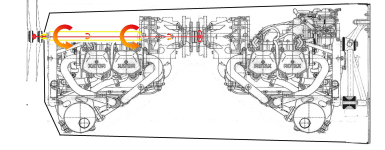
How to install two Rotax 900-series engines and connect them to contra-rotating propellers with minimal work
Note:
This is a simple, unrefined sketch — not focused on aesthetics — but it clearly illustrates the concept and shows exactly how the setup can be achieved.

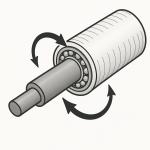
This system features two Rotax engines mounted face-to-face. The engine on the right (Engine 1) is fixed to the aircraft’s firewall and has an internal shaft (shown in red) that passes through the tubular shaft of the left engine (Engine 2), driving the front propeller — the one farthest from the engines. Engine 2 has an external tubular shaft that surrounds Engine 1’s shaft and drives the rear propeller — the one closest to the engines. Since the engines are mirrored, they rotate in opposite directions, creating a contra-rotating propeller system without the need for gearboxes or transmission mechanisms. To make this design feasible, Engine 2’s intake manifolds had to be modified to allow space for the passing shaft.

Two Rotax 915s are slightly lighter than an IO-540, but they are longer, and with the engine mount properly positioned, the CG would remain in the correct place.
When both engines are running, the torque would cancel out, making the aircraft easier to fly.
And even if the RV-10 loses one of its engines, I believe it could still remain airborne with the 140 hp of the Rotax 915, or with the 160 hp of the Rotax 916.

In another forum, someone asked me the following:
You're going to need to change more than the manifolds.

Look at where the engine mounts are. It's got a rear engine mount, not a cradle mount.

You're also going to need to bolt the two engines together solidly, you do not want to allow them to vibrate in two separate units. If they vibrate as two separate units, the concentric driveshafts will contact. And that'd be destructive.
and i reply:
Yes, the engines need to be very well secured.
But remember that an engine running at 5000 RPM generates less vibration than one running at 2500 RPM.
And I think we should have at least two bearings between the shafts to ensure they don't come into contact

1751426817069.png
I believe we have a great opportunity to build a very safe and low-cost twin-engine aircraft.
It's worth noting that an RV-10 could easily maintain flight with just one 160hp Rotax engine.


And best of all, inspired by a legend of aviation. 😊

But as many have already said, modifications to the designs are expensive
So I think the solution will be to find an RV-4 or RV-6, which are the RV models you can get for the lowest prices here in Brazil, and be happy.
In the case of the RV-4, it would be good for two reasons: I prefer tandem-seat RVs, and we would also be forced to lose some weight and take better care of our health (my wife and I).


I want to publicly apologize here on the forum — because even though translators exist, there are still many barriers that go beyond language.
The idea we Brazilians often have about the American aviation community is that you're constantly testing new things — and that idea is mistaken.
Either way, thank you all for the discussion, because even criticism can be valuable.

My best regards to all!
 
Last edited:
Well, I want to have an RV — that's my first and main point.
But I need to reduce costs as much as I can.
An RV-8 with 200 hp and an inverted flight system would be a dream, but I need to be more economical.
An experimental RV-12 with the original design and a 912 engine would be an interesting alternative, but I’d like a bit more speed.
I think the RV-4 is wonderful, but as people have already told me here on the forum, it’s not possible for two people weighing 100 kg (220 lbs) each to fly together in one. And my wife and I weigh more than that.
My alternative would be to try an RV-12 with a bit more power — and maybe new wings.
That's my point.
I think you are looking for an RV-9 with an IO-320 and constant speed prop. It would have room for you +1 and baggage, economy cruise or decent speed depending on the day. It would be a known starting point for your adjustments or modifications. There is already Rotax powered RVs and already clipped wing RVs. Best of luck to you in your quest
 
Last edited:
The idea we Brazilians often have about the American aviation community is that you're constantly testing new things — and that idea is mistaken.

I wouldn't go that far. It's just that, for every person who is experimenting, there are hundreds of people who just want a reliable and unproblematic flying machine. When you come to a forum of people who are building very polished kits like RVs, you'll mostly see people who follow the very good advice of "Just build it per the plans". Meanwhile, Van's is working the RV-15, Sonex is working on a two-seat jet and just flew their new high-wing design, and individuals are designing and building record-breaking racers and tail-less LSAs and ultralights or enjoying their RVs with twin engines or retractable gear or tapered carbon-fiber wings or turboprop engines... and that's not even including Mike Patey... or whatever the heck this is ;)

Question for you: If you want an airplane that is (1) fast, (2) relatively inexpensive, and (3) a well-proven design, then: Why not a VariEze? Why not a Sonex? Why not a Sonerai? Why not a Thorp T-18? You can buy a finished one (of any of those) for less than half the cost of an RV, or you can plans-build them from scratch which is much less expensive than buying a nice kit (and there are suppliers for the hardest-to-make parts). They are not super roomy, but that's the price for fuel efficiency. They require more work to build than an RV, but they require less work to build than the work you'd need to invest into modifying an RV in the ways that you've been talking about. And all four are aerobatic, too. The VariEze was the original fast, efficient cruiser (A VariEze with a Rotax would be outrageously fuel-efficient, and with a 915 or maybe even 914 it would probably cruise almost at VNE, 195 mph)... the Sonex is offered by a company that is still in business and offers support (and apparently it can do 170mph on the right engine... not quite as fast as a VariEze but faster than a 130hp RV-12 which can only do 145)... the Sonerai is tube-and-fabric (i.e. less expensive) and is also supported by Sonex (and with a few doable modifications, and a Rotax 912, you could turn a Sonerai into a 195 mph airplane with literally record-setting fuel efficiency)... and the T-18 is basically like an RV but requiring more fabrication work and fewer dollars (and, of course, ends up looking a little more clunky). You say you want an RV, but the combination of speed and efficiency and low-cost that you want is not what RVs are best at (although the 9 comes close).
 
Last edited: