Van's Air Force

The definitive Van's Aircraft support community! Buying, building or flying an RV? Join our exclusive family of mentors and enthusiasts!

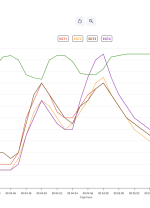
Engine Miss/Surging CHT/EGT Graph

I belong to a financial forum where people get to ask anons portfolio questions.

Moderators point out, and rather insist for questions to be layed out in a standard fashion.

I think this forum would be well served with developing a standard format to present questions .

The first post by the OP should have included this massive mag drop as a piece of the puzzle. Kind of required info and many people would not have gone down the dirty fuel system pathway if this bit of aviation 101 info had been known.
 
I did more engine runs yesterday and the symptoms were back. I have the CSV file, but it looks just like the top graph in my original post. I have noticed that my right mag might be shot. It has been dropping about 300 RPM when doing the mag check at about 1500-1600 RPM. I assumed it may be a fouling problem with a rich mixture but over the days of ground runs, nothing has helped. Today I removed the #4 and #1 fuel nozzles, cleaned them both, and swapped their positions. (#1 is now on the #4 cylinder) I also removed and cleaned all 4 top spark plugs. (The right mag plugs) They looked bad; black and wet. Put them back in and did more ground runs at various RPM and mixture combinations. No joy. Mag check showed the right mag would drop 300+ RPM and of course the engine felt horrible. All the symptoms we have been discussing above were back in the same random affair. A quick look at the CSV graph showed the issue did not follow the swapped fuel nozzles; #4 is still the anomaly.

I am guessing I will be removing that mag and sending it to EMag and see what gives.
300 rpm mag drop certainly points to potential issues with ignition. Very possible there is a problem with the #4 post in the mags distributor cap. I would put an ohm meter on the problem wire and plug. The black and wet plugs are a concern, but that would be somewhat expected on #4 due to the misfires. If you are seeing it on all the plugs, that would potentially point to global richness and worth investigation. However, with all of the ground running, it is possible that was the cause. Not high probability, but possible.
 
Last edited:
Your engine is not airworthy. I’d stop running it if it were mine.
Stop all the gobbledygook
Congrats to all the remote fuel troubleshooters, willing to move on from that ?

I think AI does a good job at this point….View attachment 117214
A very helpful post. I am sure the op appreciates your efforts and contributions. I am sure most would agree with you that we should stop coming to vaf for help and instead use AI. Excellent advice. You need to get the word out.
 
Last edited:
as long as you are seeing wet black plugs, i would not completely move off fuel as a source. Certainly could be ignition related, but wet black plugs should NOT be ignored. Symptoms can often mislead and therefore need to be careful about eliminating suspects too quickly. You need methodical plans for eliminating variables.
 
Last edited:
A very helpful post. I am sure the op appreciates your efforts and contributions. I am sure most would agree with you that we should stop coming to vaf for help and instead use AI. Excellent advice. You need to get the word out. All these people taking their cars and planes to mechanics when we could just use AI.
I would suggest the OP find a respected A&P to have them inspect and troubleshoot this issue. The missing information about a 300 RPM mag drop is a HUGE missing piece of information when remotely troubleshooting this issue. This is my last post on this thread. Anyone who goes further with this problem should have direct “in person” examination of this airplane.
 
I would suggest the OP find a respected A&P to have them inspect and troubleshoot this issue. The missing information about a 300 RPM mag drop is a HUGE missing piece of information when remotely troubleshooting this issue. This is my last post on this thread. Anyone who goes further with this problem should have direct “in person” examination of this airplane.
No disagreement here. I presume people come here for help instead of a mechanic by choice. I Never encourage them to do it via the internet. But if they do, i try to offer what I can, which is admittedly limited, because we are not in control of variable reporting or controlling test parameters. Each person has to make their own choices in how they address their problems. I presume they understand the limitations of jumping on a forum looking for diagnostic assistance. I think we all agree that they are significant.

I will continue to offer assistance under the presumption that folks take it as limited or handicapped advice vs concrete resolutions.
 
The first post by the OP should have included this massive mag drop as a piece of the puzzle. Kind of required info and many people would not have gone down the dirty fuel system pathway if this bit of aviation 101 info had been known.
To be clear here, a 300 rpm mag drop does not exclude fuel as a problem source. Certainly it would have added ignition to the testing list and closer to the top, but it does not, in and of itself, exclude fuel as a source. You can have large rpm drops when one or all cylinders have mixture out near the fringes.
 
My plan is to go out tomorrow do some PMag troubleshooting and checks (and probably more engine runs...) to see if I can find something obvious. (Pmag manual in hand.)
Mike, I'd start with page 10 in the installation manual that talks about how to set the timing. It can be found here:


Also check the plug wires to see if any have some shorts. The usually shows up as static in the headset.
 
I suspected fouled plugs as an issue with the mag as I was doing ground tests and hardly any high power runs. After a few days, I realized that various power/mix settings and cleaning of plugs, checking /separating wires, etc. did not improve the mag issue, leading me to conclude it might actually be the mag itself. I did not want to originally speak of a mag issue...if it wasn't.

I am going to focus on the mag issue first so I can get the engine back to smooth running on either mag prior to going back to the initial, possible fuel issue.

I am very familiar with the P-Mag manual and have it on my laptop; ready for troubleshooting next time I get to the hangar.

Thanks guys.
 
I suspected fouled plugs as an issue with the mag as I was doing ground tests and hardly any high power runs. After a few days, I realized that various power/mix settings and cleaning of plugs, checking /separating wires, etc. did not improve the mag issue, leading me to conclude it might actually be the mag itself. I did not want to originally speak of a mag issue...if it wasn't.

I am going to focus on the mag issue first so I can get the engine back to smooth running on either mag prior to going back to the initial, possible fuel issue.

I am very familiar with the P-Mag manual and have it on my laptop; ready for troubleshooting next time I get to the hangar.

Thanks guys.
do you have mags or pmags or a combo? pmags often have issues with the terminal at the coil. worth checking that the terminal is well crimped and has not begun to push off the coil post; both not uncommon.
 
During my troubleshooting of the Pmag dropping 300 RPM, I found a dead spark plug wire going to the #4 cylinder. (Pull through test, EMag Troubleshooting Tips) I swapped with another wire and it sparked fine. Swapped back and it was dead.

I've decided to buy the material and make all new ones myself. I'll report back after I have the new wires in place and a ground run/run up completed.
 
During my troubleshooting of the Pmag dropping 300 RPM, I found a dead spark plug wire going to the #4 cylinder. (Pull through test, EMag Troubleshooting Tips) I swapped with another wire and it sparked fine. Swapped back and it was dead.

I've decided to buy the material and make all new ones myself. I'll report back after I have the new wires in place and a ground run/run up completed.
I know the "traditional" mag check was to watch for RPM drop but do you also watch EGT's for an increase in EGT temps for each cylinder during the mag check? My RPM drop was so small during a mag check (EFII ignition) that if I don't do that, I could possibly miss a single cylinder not firing correctly. With modern EIS systems it's amazing the data one can get. Good luck with the investigation!

Screenshot 2026-05-14 084719.png
 
I know the "traditional" mag check was to watch for RPM drop but do you also watch EGT's for an increase in EGT temps for each cylinder during the mag check? My RPM drop was so small during a mag check (EFII ignition) that if I don't do that, I could possibly miss a single cylinder not firing correctly. With modern EIS systems it's amazing the data one can get. Good luck with the investigation!

View attachment 117541
+1

Was just about to write the same. Should be watching EGT behavior during mag checks. You would have instantly noticed the offending plug via EGT dropping off a cliff instead of rising.
 
My RPM drop was so small during a mag check (EFII ignition) that if I don't do that, I could possibly miss a single cylinder not firing correctly.
If you had an inop ign on one plug, you can't miss it once you kill the ignition from the fully functioning one. It will be running on three cylinders. RPM not necessary, as most cannot miss the sound and feel of running on three cylinders. Less obvious on a 6 cyl, but still don't believe most could miss it.

OTOH, carefull monitoring of EGT will allow you to observe advance drifts if you pay close attention to behavior. RPM delta also shows it, but not as granular as EGT.
 
Back
Top