Van's Air Force

The definitive Van's Aircraft support community! Buying, building or flying an RV? Join our exclusive family of mentors and enthusiasts!

Engine Miss/Surging CHT/EGT Graph

Karetaker

Well Known Member
Howdy everyone. A awhile back Mike Schollmeyer posted "Random Thud, Getting Worse". In the RV-14 Forums. I have the exact same symptoms with my IO-375-M1S. There doesn't appear to be any further discussion on that thread, so I am starting my own.

Random "miss" at all engine speeds and mixture settings. (idle, run up, full power, cruise.) Sometimes mild, sometimes more aggressive. In flight it feels like a surging/kicking/bucking with noticeable loud bangs out the exhaust. Very concerning!

I tried Mike's fix which seemed to be separating the spark plug wires and clean the fuel injector nozzles...no joy.

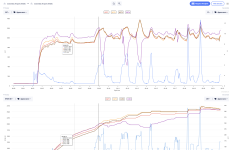
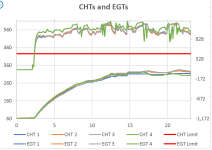
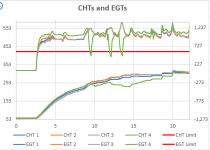
Anyhoo, here are two graphs, three days apart, ground ops., no flight. Seems like something is going on with cylinder #4.

I can also try to post the entire data file if interested.
Screenshot 2026-05-08 072031.pngScreenshot 2026-05-08 072152.png


Yeah, you are losing combustion on #4, that's certain. So its either; air, fuel, ignition, or compression. The fact that you haven't mentioned this issue exists on one mag or the other makes me think its not ignition. So fuel is the next likely culprit. I see its fuel injected and that the injectors are clean, have you had a close look at the fuel spider yet? Perform a fuel flow test on each fuel line? Also possibly a really bad intermittent induction leak on that one cylinder? Things to look into.
 
Stuck exhaust valve? How many hours on the engine? Has a wobble test ever been done. Did it start with morning sickness?
Perhaps you could just graph EGT # 4 on a more zoomed in graph to see how cold it gets and for how long.
 
Howdy everyone. A awhile back Mike Schollmeyer posted "Random Thud, Getting Worse". In the RV-14 Forums. I have the exact same symptoms with my IO-375-M1S. There doesn't appear to be any further discussion on that thread, so I am starting my own.

Random "miss" at all engine speeds and mixture settings. (idle, run up, full power, cruise.) Sometimes mild, sometimes more aggressive. In flight it feels like a surging/kicking/bucking with noticeable loud bangs out the exhaust. Very concerning!

I tried Mike's fix which seemed to be separating the spark plug wires and clean the fuel injector nozzles...no joy.

Anyhoo, here are two graphs, three days apart, ground ops., no flight. Seems like something is going on with cylinder #4.

I can also try to post the entire data file if interested.
View attachment 116985View attachment 116986


There is a good possibility you are experiencing a sticking exhaust valve on cylinder number 4. There is a whole procedure for a wobble test but a quick diagnosis is to remove the valve spring and try and move the valve; if it’s tight you’ll need to ream or ball hone the guide. The cylinder doesn’t have to be removed for the test, many examples of this procedure being done here on Vansairforce. Many people prefer the reamer and that is what lycoming recommends
 
I can also try to post the entire data file if interested.

If you can zip your CSV file and post it there are a lot of good mechanics on this forum who can look at the details of the flight and help troubleshoot.
 
What is most prominant in the graphs is that as #4 EGT drops, the other three all rise. To me, that looks like #4 injector is randomly blocking flow. Servo sends fuel volume for all 4 and then is distributed evenly via system balance. If #4 becomes blocked, all that extra fuel goes to the other three. I would start by cleaning the #4 SS line and restrictor, as well as the spider.

Sometimes there is a chunk of debris floating around in there and only occassionally blocks the opening.
 
Last edited:
What is most prominant in the graphs is that as #4 EGT drops, the other three all rise. To me, that looks like #4 injector is randomly blocking flow. Servo sends fuel volume for all 4 and then is distributed evenly via system balance. If #4 becomes blocked, all that extra fuel goes to the other three. I would start by cleaning the #4 SS line andrestrictor.

Sometimes there is a chunk of debris floating around in there and only occassionally blocks the opening.
A sticking valve is certainly possible, but would start with the easier stuff first. Stuck valves tend to not be this intermittent. They tend to act up for several seconds or minutes, then go away. Typically bad when cold, then improve as things warm up. Yours is more on then off then on again. Not typical for stuck valve.
 
Thanks Larry. I cleaned #4 fuel injector nozzle and jet prior to the run shown in the second graph. The first graph was ran before any injector cleaning. All injector nozzles/jets are the same, so I could swap two and see if the issue follows the nozzle.
 
Thanks Larry. I cleaned #4 fuel injector nozzle and jet prior to the run shown in the second graph. The first graph was ran before any injector cleaning. All injector nozzles/jets are the same, so I could swap two and see if the issue follows the nozzle.
swapping injectors is not the answer. loosen fittings at both sides of #4 SS tube and blow it out with compressed air. blockage could just as easilly be in the spider. pull the cover (watch for a spring to fall out; just under cap). lift out diaphragm carefully (there is a needle on the side you cannot see), then look for debris inside and clean out. also blow out the #4 brass fitting on the spider.

not certain this is the issue, but symptoms warrant these steps IMHO. the intermittent nature points to a chunk floating around, not necessarilly stuck somewhere.
 
on your graph, there are a whole bunch od upward spikes on the EGTs. Most go in concert; only a few have #4 diverge. Is thyat from something you commanded or is that part of the problem; that would point us in a different direction.
 
Sounds like a solid plan. I will say the small variations in EGT are commanded. To be sure, I'll need to watch EGT real time on my EFIS and see how things look when commanding/not commanding engine changes.
 
What is most prominant in the graphs is that as #4 EGT drops, the other three all rise. To me, that looks like #4 injector is randomly blocking flow. Servo sends fuel volume for all 4 and then is distributed evenly via system balance. If #4 becomes blocked, all that extra fuel goes to the other three. I would start by cleaning the #4 SS line and restrictor, as well as the spider.

Sometimes there is a chunk of debris floating around in there and only occassionally blocks the opening.
I would agree this is most consistent with the data, especially hearing backfiring in the exhaust.
Since the dips in graph 2 are way more severe, I assume the "bang" was louder too...
 
Also interesting in the data is the slight climb in temp that slowly creeps up (from data row ~450 EGT4 @ 1000F), then accelerates a bit then "breaks" @1200F (~row 550) to ~500F 20 seconds later. That's a 90 second climb, suggesting onset of clogging of fuel into injector #4 (increasing high Temp with increasingly LOP), followed by sudden complete clog (no combustion, temp. drops).
 
Seems like a blockage in #4 would send more fuel to the other three, so they would richen - which should make a modest drop in EGT, not a rise (unless it is LOP).
The coupling of the other cylinders is interesting though. Would a sticky valve change the performance of the other cylinders by changing the timing of pressure pulses in the exhaust?
The rise in EGT could come from backfired combustion of the unburnt fuel from other cylinders.
 
The three prominent events in the second graph at 9, 12, 13 seconds each show all of the cylinders leaning, then #4 leaning so severely that it mis-fires. Could this be a combination of two issues? For example, what if air bubbles in the fuel (causing sporadic leaning) combined with a weak spark in #4 that makes it less tolerant of the lean mixture?

Swap spark plugs from #4 with another cylinder (and wires too if you can) and repeat test.

Put a clear plastic segment of fuel line at the spider and look for bubbles in the fuel at idle power.

A common source of air bubbles in the fuel, even when all the lines are tight, is at the fuel selector valve.
I was reading each data point as one second from the csv file (not sure what axis of the graph posted is?).
CSV shows ~19:04 -- ~19:26 (22 minutes of data) for whole graph.

I see now the others also increase with #4, suggesting all 4 LOP (4 cylinder with 6 EGT data columns?).
A closer look at CHT also suggests there is not extra fuel to burn (CHT goes up in others when #4 runs out, suddenly more LOP, not ROP then). The "bangs" I guess are not backfires after all! (edit: at least not from the other cylinders' unburnt fuel)
 
Last edited:
Seems like a blockage in #4 would send more fuel to the other three, so they would richen - which should make a modest drop in EGT, not a rise (unless it is LOP).
The coupling of the other cylinders is interesting though. Would a sticky valve change the performance of the other cylinders by changing the timing of pressure pulses in the exhaust?
i agree, but have also seen instances where things were bad enough that egts did opposite of expected behavior. in this case, the linkage seems too much to ignore the possibility. egts were low due to runup rpm, so possible that rpm rose, increasing egt for that reason. A stuck exh valve should not change the behavior of the other cylinders, though a stuck intake valve would lower vacuum and drive more fuel and air flow. i struggle to see how any problem in #4 causes the others to go lean, beyond an induction leak in 4. but typical leaks never come and go like this.

air velocikty in the exhaust has a very small affect and it is on airflow, but only in the valve overlap period. it is not really the pulses, but the moving flow that helps to pull in more air during the overlap. the servo should adjust to that and keep the af ratio similar.

so, i am definately not confident in the diagnosis, but it absolutely seems possible and very easy to address; the others, not so much.
 
Last edited:
As I look more at the .CSV file, I find all kinds of things are changing. The RPM, fuel flow, manifold pressure are changing in ways that suggest that both throttle and propeller are being changed in the middle of these events. Fuel flow and MAP increasing while RPM is going down during the time when EGT #4 drops. These must be commanded changes in engine setting in the middle of the events.
So.....
Too many things changing all at once to draw any conclusions I think. I deleted my previous posts because the observations don't make sense when all the engine settings are changing while this is happening. It would be much more helpful to have a data run where the engine is just running at fixed settings when the event(s) occur, so that the changes are related to the event. Then, things like EGT rise on all cylinders, or variation in fuel flow, etc would actually mean something about what is happening.
 
I was reading each data point as one second from the csv file (not sure what axis of the graph posted is?).
CSV shows ~19:04 -- ~19:26 (22 minutes of data) for whole graph.

I see now the others also increase with #4, suggesting all 6 LOP.
A closer look at CHT also suggests there is not extra fuel to burn (CHT goes up in others when #4 runs out, suddenly more LOP, not ROP then). The "bangs" I guess are not backfires after all!
the bangs are afterfires. when a cyl goes to intermittently misfiring, you get afterfires. to be expected as the cyl goes offline and comes back.
 
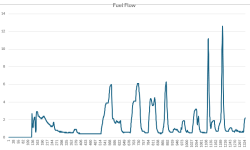
makes no sense. most of thge flow is almost nothing with spikes into normal terrritory. i don't think the engine would run with flow like that.
I think the flow meter calibration is just off. If you plot the RPM and MAP along with this fuel flow graph, it will make more sense. These are commanded engine transients in RPM and MAP.
 
As I look more at the .CSV file, I find all kinds of things are changing. The RPM, fuel flow, manifold pressure are changing in ways that suggest that both throttle and propeller are being changed in the middle of these events. Fuel flow and MAP increasing while RPM is going down during the time when EGT #4 drops. These must be commanded changes in engine setting in the middle of the events.
So.....
Too many things changing all at once to draw any conclusions I think. I deleted my previous posts because the observations don't make sense when all the engine settings are changing while this is happening. It would be much more helpful to have a data run where the engine is just running at fixed settings when the event(s) occur, so that the changes are related to the event. Then, things like EGT rise on all cylinders, or variation in fuel flow, etc would actually mean something about what is happening.
Agreed.
 
The OP has started another thread about the results of cleaning his injectors. Not sure why not here.
Ed
 
Thanks again. To be more clear, the backfiring out the exhaust has only been noticed while in flight. On the ground, (as the 2 graphs above show) I have not noticed.

The zipped CSV file is only yesterdays ground runs. 22 minutes total time sounds correct. During that time, I was changing all engine/prop settings trying to figure out what might be going on. No backfires were noticed. I agree this particular file is not the best for troubleshooting!

UPDATE! I removed the #4 cyl. SS fuel line and washed/blew it out. No contaminates/debris observed. I also removed the top cap, spring, diaphragm with needle from the flow divider. Nothing obvious inside the divider body nor on parts removed. I cleaned these parts as well and still did not find any debris or contamination.

**Started engine and noticed it seemed better. After a few minutes, all was good. By now, I would normally feel/hear the engine issues. Taxied out, did a run up...all seemed good. Back to idle...still fine. Took to the runway and did some quick full power runs...and still felt/sounded just fine. Idle, add run up power, idle, run up power...still good. It started to rain so I taxied over to the hangar. I am not sure, but there may have been a glitch or two just before shutdown NOT SURE.**

But, NO CSV file! Never reinstalled my thumb drive.

I plan to go out again Sunday and do more test runs. If I get it running, taxied and out to the runway area without symptoms, I will do a sustained run with no engine/prop changes for a clean CSV file.

Any suggestions on how long to do the sustained run and at what RPM? I'm thinking at least a few minutes around 1500 RPM.

Much obliged!
 
I posted the fuel nozzle thread yesterday. Troubleshooting my engine problem, I removed and cleaned all 4 injectors and noted the #2 was black inside. I was curious if anyone has seen that before. The CSV file and graphs above were recorded after the 4 injector cleaning.
 
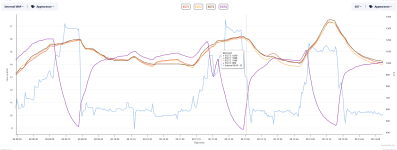
Sure, looks like injector 4 has an issue or both EGT's and CHT's are mismarked. Cylinder 4 almost from the beginning seems to have an issue. (Possibly already lean) When the throttle is advanced it goes cold and CHT 4 temps follow. (Possibly way lean) This occurs 3 times. Suggest verifying EGT's and CHT's are properly numbered or you might be chasing bad data for a while. Ultrasonic cleaners are great to clean the injector parts. Good luck!


Screenshot 2026-05-08 214653.png
 
Thanks again. To be more clear, the backfiring out the exhaust has only been noticed while in flight. On the ground, (as the 2 graphs above show) I have not noticed.

The zipped CSV file is only yesterdays ground runs. 22 minutes total time sounds correct. During that time, I was changing all engine/prop settings trying to figure out what might be going on. No backfires were noticed. I agree this particular file is not the best for troubleshooting!

UPDATE! I removed the #4 cyl. SS fuel line and washed/blew it out. No contaminates/debris observed. I also removed the top cap, spring, diaphragm with needle from the flow divider. Nothing obvious inside the divider body nor on parts removed. I cleaned these parts as well and still did not find any debris or contamination.

**Started engine and noticed it seemed better. After a few minutes, all was good. By now, I would normally feel/hear the engine issues. Taxied out, did a run up...all seemed good. Back to idle...still fine. Took to the runway and did some quick full power runs...and still felt/sounded just fine. Idle, add run up power, idle, run up power...still good. It started to rain so I taxied over to the hangar. I am not sure, but there may have been a glitch or two just before shutdown NOT SURE.**

But, NO CSV file! Never reinstalled my thumb drive.

I plan to go out again Sunday and do more test runs. If I get it running, taxied and out to the runway area without symptoms, I will do a sustained run with no engine/prop changes for a clean CSV file.

Any suggestions on how long to do the sustained run and at what RPM? I'm thinking at least a few minutes around 1500 RPM.

Much obliged!
A good sign. You won’t always see the debris in the lines. That is why we blow them. Out. Hopefully that resolved your issues
 
Sure, looks like injector 4 has an issue or both EGT's and CHT's are mismarked. Cylinder 4 almost from the beginning seems to have an issue. (Possibly already lean) When the throttle is advanced it goes cold and CHT 4 temps follow. (Possibly way lean) This occurs 3 times. Suggest verifying EGT's and CHT's are properly numbered or you might be chasing bad data for a while. Ultrasonic cleaners are great to clean the injector parts. Good luck!


View attachment 117056
You don’t want to trust that data. It shows the engine running fine at .5 gph. I think we all know that isn’t feasible. Clearly the ems has some issues.
 
Thanks again. To be more clear, the backfiring out the exhaust has only been noticed while in flight. On the ground, (as the 2 graphs above show) I have not noticed.

The zipped CSV file is only yesterdays ground runs. 22 minutes total time sounds correct. During that time, I was changing all engine/prop settings trying to figure out what might be going on. No backfires were noticed. I agree this particular file is not the best for troubleshooting!

UPDATE! I removed the #4 cyl. SS fuel line and washed/blew it out. No contaminates/debris observed. I also removed the top cap, spring, diaphragm with needle from the flow divider. Nothing obvious inside the divider body nor on parts removed. I cleaned these parts as well and still did not find any debris or contamination.

**Started engine and noticed it seemed better. After a few minutes, all was good. By now, I would normally feel/hear the engine issues. Taxied out, did a run up...all seemed good. Back to idle...still fine. Took to the runway and did some quick full power runs...and still felt/sounded just fine. Idle, add run up power, idle, run up power...still good. It started to rain so I taxied over to the hangar. I am not sure, but there may have been a glitch or two just before shutdown NOT SURE.**

But, NO CSV file! Never reinstalled my thumb drive.

I plan to go out again Sunday and do more test runs. If I get it running, taxied and out to the runway area without symptoms, I will do a sustained run with no engine/prop changes for a clean CSV file.

Any suggestions on how long to do the sustained run and at what RPM? I'm thinking at least a few minutes around 1500 RPM.

Much obliged!
A minute or two at 1800, then a couple full power applications- basically an aborted take off would be my recommendation.
 
You don’t want to trust that data. It shows the engine running fine at .5 gph. I think we all know that isn’t feasible. Clearly the ems has some issues.
Or possibly the red cube has issues, (or whatever device is being used for fuel flow) wouldn't be the first that one of these devices is giving inaccurate data at low flow rates and EIS is performing fine. What are the odds of 3 times just cylinder 4's EGT falls off 500 degs + (and 1- 3 increased) at the almost the exact same time power was increased significantly?


Screenshot 2026-05-09 032101.png
 
Last edited:
I’m not an engineer. I am barely qualified to have an opinion and have never done most of the things discussed in this thread.

This seems like a problem that can be solved absent reliance on all this fancy data/graphics.
You are trying to solve for a “rough running engine”
I think more info is needed.
Have you recently performed any work?
What flight settings do you use?
What is separating spark plug wires in this context?
What kind of ignition system are you using?
How do your fuel filters look?
When was last oil change and what does the blackstone report look like?
What spark plugs do you use? How do they look?
What are compressions like?
Oil consumption?
Why no have a camera on in flight ?
Engine temps? MAP?
What do your cylinders look like with a camera stuck down in them?

My only in flight issue similar too this was suspected lead fouling. My cfii changed settings, I think we were lower power settings descending during approaches and had to run at higher power settings for a few minutes. It did not happen again.

I’d be concerned about something related to pressure and temperature and its impact on your combustion cycle.
 
Or possibly the red cube has issues, (or whatever device is being used for fuel flow) wouldn't be the first that one of these devices is giving inaccurate data at low flow rates and EIS is performing fine. What are the odds of 3 times just cylinder 4's EGT falls off 500 degs + (and 1- 3 increased) at the almost the exact same time power was increased significantly?


View attachment 117058
To me, this looks like a piece of debris floating around in the #4 injector area. Runs fine at idle (low fuel flow). He pushes in the throttle, so MAP risess and EGTs begin to rise. As the fuel flow gets strong enough, the debris gets lodged in the restrictor and #4 goes cold. In the 2nd instance you can even see where it became dislodged and EGT began to recover then repeated. With this blown up chart, you can see that the other cylinders are not rising BECAUSE of the #4 issue, but because of the transition from idle to higher power. You can even see the rate of rise fall off right along with #4 issue, indicating lowering EGTs due to the extra richening. It was too hard to see without blowing it up, so thanks for that. The operator feels the mis and pulls back, dropping the MAP back to idle levels, debris dislodges and back to normal.

I say the odds are good and it is reinforced by the fact that it doesn't happen all the time.
 
Last edited:
I’m not an engineer. I am barely qualified to have an opinion and have never done most of the things discussed in this thread.

This seems like a problem that can be solved absent reliance on all this fancy data/graphics.
You are trying to solve for a “rough running engine”
I think more info is needed.
While you are welcome to address your problems any way you feel like. It seems inappropriate to come here and tell people not to use the incredible tools we have available today in diagnostics. Problems like this absent engine data are VERY difficult to solve for those not experienced in the art. These tools allow the inexperienced to come here and get input from others with more experience. Sure, this advice is farfrom perfect and could easilly be wrong. But is a good start for many and users can eliminate many variables before having to throw in the towel and hire a professional.

If you have something to contribute, great. But please don't come hear and tell people they are making a mistake by using available engine data to diagnose a problem.
 
To the OP

I suffered a major fuel contamination issue - 2 dead stick landings and several rough engine scenarios. Turned out to be some weird growth in the fuel pump that began shedding. When you get large debris that shows up like this, it is often something that broke off and created the issue, not something that snuck past the filter. While sometimes it is an anomoly that never repeats, like a pice of junk that has been wedged in a crevice since build, but sometimes it was just the first time and more are to follow. If you can confirm this was the issue, you need to be diligent in monitoring, as it is possible it will happen again. if you get a second occurence, a full fuel system examination is in order - everything downstream from the filter, as well as the filters themselves as they will bypass once full and send debris. you do know you have a filter in the servo, correct?
 
To the OP

I suffered a major fuel contamination issue - 2 dead stick landings and several rough engine scenarios. Turned out to be some weird growth in the fuel pump that began shedding. When you get large debris that shows up like this, it is often something that broke off and created the issue, not something that snuck past the filter. While sometimes it is an anomoly that never repeats, like a pice of junk that has been wedged in a crevice since build, but sometimes it was just the first time and more are to follow. If you can confirm this was the issue, you need to be diligent in monitoring, as it is possible it will happen again. if you get a second occurence, a full fuel system examination is in order - everything downstream from the filter, as well as the filters themselves as they will bypass once full and send debris. you do know you have a filter in the servo, correct?
This^^^
I have experienced this twice. Both times flying to/from OSH. The first time 4-5 years ago (don’t remember exactly which year). The second time last year at OSH. The first incident I spent five days at the repair station troubleshooting. After testing everything possible we did a flow test and found one cylinder (I think it was #4) had a piece of trash in the injector. Blew it out and everything was good.

Fast forward to last summer. Flying to OSH, same symptoms again. This time never found the “smoking gun” during OSH, even after extensive troubleshooting. Took off from OSH to fly home and everything was fine. . . For about 30-40 minutes. Then #4 started losing power, engine running rough, all the same symptoms as before and same as you described. Ran for about 5 more minutes like this when #2 cylinder had the same symptoms. At that point I diverted to the nearest airport and landed without incident. During the decent the engine went back to normal operation. I spent an hour or so troubleshooting there but found no abnormal engine behavior. I fueled up and flew home the rest of the 3-4 hours with no further incidents. The only thing I could conclude was that whatever “trash” had been causing problems somehow broke apart and made its way to not one but two cylinders and burned up in the combustion.

Once home I decided to pull the fuel pump and have it inspected. I sent it off to a shop to have it inspected and overhauled. The shop found several internal seals that had deteriorated to the point that pieces of the seals were breaking off. The conclusion was, these pieces were the “trash” that was making it to the spider and blocking fuel flow to the injectors.

I actually purchased a new fuel pump and have the overhauled pump on a shelf as backup now. There have been no other incidents since then.

So, as Larry mentioned, pay close attention to these symptoms. The source of the “trash” you may have blown out to resolve this issue today may break loose again in the future.
 
While you are welcome to address your problems any way you feel like. It seems inappropriate to come here and tell people not to use the incredible tools we have available today in diagnostics. Problems like this absent engine data are VERY difficult to solve for those not experienced in the art. These tools allow the inexperienced to come here and get input from others with more experience. Sure, this advice is farfrom perfect and could easilly be wrong. But is a good start for many and users can eliminate many variables before having to throw in the towel and hire a professional.

If you have something to contribute, great. But please don't come hear and tell people they are making a mistake by using available engine data to diagnose a problem.
PM sent

Sorry, but there is a bit of history on VAF where folks got distracted by too much data: https://vansairforce.net/threads/large-rpm-drop-during-mag-test.241713/#post-1918768

I like to look for the simple explanations before getting in the weeds: https://en.wikipedia.org/wiki/Occam's_razor
 
Last edited:
PM sent

Sorry, but there is a bit of history on VAF where folks got distracted by too much data: https://vansairforce.net/threads/large-rpm-drop-during-mag-test.241713/#post-1918768

I like to look for the simple explanations before getting in the weeds: https://en.wikipedia.org/wiki/Occam's_razor
no distraction on that thread. luik's problem was a magneto failure and the data helped us to remotely diagnose it. granted, some of the follow up data from additional testing parameters I gave him was between me and luik and not posted, but this saved him a fortune and plane is running great after the mag overhaul. Sure, there was some back and forth and some folks suggested things that weren't correct, but in the end it was a successfull remote diagnostic exercise, based upon data that led to a successfull outcome. not sure why you are trying to portray that as a failure based upon using data.

just because the EGT data did not follow classic behavior does not mean the data was invaluable. Many nuances in diagnostics.
 
Last edited:
Turned out to be some weird growth in the fuel pump that began shedding.
Once home I decided to pull the fuel pump and have it inspected. I sent it off to a shop to have it inspected and overhauled.

Just to clarify so I can file this wisdom away in my data banks for the future... you guys are referring to the engine-driven fuel pump, not the boost pump, right?
 
Just to clarify so I can file this wisdom away in my data banks for the future... you guys are referring to the engine-driven fuel pump, not the boost pump, right?
In my case, yes. It was a white crusty build up that formed on the aluminum. Also found a couple black pieces of what appeared to be rubber in a restrictor. Hoses were less than 6 years old. Never came up with a root cause but other posters here were discussing potential issues with fuel additives at the time. A bad batch of additives in the fuel was my best guess.

I asked spruce to send it back to tempest for analysis, but no surprise they never got back to me.
 
Howdy everyone. A awhile back Mike Schollmeyer posted "Random Thud, Getting Worse". In the RV-14 Forums. I have the exact same symptoms with my IO-375-M1S. There doesn't appear to be any further discussion on that thread, so I am starting my own.

Random "miss" at all engine speeds and mixture settings. (idle, run up, full power, cruise.) Sometimes mild, sometimes more aggressive. In flight it feels like a surging/kicking/bucking with noticeable loud bangs out the exhaust. Very concerning!

I tried Mike's fix which seemed to be separating the spark plug wires and clean the fuel injector nozzles...no joy.

Anyhoo, here are two graphs, three days apart, ground ops., no flight. Seems like something is going on with cylinder #4.

I can also try to post the entire data file if interested.

View attachment 116985View attachment 116986


I had the same problem with my carbureated
Howdy everyone. A awhile back Mike Schollmeyer posted "Random Thud, Getting Worse". In the RV-14 Forums. I have the exact same symptoms with my IO-375-M1S. There doesn't appear to be any further discussion on that thread, so I am starting my own.

Random "miss" at all engine speeds and mixture settings. (idle, run up, full power, cruise.) Sometimes mild, sometimes more aggressive. In flight it feels like a surging/kicking/bucking with noticeable loud bangs out the exhaust. Very concerning!

I tried Mike's fix which seemed to be separating the spark plug wires and clean the fuel injector nozzles...no joy.

Anyhoo, here are two graphs, three days apart, ground ops., no flight. Seems like something is going on with cylinder #4.

I can also try to post the entire data file if interested.

View attachment 116985View attachment 116986


I had the same problem with my carbureted RV7. It sounded like a miss with headsets on. Went through the entire fuel system and it did not solve anything. A friend videoed my takeoff and it was backfiring. Compression check showed # 4 was zero. It turned out to be basically a chip out of the intake valve.
 
I did more engine runs yesterday and the symptoms were back. I have the CSV file, but it looks just like the top graph in my original post. I have noticed that my right mag might be shot. It has been dropping about 300 RPM when doing the mag check at about 1500-1600 RPM. I assumed it may be a fouling problem with a rich mixture but over the days of ground runs, nothing has helped. Today I removed the #4 and #1 fuel nozzles, cleaned them both, and swapped their positions. (#1 is now on the #4 cylinder) I also removed and cleaned all 4 top spark plugs. (The right mag plugs) They looked bad; black and wet. Put them back in and did more ground runs at various RPM and mixture combinations. No joy. Mag check showed the right mag would drop 300+ RPM and of course the engine felt horrible. All the symptoms we have been discussing above were back in the same random affair. A quick look at the CSV graph showed the issue did not follow the swapped fuel nozzles; #4 is still the anomaly.

I am guessing I will be removing that mag and sending it to EMag and see what gives.
 
Just to clarify so I can file this wisdom away in my data banks for the future... you guys are referring to the engine-driven fuel pump, not the boost pump, right?
Yes. It was the engine driven fuel pump. In my case I have an ECi IO340 with the ECi fuel pump. That pump is very different from the standard common Lycoming fuel pump. This caused some concern since ECi was bought out by Continental. Continental did not continue using the ECi designed fuel pump. It is not supported. I was fortunate to be able to overhaul this pump. Without shops doing continuing to do so going forward, any future incidents may require a complete overhaul of the fuel delivery system of this existing ECi system.
 
My plan is to go out tomorrow do some PMag troubleshooting and checks (and probably more engine runs...) to see if I can find something obvious. (Pmag manual in hand.)
 
I looked closer at today's engine run EGT graph and I noticed #3 cylinder also seems to have some weird things happening from time to time. The 4 sharp negative spikes from #4 might be while doing mag checks. I don't recall when during the run I did them nor how many. I was trying different RPM/MIX combos at various times to see what would happen.


Screenshot 2026-05-10 171516.png
 
Your engine is not airworthy. I’d stop running it if it were mine.
Stop all the gobbledygook
Congrats to all the remote fuel troubleshooters, willing to move on from that ?

I think AI does a good job at this point….IMG_0134.png
 
Back
Top