Van's Air Force

The definitive Van's Aircraft support community! Buying, building or flying an RV? Join our exclusive family of mentors and enthusiasts!

GRT Horizon panel planning - help!

skirting_virga

Well Known Member
Patron
Apologies if there is a good thread/resource that covers what I want to do - I've searched and it's difficult to find relevant information.

My plane is down for several months and I'm trying to conceptualize a budget upgrade path for my panel. I have bought a GTN 625 for the purpose of enabling IFR practice approaches, but recently ruled out the possibility of adding it to the existing panel due to a rats nest of wiring, and would like to build a clean, reliable panel from scratch. I basically want to build a panel completely on the bench and then transplant it into the plane to avoid having to work with any of the existing wiring. After looking at Dynon/AFS, I think the price is just going to be too high - especially if I want to use the ACM.

I'm confident that I can handle the physical panel and mounting, even with relatively close instrument spacing. I have a lot to learn about the connectivity and configuration of the various avionics.

Present equipment
  • GRT Sport EX EFIS
  • Garmin GTR 200 Radio
  • Garmin GTX 327 Transponder
  • Echo UAT ADS-B out
  • GRT Safe-Fly 2020 ADS-B Compliant GPS Module
  • Garmin Aera 660 with dock
  • Garmin GDL 39 ADS-B Receiver
  • JPI 350 Engine Monitor
  • ACK ELT
  • GRT Pitch and Roll servos

My goals for a new panel:
  • Replace the Sport EX with a GRT Horizon 10.1 and put the Sport EX in the back seat
  • Connect the Safe-Fly 2020 to the GRT Horizon 10.1
  • Replace the GTX 327 with a transponder that incorporates ADS-B out like the GTX 335
  • remove the Aera 660, GDL 39, and Echo UAT
  • Use GRT Discovery ADS-B Receiver in place of the GDL 39 (GTX 345 is $$$, but another option)
  • Add my GTN 625 with GRT Discovery ADS-B input (should this take GPS position from the GRT EFIS? From the GTX 335?)
  • Send GPS signal to the ACK ELT from either the transponder, the EFIS, or the 625
  • Keep the GTR 200 radio, but rewire it
  • Keep the JPI 350 and maybe skip the rewire
  • Consider provision for a backup attitude instrument like a G5, or one of GRT or Dynon's options

I need a lot of help figuring out if this plan makes sense, figuring out how to block-diagram connectivity, and understanding the wiring diagram that I will have to create.

What is the most sensible place to source GPS position? I was planning to connect the GRT Safe-Fly to the Horizon. Should the GTN 625 be an independent GPS position source? Is it worth $500 extra for the transponder to have its own GPS positioning?

Can the GTN 625 connect to the GTX 335? Can it control the transponder if I want to type the code on the screen? Should it take position source from the transponder? Can the GTN 625 receive ADS-B and FIS-B from the GRT Discovery?

Am I setting myself up for problems by having a 1090 MHz ADS-B out instead of UAT? Are there a bunch of GA aircraft that won't be able to detect me on their ADS-B?

At a significant increase in cost, I would consider adding a 2nd COM radio and an audio panel, but I could also leave this for a future upgrade.
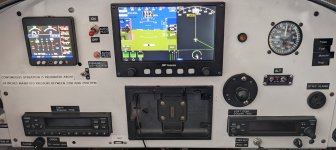
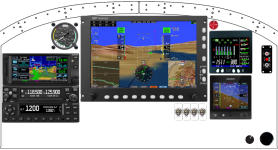
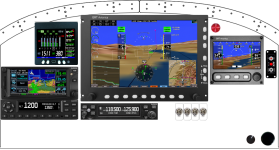
current panel 8A.jpg
Horizon panel upgrade.png
 
Last edited:
Apologies if there is a good thread/resource that covers what I want to do - I've searched and it's difficult to find relevant information.

My plane is down for several months and I'm trying to conceptualize a budget upgrade path for my panel. I have bought a GTN 625 for the purpose of enabling IFR practice approaches, but recently ruled out the possibility of adding it to the existing panel due to a rats nest of wiring, and would like to build a clean, reliable panel from scratch. I basically want to build a panel completely on the bench and then transplant it into the plane to avoid having to work with any of the existing wiring. After looking at Dynon/AFS, I think the price is just going to be too high - especially if I want to use the ACM.

I'm confident that I can handle the physical panel and mounting, even with relatively close instrument spacing. I have a lot to learn about the connectivity and configuration of the various avionics.

Present equipment
  • GRT Sport EX EFIS
  • Garmin GTR 200 Radio
  • Garmin GTX 327 Transponder
  • Echo UAT ADS-B out
  • GRT Safe-Fly 2020 ADS-B Compliant GPS Module
  • Garmin Aera 660 with dock
  • Garmin GDL 39 ADS-B Receiver
  • JPI 350 Engine Monitor
  • ACK ELT
  • GRT Pitch and Roll servos

My goals for a new panel:
  • Replace the Sport EX with a GRT Horizon 10.1 and put the Sport EX in the back seat
  • Connect the Safe-Fly 2020 to the GRT Horizon 10.1
  • Replace the GTX 327 with a transponder that incorporates ADS-B out like the GTX 335
  • remove the Aera 660, GDL 39, and Echo UAT
  • Use GRT Discovery ADS-B Receiver in place of the GDL 39 (GTX 345 is $$$, but another option)
  • Add my GTN 625 with GRT Discovery ADS-B input (should this take GPS position from the GRT EFIS? From the GTX 335?)
  • Send GPS signal to the ACK ELT from either the transponder, the EFIS, or the 625
  • Keep the GTR 200 radio, but rewire it
  • Keep the JPI 350 and maybe skip the rewire
  • Consider provision for a backup attitude instrument like a G5, or one of GRT or Dynon's options

I need a lot of help figuring out if this plan makes sense, figuring out how to block-diagram connectivity, and understanding the wiring diagram that I will have to create.

What is the most sensible place to source GPS position? I was planning to connect the GRT Safe-Fly to the Horizon. Should the GTN 625 be an independent GPS position source? Is it worth $500 extra for the transponder to have its own GPS positioning?

Can the GTN 625 connect to the GTX 335? Can it control the transponder if I want to type the code on the screen? Should it take position source from the transponder? Can the GTN 625 receive ADS-B and FIS-B from the GRT Discovery?

Am I setting myself up for problems by having a 1090 MHz ADS-B out instead of UAT? Are there a bunch of GA aircraft that won't be able to detect me on their ADS-B?

At a significant increase in cost, I would consider adding a 2nd COM radio and an audio panel, but I could also leave this for a future upgrade.
Hi Chris,
Here are my opinions, specific to your questions, keeping in mind that (1) IFR isn’t cheap, and (2) you want to keep costs under control.
Along with the Horizon 10.1, you’ll need a remote magnetometer (I don’t think it’s included?) and, definitely, the add-on ARINC module.
In the -8 you’re always running out of panel space. So, reluctantly, I’d sell the JPI and replace it with the remote mounted version of GRT’s EIS.
Save $, buy the remote mounted Trig TT22 mode S transponder (controlled thru the EFIS). It can read the ‘adsb+’ formatted rs232 signal out of the 625 to get the needed adsb-out data.
Feed the gps signals (RS232 and ARINC) from the 625 into the efis as ‘gps1’. Feed the ‘safe-fly’ rs232 signal into the efis as ‘gps2’.
Most likely the 625 will not take data from the Discovery (?) I think the 625 uses a proprietary format. No matter, you want adsb-in data on the biggest screen you have, which is the 10.1 efis. And the Discovery is definitely compatible with the 10.1
1090 vs 978(UAT). The majority of aircraft flying listen on 1090. The only aircraft that won’t see you have either (1) no adsb-in at all, or (2) 978 MHz in only AND are not in contact with an adsb ground station, or you are not in contact with either a ground station or ATC radar. Possible but not likely.
IMHO, if you are contemplating ifr operations, top of your list should be a back up attitude source with its own battery (Garmin G5, GRT mini-efis, Dynon equivalent). More important than a second com.
 
Last edited:
IMHO, if you are contemplating ifr operations, top of your list should be a back up attitude source with its own battery (Garmin G5, GRT mini-efis, Dynon equivalent). More important than a second com.
Agree 100%. If you have a complete electrical failure, the second comm will be useless, while the attitude indicator with backup battery will be very useful. To say the least.
 
Basically, what BobTurner said with the addition of the following:

1. I have an RV8 with a panel setup that is similar to yours, except the two small screens on the right are GRT "MINIs". The advantage that I find for this is that you have very similar "buttonology" with the 10.1. You ALSO have in each MINI the ability to have it serve as a PFD, or MAP, or ENG (Engine Monitor screen for the remotely mounted EIS.)

2. Consider selling the JPI and replacing it with a MINI that you dedicate to engine monitoring, AND have another battery-backed-up PFD if the need arises.

3. I don't see an audio panel. Did I miss something, or do you plan to have that "remote" via the 10.1??

4. I can send you pictures of my setup (via email or private message here, to avoid unnecessary image uploads here).

5. I am using some relatively new software for developing the wiring diagrams for the RV6A, which has been listed on my posts as under construction for a few decades now. (Finally back at it.) :) :) While it features a lot of Garmin and Dynon (and others), it requires the development of the many missing GRT modules. I am almost done building those and will post about it later for those who may be interested. (DISCLAIMER: I have no affiliation with the company doing this. I am just a user who is volunteering a bit of time to build the modules and am giving them a bit of feedback. I mention all of this because it MAY be of value to you once you decide on your path.

Send me a PM if interested in a follow-up.
 
Hi Chris,
Here are my opinions, specific to your questions, keeping in mind that (1) IFR isn’t cheap, and (2) you want to keep costs under control.
Along with the Horizon 10.1, you’ll need a remote magnetometer (I don’t think it’s included?) and, definitely, the add-on ARINC module.
I have the remote magnetometer already for the Sport EX, and I may be mistaken but I thought the modern Horizon had internal ARINC and didn't need the external module.
In the -8 you’re always running out of panel space. So, reluctantly, I’d sell the JPI and replace it with the remote mounted version of GRT’s EIS.
Man, I really like that JPI, and rewiring the engine harness seems like a bit of a headache. I'll certainly have to consider it.
Save $, buy the remote mounted Trig TT22 mode S transponder (controlled thru the EFIS). It can read the ‘adsb+’ formatted rs232 signal out of the 625 to get the needed adsb-out data.
This seems reasonable. I'd like to have physical buttons to type my squawk code quickly, but I'm willing to try a "headless" setup in conjunction with the Horizon. The savings is noticeable.
Feed the gps signals (RS232 and ARINC) from the 625 into the efis as ‘gps1’. Feed the ‘safe-fly’ rs232 signal into the efis as ‘gps2’.
Ok, I think I get it so far
Most likely the 625 will not take data from the Discovery (?) I think the 625 uses a proprietary format. No matter, you want adsb-in data on the biggest screen you have, which is the 10.1 efis. And the Discovery is definitely compatible with the 10.1
I guess I was just hoping for a "bonus" input to the 625 with Nexrad and traffic or something. It's not mission-critical given the size of the screen.

1090 vs 978(UAT). The majority of aircraft flying listen on 1098. The only aircraft that won’t see you have either (1) no adsb-in at all, or (2) 978 MHz in only AND are not in contact with an adsb ground station, or you are not in contact with either a ground station or ATC radar. Possible but not likely.
This is reassuring.

IMHO, if you are contemplating ifr operations, top of your list should be a back up attitude source with its own battery (Garmin G5, GRT mini-efis, Dynon equivalent). More important than a second com.
I'm 100% on board with the backup and leaning GRT Mini, but I'm scratching my head as to how that integrates. Could I have the Sport EX in the back seat and the GRT Mini as a "slave"? I don't know how 3-displays would work. A power switch to omit the back seat display is a good idea for 90%+ solo flight too.


In terms of panel space with the JPI, there's not enough to add a second EFIS no matter what (would have to use something smaller than the 10.1). I can easily add 2 GRT minis, 2 G5s, etc with the space remaining and still have room to cutout a bottom panel relief for a longer stick. The advantage would be the location of the secondary for a tighter scan in the event of PFD failure. Hypothetically I could also swap the location of the JPI and the backup. I'll certainly consider replacing it but it just works so well right now.
 

Attachments

  • GRT EFIS.png
    GRT EFIS.png
    530.4 KB · Views: 23
Why do you think you need an airspeed indicator with 2 EFIS units? Waste of space and you could move the left stack up into a better viewing angle.
 
I sent a layout of my panel with similar equipment. Several of us have the same or similar layout. Check PM.
 
3. I don't see an audio panel. Did I miss something, or do you plan to have that "remote" via the 10.1??
IMHO in an airplane like this - no vor, one com - a full up audio panel is money down the drain and a waste of panel space. He needs an intercom to talk to the back seat. Get an intercom with several unswitched inputs in case a second com comes along.
 
IMHO in an airplane like this - no vor, one com - a full up audio panel is money down the drain and a waste of panel space. He needs an intercom to talk to the back seat. Get an intercom with several unswitched inputs in case a second com comes along.
Maybe I'm misunderstanding the audio panel, but the current panel with just the GTR 200 will allow the back seat to communicate with the front at all times, plus transmit and receive (separate PTT button). My prior audio panel experience has been selection between COM1/COM2/NAV1/NAV2 as an audio source, or some combination of listening to 2 frequencies and transmitting on one frequency. I think there's no need for a designated audio panel outside of multiple com radio functionality or identifying a VOR by morse code. I'd love to have a second radio or NAV/COM but the prices are pretty high for what they are. GTR 200 will allow monitoring of the standby frequency which is a little bit of the functionality of a second radio for the purposes of getting ATIS while listening to a TRACON.

Why do you think you need an airspeed indicator with 2 EFIS units? Waste of space and you could move the left stack up into a better viewing angle.
Eh, I have the ASI anyways and it doesn't require any power to give me airspeed. I figured I'd leave it on there somewhere. The advantage of removing it seems small but I would consider for a cleaner panel.
 
I have the remote magnetometer already for the Sport EX, and I may be mistaken but I thought the modern Horizon had internal ARINC and didn't need the external module.
Unfortunately, it’s the older, Hx/HXr, that have ARINC built in. Check, but I think it’s a ‘mount on the back panel’ option on the 10.1.
This seems reasonable. I'd like to have physical buttons to type my squawk code quickly, but I'm willing to try a "headless" setup in conjunction with the Horizon. The savings is noticeable.
On the Hx a short cut (push and hold the far right button) brings up the transponder page. Setting the squawk code is rotate knob (1234567123…), stop at the correct first digit, push knob, cursor moves to second digit, rotate, stop at desired number, push knob, ….
I don’t know the procedure on the 10.1. More buttons, maybe easier
I'm 100% on board with the backup and leaning GRT Mini, but I'm scratching my head as to how that integrates.
In my opinion your last-ditch save-my-butt efis should not be integrated with anything. You want zero probability that a bad software bit, over-voltage, etc, propagates into the backup and takes it down. Don’t forget a back up battery for it.
In terms of panel space with the JPI, there's not enough to add a second EFIS no matter what (would have to use something smaller than the 10.1). I can easily add 2 GRT minis, 2 G5s, etc with the space remaining and still have room to cutout a bottom panel relief for a longer stick. The advantage would be the location of the secondary for a tighter scan in the event of PFD failure. Hypothetically I could also swap the location of the JPI and the backup. I'll certainly consider replacing it but it just works so well right now.
If you can fit it in, keep it!
 
Maybe I'm misunderstanding the audio panel, but the current panel with just the GTR 200 will allow the back seat to communicate with the front at all times, plus transmit and receive (separate PTT button). My prior audio panel experience has …..
I forgot you’ve already got an intercom built into the com….
 
Unfortunately, it’s the older, Hx/HXr, that have ARINC built in. Check, but I think it’s a ‘mount on the back panel’ option on the 10.1.
That makes sense. GRT Support affirmed that the 10.1 doesn't have ARINC built in but I was asking about Sport 10.1, not Horizon 10.1 - still you're probably right that the box is needed. I wish they had an updated wiring diagram for the newer EFIS.

On the Hx a short cut (push and hold the far right button) brings up the transponder page. Setting the squawk code is rotate knob (1234567123…), stop at the correct first digit, push knob, cursor moves to second digit, rotate, stop at desired number, push knob, ….
I don’t know the procedure on the 10.1. More buttons, maybe easier
It's probably manageable but that's the sort of workflow I was hoping to get away from. The buttons on a GTX 330/335/etc are easy and fast. 1-2-0-0, done. I'll compare it to punching in an airport identifier on the old 430/530 with the large and small knobs, vs just typing it in on the touchscreen of the 650/750. Admittedly touchscreens have their own problems, but navigators tend not to have a keypad to save space. Still worth considering. I don't know how any of it is connected on the back end at the moment.

In my opinion your last-ditch save-my-butt efis should not be integrated with anything. You want zero probability that a bad software bit, over-voltage, etc, propagates into the backup and takes it down. Don’t forget a back up battery for it.
Good point. I guess I figured it would be nice if the backup could run the autopilot and sync the BARO, HDG, ALT, etc from the primary display. I can see why you might want to keep it independent though...
 
Good point. I guess I figured it would be nice if the backup could run the autopilot and sync the BARO, HDG, ALT, etc from t I can see why you might want to keep it independent though...
Independent is the way to go. Software updates remain capable of taking down glass panels, and if you have a complete electrical failure none of that other stuff will be working anyway.
 
i bought a RV 7 last fall with GRT screens in it which i've never used before. i love the technology and their support is awsome. can't wait to see a picture of your panel when your finished with the upgrade!!
 
On the Hx a short cut (push and hold the far right button) brings up the transponder page. Setting the squawk code is rotate knob (1234567123…), stop at the correct first digit, push knob, cursor moves to second digit, rotate, stop at desired number, push knob, ….
I don’t know the procedure on the 10.1. More buttons, maybe easier
On the Hxr, there is a code button. You press that, and the bottom row of buttons become the numbers for entering the code. Very easy and suspect the newer versions use the SW developed when the Hxr was developed. It was a big change from the older Hx. The 10.1 looks just like the Hxr. OP, take a look at the 10.1 pilots manual to confirm.

I also haver the G3X in my 10, but still like the GRT more in most regards. One large exception is the AP. The garmin is much more refined. I believe it is a stepless servo, where the GRT has fairly coarse steps.
 
IMHO in an airplane like this - no vor, one com - a full up audio panel is money down the drain and a waste of panel space. He needs an intercom to talk to the back seat. Get an intercom with several unswitched inputs in case a second com comes along.
You are correct. With the new Garmin radios, if you only plan for ONE, then all is well. My thinking was about another discussion (with a friend) who has decided that a second radionis really wanted (needed?) after a very long cross country trip. Also, I happen to personally be a fan of having two radios. But that is a personal bias.
 
On the Hxr, there is a code button. You press that, and the bottom row of buttons become the numbers for entering the code. Very easy and suspect the newer versions use the SW developed when the Hxr was developed. It was a big change from the older Hx. The 10.1 looks just like the Hxr. OP, take a look at the 10.1 pilots manual to confirm.

I also haver the G3X in my 10, but still like the GRT more in most regards. One large exception is the AP. The garmin is much more refined. I believe it is a stepless servo, where the GRT has fairly coarse steps.
The HXr functions and the 10.1 functions are nearly identical.

And yes, the GRT servos require more work than I like to get them "dialed in". Initially, my 6 flew like it was on rails (over a decade ago), but either I or they changed something and though it works as advertised, is not quite as smooth. I have shared some ideas with them that I hope they consider to see if that helps and if so, implement same. And I admitted that the problem might be ME! 😀
 
On the Hxr, there is a code button. You press that, and the bottom row of buttons become the numbers for entering the code. Very easy and suspect the newer versions use the SW developed when the Hxr was developed.
Correct, button on upper right activates lower buttons for setting xpnder code.
 
You are correct. With the new Garmin radios, if you only plan for ONE, then all is well. My thinking was about another discussion (with a friend) who has decided that a second radionis really wanted (needed?) after a very long cross country trip. Also, I happen to personally be a fan of having two radios. But that is a personal bias.
I have two coms, no real audio panel-just an intercom that has multiple unswitched inputs, plus a single toggle switch that selects transmit com1/transmit com2. Receive is ‘switched’ by turning up the radio’s volume control.
Something similar can be done by the OP, although the rear seat passenger might not hear the #2 com (if and when it’s installed).

Note to the OP: a common grt complaint is that their manuals lag behind the products. Fortunately the wiring diagrams for one model usually work for other models. Read thru the installation manual (a lot of reading!) for the Hx, it’s ‘mature’ and most of what you’ll need for interconnects is there. And it’s usually the same for the newer models.
 
Note to the OP: a common grt complaint is that their manuals lag behind the products. Fortunately the wiring diagrams for one model usually work for other models. Read thru the installation manual (a lot of reading!) for the Hx, it’s ‘mature’ and most of what you’ll need for interconnects is there. And it’s usually the same for the newer models.
I think I'm finding this to be true already. Several of the diagrams I was able to find reference outdated models that are no longer offered. The GTN 650/750 document, for example.

And yes, the GRT servos require more work than I like to get them "dialed in". Initially, my 6 flew like it was on rails (over a decade ago), but either I or they changed something and though it works as advertised, is not quite as smooth. I have shared some ideas with them that I hope they consider to see if that helps and if so, implement same. And I admitted that the problem might be ME!
I went through a lengthy process of tuning them to the point where they were "acceptable" in my plane before it went down for maintenance. What never seemed to work perfectly was navigating a course instead of a heading. No combination of settings would make it do anything other than ping-pong down the track at varying degrees of urgency. Even cranking various gains way down just resulted is slow oscillation down the intended course. Heading mode was rock solid though.

Also, with no ability to trim the airplane, the pitch servo runs out of authority sometimes if there is vertical air movement like afternoon thermals. It calls for trim and then eventually just gives up after overheating or hitting a torque limit. I asked if the "high torque" servo would be able to cope with more and never got a real answer. This is AFTER I reconfigured the mechanical ratio of the servo arm to the elevator bellcrank. The servo now has maximum leverage within the acceptable limits of travel.
 
I think I'm finding this to be true already. Several of the diagrams I was able to find reference outdated models that are no longer offered. The GTN 650/750 document, for example.


I went through a lengthy process of tuning them to the point where they were "acceptable" in my plane before it went down for maintenance. What never seemed to work perfectly was navigating a course instead of a heading. No combination of settings would make it do anything other than ping-pong down the track at varying degrees of urgency. Even cranking various gains way down just resulted is slow oscillation down the intended course. Heading mode was rock solid though.

Also, with no ability to trim the airplane, the pitch servo runs out of authority sometimes if there is vertical air movement like afternoon thermals. It calls for trim and then eventually just gives up after overheating or hitting a torque limit. I asked if the "high torque" servo would be able to cope with more and never got a real answer. This is AFTER I reconfigured the mechanical ratio of the servo arm to the elevator bellcrank. The servo now has maximum leverage within the acceptable limits of travel.
The grt can be made to fly pretty well on ap. It is just difficult because there is a bit of mystery as to how the gains interact with one another and this is amplified by the poor documentation. If you keep experimenting, it can be improved.
 
Also, with no ability to trim the airplane, the pitch servo runs out of authority sometimes if there is vertical air movement like afternoon thermals. It calls for trim and then eventually just gives up after overheating or hitting a torque limit…..
I don’t understand. When the AP asks for trim, do you not manually trim it?
I wonder if it would work better with the ARINC hooked up?
I’m going to make a suggestion, that is at odds with your goal of keeping costs down: spend $3K+ and get a Trio Pro autopilot. I have one in a -10 and it is a great AP. The GRT EFIS can control it and shoot all kinds of approaches. Or, the Trio can operate without the efis, and shoot GPS approaches, including LPV. I have some time in a 182 with the Garmin 500 AP system. The two AP’s are a bit different, but I would rate both excellent. The Trio, though, has a big plus: like the grt AP, the 500 needs the EFIS to work. The Trio can ‘stand alone’. I count it as ‘a half’ of a backup instrument. ‘Half’, because it needs buss power. If I had installed a second backup battery, I’d count the Trio as a full backup, maybe better than having a mini-EFIS. Even without the servos engaged the Trio displays a symbolic turn coordinator, digital altitude, and an airspeed sensitive pitch trim function, although honestly it’s a handful to manually fly it that way. With the servos engaged the Trio will do the pitch trimming for you. It’s quite amazing to engage the AP prior to an approach at a fairly high speed, slowly retard the throttle, put out flaps, slow to 75 knots, runway in sight disconnect the AP - and find the plane in perfect trim.
 
I don’t understand. When the AP asks for trim, do you not manually trim it?
I mean, yes, but in smooth air it might be once every 10-15 minutes. In afternoon thermals it can be every 30 seconds. It will suddenly require a lot of down trim and then immediately require a lot of up trim within a short period of time. In some conditions the amount of user input to get it to hold an altitude is considerable.

I clarified with GRT that they do not presently have any system for controlling the trim tab - it must be done manually, which is not as polished as other autopilots.

I’m going to make a suggestion, that is at odds with your goal of keeping costs down: spend $3K+ and get a Trio Pro autopilot. I have one in a -10 and it is a great AP. The GRT EFIS can control it and shoot all kinds of approaches. Or, the Trio can operate without the efis, and shoot GPS approaches, including LPV. I have some time in a 182 with the Garmin 500 AP system. The two AP’s are a bit different, but I would rate both excellent. The Trio, though, has a big plus: like the grt AP, the 500 needs the EFIS to work. The Trio can ‘stand alone’. I count it as ‘a half’ of a backup instrument. ‘Half’, because it needs buss power. If I had installed a second backup battery, I’d count the Trio as a full backup, maybe better than having a mini-EFIS. Even without the servos engaged the Trio displays a symbolic turn coordinator, digital altitude, and an airspeed sensitive pitch trim function, although honestly it’s a handful to manually fly it that way. With the servos engaged the Trio will do the pitch trimming for you. It’s quite amazing to engage the AP prior to an approach at a fairly high speed, slowly retard the throttle, put out flaps, slow to 75 knots, runway in sight disconnect the AP - and find the plane in perfect trim.
Since I'm here asking for advice, I have to consider it. Can the Trio use GRT servos? Replacing the servos would be a big PITA as far as I can tell.

If servo replacement were required, I think a Garmin autopilot (with a G5 instead of the GRT Mini) wouldn't add much cost over the Trio, and people rave about it. I think that would require a GMC 507 + 2 servos at a cost of about $3k, and the G5 can operate them. For reasons of cost I'm leaning sticking with the GRT autopilot for now.
 
I mean, yes, but in smooth air it might be once every 10-15 minutes. In afternoon thermals it can be every 30 seconds. It will suddenly require a lot of down trim and then immediately require a lot of up trim within a short period of time. In some conditions the amount of user input to get it to hold an altitude is considerable.

I clarified with GRT that they do not presently have any system for controlling the trim tab - it must be done manually, which is not as polished as other autopilots.


Since I'm here asking for advice, I have to consider it. Can the Trio use GRT servos? Replacing the servos would be a big PITA as far as I can tell.

If servo replacement were required, I think a Garmin autopilot (with a G5 instead of the GRT Mini) wouldn't add much cost over the Trio, and people rave about it. I think that would require a GMC 507 + 2 servos at a cost of about $3k, and the G5 can operate them. For reasons of cost I'm leaning sticking with the GRT autopilot for now.
will need a magnetometer as well for the g5
 
I’ve been watching this thread for several days. While everyone is offering solid advice I’m going to suggest another idea. Keep in mind my EFIS setup is the GRT EX (one touch screen and one non-touchscreen) with the TruTrac 385 Verizon A/P, two 430s (one WAAS and one Non-WAAS) with the ARINC interface. I also have the GRT EIS installed.

My advice - GO GARMIN! Yes, you’re going to spend more $ but your tech support will be much, much greater and resale value will be significantly more. Garmin IFR panels are sought after by people looking to buy a used RV. It sounds like you’re going to rewire your panel anyway so why not spend a few more bucks and reap the rewards. Garmin tech support will talk with you, their manuals are current and specific to the products you’ll install and videos are plenty.

While I can’t complain about the quality of GRT products themselves, they work well and are reliable, I honestly think GRT is not going to be around another 5 years. There is a lot of consolidation going on in tech companies today and a company must offer not only quality products but also quality service and documentation to survive.

Tech support is via email because GRT is never available on the phone. You will send a lot of time trying to find appropriate answers perusing their numerous outdated manuals for wiring and setup solutions, and travel down a few dark holes because the answer you’re looking for is in a product manual or pamphlet they no longer sell or support.

If you’re going to spend money upgrading your panel anyway please think long term.
 
Hate to say it, but Jim makes some good points.

Been flying GRT for 15 years in two different planes and although I love the equipment, Jim is totally correct about the manuals and support.
 
Hate to say it, but Jim makes some good points.

Been flying GRT for 15 years in two different planes and although I love the equipment, Jim is totally correct about the manuals and support.
+2

The only reason I went garmin on my 10 was resale value and a small concern that GRT may not be around for the long haul. If I hadn't gotten a great deal on the garmin though, I may have gone a different direction. These are not easy decisions.
 
Since I'm here asking for advice, I have to consider it. Can the Trio use GRT servos? Replacing the servos would be a big PITA as far as I can tell.

If servo replacement were required, I think a Garmin autopilot (with a G5 instead of the GRT Mini) wouldn't add much cost over the Trio, and people rave about it. I think that would require a GMC 507 + 2 servos at a cost of about $3k, and the G5 can operate them. For reasons of cost I'm leaning sticking with the GRT autopilot for now.
No, Trio needs its own servos.
I forgot to ask, does your 8 have electric pitch trim? All these ‘auto-trim’ APs need electric pitch trim to work.
No question, the 507 AP is a fine unit. But, for IFR, it does not add to the redundancy count since it needs the g5 efis to work. (Or, it costs more when you include the g5 cost - however you look at it.)
Edit. I know I keep harping about redundancy for basic ifr flying. But everyone is different. Legally EABs don’t require any redundancy, and I know of owners who venture into IMC with a single efis. For me, personally, the number is 3, 3 separate attitude sources (2 GRT EFIS’s, Dynon D6, Trio stand-alone AP). Any ifr pilot needs to think this thru, and decide for himself (and his passengers) what risk level is acceptable. It’s never zero.
Edit 2. GRT viability. I’ve been hearing this for nearly 20 years. My response is, so what? I’ve never needed to send any grt box back for service (I cannot say the same for some other companies) so if they had disappeared 10 years ago I’d be unaffected. OTOH Garmin won’t repair SL30’s anymore because some parts are no longer available. So buying from a big company is no guarantee for the future, either. I will say GRT is probably not for everyone. I personally wired my panel, and the first time I powered it up, everything worked, no smoke. But I also probably have a more extensive practical electronics background than most. If you need a lot of handholding then you should probably pay a shop to do the wiring.
 
Last edited:
No, Trio needs its own servos.
I forgot to ask, does your 8 have electric pitch trim? All these ‘auto-trim’ APs need electric pitch trim to work.
Yes, electric pitch trim. I've always thought of electric without a wheel in the cockpit as an emergency waiting to happen, but it's just how RVs are configured the vast majority of the time.

No question, the 507 AP is a fine unit. But, for IFR, it does not add to the redundancy count since it needs the g5 efis to work. (Or, it costs more when you include the g5 cost - however you look at it.)
If I was going that direction, it would make sense to get the G5 instead of another backup instrument, so no increase in cost. I really don't want to replace the servos unless the replacement is almost bolt-hole compatible. Scope creep in this job is probably too painful...
 
Yes, electric pitch trim. I've always thought of electric without a wheel in the cockpit as an emergency waiting to happen, but it's just how RVs are configured the vast majority of the time.
Yes, another way EABs can be different from normally certified aircraft. You should experiment, at altitude, with a run-away trim condition. I think you’ll find that it requires strong control inputs but is manageable, at least by pilots of average strength. But you’ll want to slow down and land as soon as possible, it’s tiring.
If I was going that direction, it would make sense to get the G5 instead of another backup instrument, so no increase in cost. I really don't want to replace the servos unless the replacement is almost bolt-hole compatible. Scope creep in this job is probably too painful...
You’d need to check, sometimes they do use a common bolt hole pattern (it has to match the structure in the plane, so options are limited).
 
Yes, another way EABs can be different from normally certified aircraft. You should experiment, at altitude, with a run-away trim condition. I think you’ll find that it requires strong control inputs but is manageable, at least by pilots of average strength. But you’ll want to slow down and land as soon as possible, it’s tiring.

You’d need to check, sometimes they do use a common bolt hole pattern (it has to match the structure in the plane, so options are limited).
I can attest that RVs can be landed with the trim tab fully disconnected - ie greater than a full nose up trim condition. It happened twice in my early ownership of my RV7A and both times caught me totally off guard. The trim cable became disconnected at the trim wheel - why, I had no clue - but those two occurrences made me start thinking about the conversion to electric trim that I did later. At the time I discussed this on VAF several folks criticized me and said it wasn’t possible for the trim cable to inadvertently become disconnected from the trim wheel - but it happened - twice!

Without the elevator trim tab connected to the trim wheel the aircraft has a very strong nose up moment which is controlled with a firm nose down push on the stick. Uncomfortable? Yes but definitely controllable. The most uncomfortable part was releasing forward pressures to land the aircraft. Definitely seemed wrong!
 
<<SNIP, SNIP>>
Edit 2. GRT viability. I’ve been hearing this for nearly 20 years. My response is, so what? I’ve never needed to send any grt box back for service (I cannot say the same for some other companies) so if they had disappeared 10 years ago I’d be unaffected. OTOH Garmin won’t repair SL30’s anymore because some parts are no longer available. So buying from a big company is no guarantee for the future, either. I will say GRT is probably not for everyone. I personally wired my panel, and the first time I powered it up, everything worked, no smoke. But I also probably have a more extensive practical electronics background than most. If you need a lot of handholding then you should probably pay a shop to do the wiring.
Bob,
So have I. Especially because a lot of friends know that I use a lot of GRT (and other) stuff.

The following is NOT a negative commentary about the "Just buy Garmin" comment, as I do believe that is in fact a somewhat universal opinion in many circles.
Also, the following is NOT a "paid political announcement" from GRT. I get harsh with too. It is just a different perspective for people to consider.

----------------

Perhaps I am just a cantankerous old-school type, but I recall when GRT was leading the pack in innovations for us EABers who wanted EFIS-style technology in the panels. Yes, there was Blue Mountain and the "INITIAL" Dynon D10 had a few issues. But BMA got ahead of themselves with reliability leading to not surviving, and Dynon had the $$$ and wherewithal to go back to the drawing board, take the time to make it all work right, and also explore doing something larger than the D10 (Two thumbs up for Dynon). It was only later that a small super sharp group at Garmin got the folks there to do their, I think it was, "Project X". All along, the GRT stuff was working. It was working with Garmin 430's (and others) tied to Trutrak autopilots doing approaches that many didn't think an "Experimental" would be able to do.

They (GRT) experimented with a lot of "cool stuff". Maybe too much at times but they were innovating and helping create the market for all the really nice stuff that you can get from people like Garmin and Dynon for "experimental" these days. (Yes, I know, Garmin was already MAJOR (ask KING) in the certified space.

To me, the big plusses of GRT were:
1. Their stuff just worked. It was solid. It was reliable.
2. Their stuff worked and played well with others.
3. Their stuff was fore and aft compatible
4. Their stuff was innovative (at times)
5. Their stuff was "cost effective"

Now on the DOWNSIDE:
1. They FAILED to adequately MARKET properly document all the good stuff that they had.
2. They SEEMED to have stopped innovating (although in reality, I happen to know that they still are working on stuff)
3. They WASTED too much of their most talented resources on the "Approach" stuff when they were ahead and that gave others years to catch up.
4. They are either understaffed or underfocussed adequately on the outward facing part of the company (outbound marketing, incoming call handling, etc.)
5. They have an (understandable) desire to not try to be the "next big company".

Sooo .....

Do I think they will be around another 5, 10, 15 years? Of course I do! Otherwise, my current project (that I started in the late 1990's) would not have any of their stuff in it. And as Bob implied, "reports of the death of GRT has been a bit premature for the last 5, 10, 15 years."

Do I complain to them about the things I mentioned above? Of course I do, and I have faith that they will be making a move to address much of the above.

Do I get "paid" to make my comments about them ***NO, NO, NO***.
I have helped a few friends with installations and when I took on the project, sometimes, they knocked off a few $$ because they knew that I was basically volunteering my time on the project and thus maybe netted a hundred bucks on something that took me days or weeks. (And I am happy with that).


Would I build a system with all Garmin or all Dynon? SURE!! I fly with friends that have such all the time. I have grown to appreciate the plusses (and minusses) of each of these system. And they all have +'s and -'s. In the end, I think Paul Dye once said ... go fly in planes that have different systems and see what feels right for YOU. Some people are MacOS, some people are Windows, and some people are Linux. "To each his reach".

In summary though, I also believe in "Dance with the one that brought you to the Prom" and "Always throw the little guy a bone when he is the one that helped get it all started."
 
I’ve been watching this thread for several days. While everyone is offering solid advice I’m going to suggest another idea. Keep in mind my EFIS setup is the GRT EX (one touch screen and one non-touchscreen) with the TruTrac 385 Verizon A/P, two 430s (one WAAS and one Non-WAAS) with the ARINC interface. I also have the GRT EIS installed.

My advice - GO GARMIN! Yes, you’re going to spend more $ but your tech support will be much, much greater and resale value will be significantly more. Garmin IFR panels are sought after by people looking to buy a used RV. It sounds like you’re going to rewire your panel anyway so why not spend a few more bucks and reap the rewards. Garmin tech support will talk with you, their manuals are current and specific to the products you’ll install and videos are plenty.

Truly, there is nobody who would like a Garmin panel than me. I'm of the opinion that the G3X is due for an update and I may miss it by a couple months to a couple years. Regardless, the budget considerations are real for this panel - I have to buy a new/overhauled engine (more on that later) and want to revamp what I have for passable, legal IFR, more than I want to put in the ideal panel. I've been modestly happy with the capabilities of the GRT Sport EX and wouldn't pass up the opportunity to try a panel I designed, with a TSOed IFR navigator. There's a real need to cut down on some, uh, less than serviceable wiring during the 6+ months I may not have an engine.

I view this as an "interim panel" and not necessarily the "ultimate panel". My original goal was Garmin in 2 years, but events have forced my hand and I would be looking at a stopgap to hold me 3-4 years.
 
It's like modern PCs. if you wait for the fastest, bestest, most capable, etc, you'll never have one.

Dive in, set a budget and head in that direction knowing that if you are talking months to get there - things *will* change! But better that than nothing!
 
It's like modern PCs. if you wait for the fastest, bestest, most capable, etc, you'll never have one.

Dive in, set a budget and head in that direction knowing that if you are talking months to get there - things *will* change! But better that than nothing!
I mean, I don't quite agree - sometimes it's evident that we are (or should be) on the cusp of an update, and doing a full install of the old stuff shortly before the new stuff is due to be announced isn't ideal. I figure we can't be far away from a "G3X TXi" or whatever they want to call the next gen. I could use a bigger display (since the 8 likely has room for only one display), and have heard several users comment that the G3X touch is getting long in the tooth.

Regardless, I think putting together the funds for a full Garmin panel could be prohibitive. My goal for this project is an "interim panel" that gets me IFR capabilities. What would you estimate a new G3X touch panel with one display + all the required modules + autopilot would cost, if I did all the labor myself?
 
I mean, I don't quite agree - sometimes it's evident that we are (or should be) on the cusp of an update, and doing a full install of the old stuff shortly before the new stuff is due to be announced isn't ideal. I figure we can't be far away from a "G3X TXi" or whatever they want to call the next gen. I could use a bigger display (since the 8 likely has room for only one display), and have heard several users comment that the G3X touch is getting long in the tooth.

Regardless, I think putting together the funds for a full Garmin panel could be prohibitive. My goal for this project is an "interim panel" that gets me IFR capabilities. What would you estimate a new G3X touch panel with one display + all the required modules + autopilot would cost, if I did all the labor myself?
They have been saying that for years. It's a pretty costly thing to cert new avionics, I'm just not with the will they, won't they and when crew. The answer is yes, they will. When is anyone's guess.
 
Received two GRT autopilot servos yesterday to replace my TruTrak digiflight II (the LCD screen is dying.) As usual, the build quality of GRT is excellent. Solid aluminum block to anchor the servo with treaded holes to mount the servo securely. I continue to buy GRT because I like their ability to work with other vendors (Like the trutrak and uavionix) and I like their performance.
 
As I said before, GRT’s product line is solid and reliable. It tends to play well with other platforms. But in economics there is a concept called “sunk costs.” Meaning, be careful to not let previous economic decisions lead you into thinking the best strategy for current or future economic decisions is to continue with your present platform.

Chris in his original post said he had a “rats nest” for wiring and wanted to build a “clean, reliable panel from scratch.” My point to “go Garmin” was based on that concept.

Yesterday I was visiting my cousin’s new home airport at Conroe, TX. While there we visited his hangar where a gentleman in the next hangar over was working on a RV14A build. I noticed his wiring work looked very, very professional. In fact his whole aircraft build, from my perspective, was just exceptional!

His avionics solution was Advanced Flight Systems, and he had installed their Advanced Control Module (ACM) behind his panel area. His decision to go AFS was, (for him) a well thought out decision - just like the rest of the build appeared to be. When I asked him about the ACM module he pointed out it made system design, wiring and installation a lot easier and would simplify future upgrades if panel wiring changes were needed.

Now I’m not saying AFS is better, as good, or even equal to GRT or Garmin. What I am suggesting is that AFS made a business decision a while back to become part of a bigger company (Dynon) to support continued growth and development as an avionics company and one that supports their experimental aircraft community with planned growth into certified aircraft equipment. Tech support and documentation requires serious investment - just like innovation. Garmin is the big dog in avionics. Dynon/AFS is rapidly becoming a larger competitor. GRT has stagnated.

Innovation and ongoing support requires economic resources. Those resources don’t develop from stagnant companies. There is an old adage in business that says either grow or die. I’m not saying that GRT will not be there in five years. I am saying that new money put into an airplane that hope’s to be around an owner’s useful flying career and hopefully someone else’s career should have new IFR panels designed, equipped, wired and built with current needs and future growth in mind - not based on past decisions. Rats nest IFR panels originate because upgrades are often based on past system decisions. I just wish I had followed this advice seven years ago with my own avionics update decisions.
 
....I am saying that new money put into an airplane that hope’s to be around an owner’s useful flying career and hopefully someone else’s career should have new IFR panels designed, equipped, wired and built with current needs and future growth in mind - not based on past decisions. Rats nest IFR panels originate because upgrades are often based on past system decisions. I just wish I had followed this advice seven years ago with my own avionics update decisions.
I'm coming to the conclusion that shooting for an "ideal" panel with Garmin is more than I should be spending right now. I'm looking at a lower bound of $25k in boxes alone, $30k with a few extras, and probably +5-10k in unforeseen wiring, connectors, trays, and misc stuff. That's too much for me to spend right now, especially while my plane needs an engine.

If I can get the total cost closer to $10-15k (from $30k+) with GRT and sacrifices, I will still get some utility out of it, and can probably fly IFR without an ideal setup. I probably would like to use some of the boxes that would be later compatible with the G3X Touch if GRT will talk to them...
 
I'm coming to the conclusion that shooting for an "ideal" panel with Garmin is more than I should be spending right now. I'm looking at a lower bound of $25k in boxes alone, $30k with a few extras, and probably +5-10k in unforeseen wiring, connectors, trays, and misc stuff. That's too much for me to spend right now, especially while my plane needs an engine.

If I can get the total cost closer to $10-15k (from $30k+) with GRT and sacrifices, I will still get some utility out of it, and can probably fly IFR without an ideal setup. I probably would like to use some of the boxes that would be later compatible with the G3X Touch if GRT will talk to them...
As long as you’re happy then we all should applaud. I was just throwing out “food for thought.”

Like I said, my panel upgrades were driven by money restrictions and existing systems. Now that I’ve made those changes hind sight has me rethinking some of those decisions. It’s your aircraft, spend your money where it makes the most sense. It’s experimental!
 
Since you want to save money, why not go back to the original plan. Yes, wiring in a ‘rat’s nest’ is unpleasant but if there are no problems keep it for now. Buy the ARINC adaptor for your efis. Install the 625 (with careful measurements you can build up the wiring harnesses on the bench.). Wire up the AP servos. You now have a nice vfr airplane, and can practice IFR flying and gps approaches in VMC. Add a second attitude source (G5, grt mini, Dynon) and you should be okay for IMC. As always, try to always have solid gold alternates available.
 
As long as you’re happy then we all should applaud. I was just throwing out “food for thought.”

Like I said, my panel upgrades were driven by money restrictions and existing systems. Now that I’ve made those changes hind sight has me rethinking some of those decisions. It’s your aircraft, spend your money where it makes the most sense. It’s experimental!
It's appreciated. Your input caused me to actually look into and price out a full G3X Touch panel which really helps me put the whole thing in perspective. Arguably the price difference is small for the amount of work needed to make it all work together and the value on the back end, but I may have to start "smaller". At this point I'm considering building without a 2nd radio and other concessions to save $$.

Since you want to save money, why not go back to the original plan. Yes, wiring in a ‘rat’s nest’ is unpleasant but if there are no problems keep it for now. Buy the ARINC adaptor for your efis. Install the 625 (with careful measurements you can build up the wiring harnesses on the bench.). Wire up the AP servos. You now have a nice vfr airplane, and can practice IFR flying and gps approaches in VMC. Add a second attitude source (G5, grt mini, Dynon) and you should be okay for IMC. As always, try to always have solid gold alternates available.
I'm definitely looking into "plan A" (GRT) at the moment, and maybe even dialing it back to see how much I can do without the Horizon. I need a better understanding of what it adds to the project - sounds like serial ports, connectivity, and control of remote-mount xpdr/comm/etc. My Sport EX EFIS has been, if not the most premium equipment, surprisingly featured and seemingly capable.
 
One more data point, if I may.

The FAA 91.411 (altimeter check - required for IFR operations) and FAA 91.413 (transponder check) were not that easy to accomplish last summer because a number of shops that I called didn’t want to deal with GRT equipment, non-familiarity with the equipment and documentation being their expressed concern. I contacted four different shops before returning to Walt at Experimental Aircraft Services in Texas.

Walt is a two hour flight for me so I wanted to see if there was someone closer. Walt does excellent work but I’ve heard him express frustration with GRT (I think because he’s a Garmin dealer and the GRT documentation issue). He was gracious enough to do my inspection again.
 
One more data point, if I may.

The FAA 91.411 (altimeter check - required for IFR operations) and FAA 91.413 (transponder check) were not that easy to accomplish last summer because a number of shops that I called didn’t want to deal with GRT equipment, non-familiarity with the equipment and documentation being their expressed concern. I contacted four different shops before returning to Walt at Experimental Aircraft Services in Texas.

Walt is a two hour flight for me so I wanted to see if there was someone closer. Walt does excellent work but I’ve heard him express frustration with GRT (I think because he’s a Garmin dealer and the GRT documentation issue). He was gracious enough to do my inspection again.
There certainly are documentation issues with the GRT stuff BUT, I have never had anyone not be willing to do the check over 20+ years! Maybe that is because I was there to push any button if needed. So what I would do is tell the person that "I will set up the screen" and they just capture the data. Now if there is a need for a "bias" at a certain altitude, that can be done with a little more work, but it is not that hard.

So I would say read up on it or contact me offline and I will share my thoughts and tips.
(This is NOT for hire or anything .... just giving back.)
 
Back
Top