BillL

Well Known Member
Friend
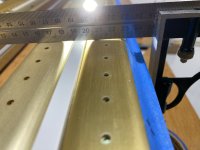
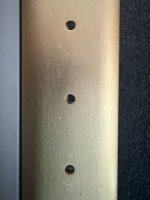
A 15 builder friend told me this doubler on his spar had the holes misaligned. A proper drill size or rivet would not go through. Has this happened on others? I'll check mine tomorrow.
IMG_0895.jpeg
 
Last edited:
Would go through…… or wouldn’t go through?
Edited for NOT go through. He said on one end of the doubler holes matched, but the other end did not match. Not clear if it is progressively offset along the length. I suggested using a drill bit solid end to roughly quantify the offset. The second spar was just fine. L/R not specified.
 
I just checked both of my spars. I can't get an LP4-3 rivet through any of the holes where the doubler is installed. On the shorter piece of the spar, it looks like the holes are visibly smaller than a regular size 30 hole. I can get a size #30 drill bit through the longer spar piece, but the shorter piece(the one with the doubler), I have to step down to a #31 drill bit to get through. I'm calling Van's in the morning, but has anyone reamed the spar to get rivets installed on the -15? If nobody else has done this, I don't plan on being the first.
 
I just checked both of my spars. I can't get an LP4-3 rivet through any of the holes where the doubler is installed. On the shorter piece of the spar, it looks like the holes are visibly smaller than a regular size 30 hole. I can get a size #30 drill bit through the longer spar piece, but the shorter piece(the one with the doubler), I have to step down to a #31 drill bit to get through. I'm calling Van's in the morning, but has anyone reamed the spar to get rivets installed on the -15? If nobody else has done this, I don't plan on being the first.
I checked my spars, and I have the same problem. It almost seems to me that the doubler didn't have clecos on one side during riveting. The misalignment on one of my spars is small, and I can pry the holes with some difficulty to be able to put LP4-3 rivets in them. But the misalignment on the second spar is much bigger and I can't pry it into place. The holes seem to be the correct diameter though.

I suspect that in the worst case, I could drill out all rivets from the doubler and re-rivet it. But I am definitely not going to do such a nice job like Van's did.
 

Attachments

  • IMG_2098.jpeg
    IMG_2098.jpeg
    979.4 KB · Views: 46
Last edited:
To answer questions about whether anyone has reamed the rivet holes on these 15 spars: Yes I have.

This is the 8th RV I have built. There have always been instances on every one when I had to ream a rivet hole to get a rivet to fit. What exactly does anyone think will happen to those rivet holes if you do have to ream them to get a rivet to fit? You should absolutely get advice from Vans on this concern, but I pretty much know what they will say.
 
I found in the drawings where it has you #30 ream on the smaller holes. Solves that question. Question remains on the other piece with the doubler. I’ll attempt to get an answer tomorrow.
 
To answer questions about whether anyone has reamed the rivet holes on these 15 spars: Yes I have.

This is the 8th RV I have built. There have always been instances on every one when I had to ream a rivet hole to get a rivet to fit. What exactly does anyone think will happen to those rivet holes if you do have to ream them to get a rivet to fit? You should absolutely get advice from Vans on this concern, but I pretty much know what they will say.
I consider reaming holes to be acceptable when the fastener will be a standard aluminum rivet because it does a fairly good job of entirely filling an irregular shaped hole.

I am not in favor of reaming when an LP4-3 or similar blind rivet will be used.
 
If you insert a cleco into every hole can you get the rivets to fit?

Also how long is the spar cap?
Reason I ask is that I have a spare RV10 HS rear spar in my garage roof.
The reason being - it was too long to punch in one operation so they move it in between punches. If the jigging isn’t right then you can have what I had which is 3/4 of the holes lining up but the second punched 1/4 don’t. Not by much - but enough to need a new part.
 
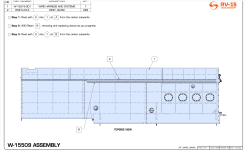
I'm not sure exactly where you are describing but the KAI's do call for reaming some holes during the skin riveting process. Step # 2 below.

Screenshot 2026-06-22 at 5.33.10 AM.png
 
Update on the OP - testing with the smooth end of a drill bit. #31 fits in the spar holes that get "reamed" but starting inboard on the doubler, a #34 fits vertically ending with a #47 on the outboard end. Just so you don't have to look it up, that is .0415" centerline offset.

It will be interesting to hear Vans recommendation.
 
My spar was measured - a #31 fit all doubler holes in one, but not a #30. Second spar was 34-33-32 with all holes offset perpendicular to the spar main axis. It appears that the bend angle of the cap varies on the length, and in the direction that would result in the shift. The greater bend the smaller the drill bit that passed. The photo illustrates the bend. I wonder if the bend spring back varies along the length due to the open areas in the center web and/or stiffness of the tooling. I thought Vans used long press brakes for this so, that seems unlikely.

A straight edge on the remainder of the spar length resulted in no gaps over both sides (fore/aft) of the caps. You can see the offset in the near fuzzy hole.

Spar IMG_9265.jpg
 
Any replies back from Vans on this issue?
Sorry, I had been excommunicated from VAF and only recently reinstated. I posted a lot more detail on the RV-15 forum of FB, but I'll summarize here.

I was the "builder friend" that @BillL referred to and thanks to him for posting on my behalf. I was concerned that this issue would not be discovered until someone was trying to rivet on the wing skin. Even then, given the instruction to ream those holes - a builder might never know.

As Bill passed along, I could only get a #34 drill bit into the first hole and it tapers to where only a #47 bit would fit. If one were to ream all the holes as stated in the KAI- there would be a lot of non-concentric holes in the doubler. Going from a #31 (which is what they should be) to a #30 would not remove much material. A new builder might not recognize how different reaming would be when one is removing a lot of material.

To Van's credit (at least initially), Tech Support got back to me very quickly stating that they would replace the spar immediately and would like the old one back for investigation. I have no doubt this doubler could be removed and a new, properly drilled one reinstalled using the equipment and processes they have in place at the factory.

Unfortunately, it has been crickets since then as I have heard nothing from them regarding shipping of a new spar, nor picking up the defective one. Doesn't really matter I guess since I also have two left flap spars, a bunch of missing tank parts (SB tanks) and only left aileron ribs.
 
I'm another -15 builder with the same hole misalign issue who reported the issue last week with detailed videos who is still waiting for a response.
 
I'm another -15 builder with the same hole misalign issue who reported the issue last week with detailed videos who is still waiting for a response.
The good news is we both caught this before assembling a majority of the wing.

The bad news is this should never have happened (decent QC would have caught this prior to shipping) and no telling how long it will be for Van’s to remedy the error.
 
Is the misalignment enough to prevent clecoes from going in?

I did not notice anything on my L wing (now complete); the clecoes for those aft holes were a bit tighter, but my assumption was that was due to them not being reamed. The reaming was uneventful, and similar across all of the holes (i.e. there weren't some that required excessive reaming).
 
Is the misalignment enough to prevent clecoes from going in?
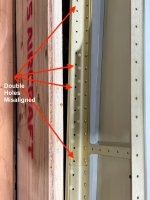
The misalignment on my spar absolutely would.

I would encourage everyone to check their spars across the 51 holes that has the underlying doubler. This is in the general area of the strut attach point. Make sure you can pass a #31 drill bit shank through these holes before you ream them. My holes were so misaligned that it only required a quick visual inspection to see the assembly error.