Radioflyer

Well Known Member
To my way of thinking, an engine hour is Tach Time of the bottom end or heart of the engine. The top end, typically cylinders, are more fungible. I think tach time is ideally more representative of actual engine wear and use. One can also consider Hobbs Time, which is usually some variable percentage (normally ~ 15% ?) higher, but doesn’t reflect relative idle vs high speed use. An engine hour is really not an absolute thing, right? Under ideal service conditions, engine hours can be a useful metric, but in real life…often not. Nevertheless, people often talk about engine hours (especially published TBO) as an absolute thing. Incidentally, I’ve looked at logs with tach and Hobbs used interchangeably.

A 300 tach hour engine has sat for 5 years with only an occasional brief run. That good sounding time is irrelevant, except for hope, with respect to condition. If an engine is opened for inspection after a prop strike, no defects found, and returned to service, it still retains the original service time… legally. To my mind, because of infant mortality or enhanced plastic strain, service time is now not so helpful. Simpler case - if an X time engine has all cylinders overhauled or replaced with (new or used) some hours later, time is still just X, but the number doesn’t reflect the improvement unless you study the logs.

Sorry for the rant, but I’m out of time.
 
Back when I started flying and it was common to fly trainers with no electrical systems, we paid for flight time by multiplying recording tach time by 1.3. Of course, there were lots of touch and goes in that time, so it probably did work out close to what a Hobbs would have measured had there been a Hobbs…
 
I was listening to one of Mike Busch webinars and I remember he said only the manufacturer can zero time the engine. If the engine is overhauled, cylinder(s) replaced, etc, then the hours continue to count on the same engine. There is no rolling back the hours from the engine log book. I suppose from your example, a 300 hours engine, after a complete overhaul, maybe with 1 cylinder replaced, it will still has 300 hours but in a much better shape than before.
 
An engine hour is really not an absolute thing, right?

Well it is according to 14 CFR 1.1 definitions -

"Time in service - with respect to maintenance time records, means the time from the moment an aircraft leaves the surface of the earth until it touches it at the next point of landing."

Neither Hobbs nor tachometer record that time but a Garmin G3X Touch system can be configured to do so.

I'm sure this has been debated ad nauseam but you did ask the question.

With respect to engine hours - who cares? If it's running fine leave it alone. People get so excited about 2,000 hour TBO on Lycoming engines but conveniently forget, or never knew, that TBO is 12 years or 2,000 hours, which ever happens first.
 
The question was specifically about engine time, not flight time. Obviously, the engine is logging time even before the plane flies. Yeah, my flight school also charged by Hobb time but used tach times multiplied by some factor when the Hobbs was non-functional. The idea being that since the engine was not running fast in the pattern that the tachometer under-reporting.

“…who cares?” Really?
 
Last edited:
In the pre-dinosaur days, we (EABer’s) had different ways of slowing down accumulated engine hours logged. One (sneaky) way was to install a mechanical tach geared for a fixed pitch propeller (2500 RPM cruise), and then with a constant speed propeller you could operate at a lower RPM - say in my Rocket’s case, 2200 RPM. So do the math - for every hour flown at 2200 RPM cruise, would net 22/25ths (.88 hrs). So … over time you accumulated “free” engine hours toward your TBO.

Kinda like the shell game - “Where’s the Pea”.

My FSDO inspector never asked about at the certification inspection, and I sure as h**l didn’t offer it …

HFS
 
The answer was about engine time not flight time. The FAA definition of flight time is very different

edited to add "FAA".
Hmmm, maybe you're right, but I don't think so. There is no specific mention of "engine", but there is reference to "aircraft". My interpretation of that CFR definition that you mentioned is that it refers to the maintenance logs of the aircraft, not the engine specifically. (Most people keep separate airframe and powerplant logs, right?) But by mentioning that CFR definition, you raise one of the points I'm trying to make i.e., there is no absolute meaning to "engine time", at the very least because people use different time standards.

All those start-up times (especially in winters), maintenance ground testing, and taxi times add up meaningfully in the time history of an engine. My brand new engine had at least 1 hour of run time before it was delivered and so my engine logbook starts with 1 hour, actually more before the plane actually flew. I would argue that time and all the other low speed run times (flying or not) are cumulative and count toward engine condition. Another point I was questioning was whether there was agreement that tach time is more representative of "engine time" than say, Hobb time.

BTW, my post was for academic discussion of the relative meaning of engine time. My engine is healthy, running well, and I'm not trying to solve or justify any mechanical issue. However, insofar as I do care about things like oil changes, magneto overhaul times, intake gasket deterioration, hoses, etc, I do care about what is the best representation of engine time. (Admittedly, other maintenance items are perhaps better monitored "on condition".) Also, I do know that as an "experimental" there is no requirement to record times or even keep logs, except for recording the condition inspection, but good luck with that on the resale market.
 
There is no specific mention of "engine", but there is reference to "aircraft". My interpretation of that CFR definition that you mentioned is that it refers to the maintenance logs of the aircraft, not the engine specifically

It is a definition of the term "time in service", no more, and no less. How time in service is applied to the engine, airframe, propeller, or any installed appliances would be as defined in any applicable regulation.

Maybe a read of AC 43-9C would make it clearer. It includes -

(1) Section 91.417(a)(2)(i). Requires a record of total time in service to be kept for the airframe, each engine, and each propeller. Part 1, § 1.1, Definitions, defines time in service, with respect to maintenance time records, as that time from the moment an aircraft leaves the surface of the earth until it touches down at the next point of landing.

Please understand that I'm not telling anyone how their engine, airframe, or propeller time should be logged. I'm only saying that FAA has defined what they expect to be recorded.
 
Back when I started flying and it was common to fly trainers with no electrical systems, we paid for flight time by multiplying recording tach time by 1.3. Of course, there were lots of touch and goes in that time, so it probably did work out close to what a Hobbs would have measured had there been a Hobbs…
Isn't that just a marketing ploy so they could advertise lower rates? :)
 
Back when I started flying and it was common to fly trainers with no electrical systems, we paid for flight time by multiplying recording tach time by 1.3. Of course, there were lots of touch and goes in that time, so it probably did work out close to what a Hobbs would have measured had there been a Hobbs…
My post dinner flier is a 42 J3 Cub. Foreflight recorded 135 hours last year, my tach recorded 65hrs! I averaged 2.4 landings per hour, so those 1500 RPM descents really impact the "time" acuracy.

I try not to think about what that means to the airframes ACTUAL TT :(
 
When I was just starting out we would charge based on hobbs and schedule maintenance based on tach. I maintain my own plane based on hobbs.
danny


Please understand that I'm not telling anyone how their engine, airframe, or propeller time should be logged. I'm only saying that FAA has defined what they expect to be recorded.
Ok, so your point is that the FAA doesn’t count any engine time unless it is in flight. I guess that will make sense to some. The second my wheels leave the ground, I will have to record the time on the meter, lol.

Does the FAA say anything about what type of “time in service” to log, Hobbs or tach? Every engine logbook I’ve ever seen has a column labeled “recording tach time”. Why would that be?

Tach time makes sense to me for engine maintenance purposes, from engine start to off. I still think it more truly represents engine usage and wear than Hobbs time. An engine at 1500 or 2200 rpm is working and wearing less than at 2700. Tach time would reflect this but Hobbs would not. Perhaps the most important thing is to be aware of what exactly one is recording and being consistent.

Now, is it better to use knots or mph for airspeed? Just kidding, pls don’t answer!
 
There is a good bit of history on tach time that spreads across the engine industry. Engine ratings (generally) were max power and continuous power. The difference was primarily lower rpm which was piston speed in ft/min, and BMEP or in aviation is manifold pressure. For the Lycoming that is roughly 2700 rpm and 2500 RPM. The tach was mechanical so hours were really revolutions, and an hour was at "cruise" or "continuous" RPM or about 2500. With EFIS managing this it is what you say it is. And that was always the case with engine manufacturers - it is what they say it is. Uninteresting answer, and not definitive, but relates to the general confusion about tach time.

You might recall that Road & Track always reported piston travel per mile of distance traveled. That was supposed to relate to wear/durability.

Surely Radioflyer has lost interest in this thread and will never find this answer.
 
There is a good bit of history on tach time that spreads across the engine industry. Engine ratings (generally) were max power and continuous power. The difference was primarily lower rpm which was piston speed in ft/min, and BMEP or in aviation is manifold pressure. For the Lycoming that is roughly 2700 rpm and 2500 RPM. The tach was mechanical so hours were really revolutions, and an hour was at "cruise" or "continuous" RPM or about 2500. With EFIS managing this it is what you say it is. And that was always the case with engine manufacturers - it is what they say it is. Uninteresting answer, and not definitive, but relates to the general confusion about tach time.
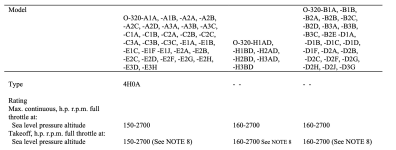
Just to be clear, for most (if not all) normally aspirated Lycoming engines, max continuous power is full (100%) rated power.

For example, note this clip from the FAA TCDS E-274 for the O-320 series. Max continuous power is 150/160 hp at 2700 rpm, which is full (100%) rated power.

1784431528079.png