Python

Active Member
Hi, I’m thinking about changing my FP Sensenich metal prop to a Sensenich composite ground adjustable for my 160hp RV 6. Has anyone done this before & are these suitable ? Are 3 blade or 2 blade preferable ? Apart from the obvious advantages of changing pitch & less weight are they smoother ( less vibration) than the metal prop ? Also will they handle rain ? Cheers 🐍.
 
Hi, I’m thinking about changing my FP Sensenich metal prop to a Sensenich composite ground adjustable for my 160hp RV 6. Has anyone done this before & are these suitable ? Are 3 blade or 2 blade preferable ? Apart from the obvious advantages of changing pitch & less weight are they smoother ( less vibration) than the metal prop ? Also will they handle rain ? Cheers 🐍.
Original wood propeller, was changed to a metal Sensenich, and now to GA Sensenich on my O-320 RV6. Yes, the Sensenich GA are suitable for the RV6, recognizing the lighter weight of the GA will change the weight and balance. There does not appear to be a performance preference between the 2 and 3 blade propellers. My Sensenich GA is not any smoother than the metal propeller. Both dynamically balanced to very low vibration. I have not flown the GA in rain so no experience.
 
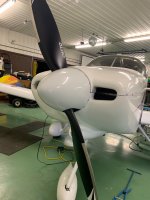
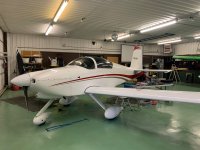
On my 9a with stock 160HP -320 I just changed from a metal Sensenich 2B to a 2B Catto composite. The Catto prop is lighter, smoother, and resulted in 5mph faster cruise and no RPM limitation. I also saw my CHT on climb out lower by 50 degrees and my rate of climb go up by over 200 fpm. This spring, I will increase pitch a bit more and really go fast! Now in std loading, level cruise flight, my elevator runs flush with the H-Stabilizer due to change in cg further aft.
 

Attachments

  • N839RV Mar 26 2.jpg
    N839RV Mar 26 2.jpg
    421.2 KB · Views: 39
  • N839RV Mar 26 3.jpg
    N839RV Mar 26 3.jpg
    466.1 KB · Views: 38
Original wood propeller, was changed to a metal Sensenich, and now to GA Sensenich on my O-320 RV6. Yes, the Sensenich GA are suitable for the RV6, recognizing the lighter weight of the GA will change the weight and balance. There does not appear to be a performance preference between the 2 and 3 blade propellers. My Sensenich GA is not any smoother than the metal propeller. Both dynamically balanced to very low vibration. I have not flown the GA in rain so no experience.
Same path for my RV-6. Now I've got the 2 blade composite GA propeller on it, and have put several hundred hours on it. I've flown in it rain a number of times and haven't noticed any issues, erosion, or other signs of wear. It's a good prop.

--Ron
 
Hi, I’m thinking about changing my FP Sensenich metal prop to a Sensenich composite ground adjustable for my 160hp RV 6. Has anyone done this before & are these suitable ? Are 3 blade or 2 blade preferable ? Apart from the obvious advantages of changing pitch & less weight are they smoother ( less vibration) than the metal prop ? Also will they handle rain ? Cheers 🐍.
I just did this. Swapped a two-blade aluminum Sensenich 72FM8SS9-1-85 for a three-blade, composite ground-adjustable Sensenich 3F0M8-C68NFF. This is on an 8A with an IO-360. I haven’t flown the new prop yet, but the condition inspection should be completed this week, so hopefully I’ll fly it soon.
 
Hi, I’m thinking about changing my FP Sensenich metal prop to a Sensenich composite ground adjustable for my 160hp RV 6. Has anyone done this before & are these suitable ? Are 3 blade or 2 blade preferable ? Apart from the obvious advantages of changing pitch & less weight are they smoother ( less vibration) than the metal prop ? Also will they handle rain ? Cheers 🐍.
I have a Sensenich 2 blade GA (I need to sell) that I flew for a year. I converted to CS at engine overhaul. I did fly through light rain with no effect on the prop. I don't know about vibration compared to metal but the GA Sensenich is very smooth and because its light engine acceleration is very fast. Cruise speed is the same with the GA compared to the CS.
 
hello, I wish I saw your post earlier.. as I just purchased a 3 blade GA... I'm still waiting on it.
Question... What airplane did you install it,.. did you go from a metal fixed pitch to a composite GA? how much lighter was it with the spinner?... Did you need to add ballast in the front or what did you do and what did you feel? I would appreciate the info and experience you had
 
I have an RV8A with an IO-360. I removed a Sensenich 72FM8SS9-1-85 at 25 lb and put on a Sensenich 3F0M8-C68NFF at 16 lb. I only have 1.5 hours on it so far, so not much experience yet.
 
I have read and heard that the lighter Sensenich composition prop has very fast “almost immediate thrust”. But I have not heard anyone talk about how the prop acts with reduction of power and “braking effect”. Is it similarly fast as well without the heavy inertia of a metal prop?
 
Once I get some time on it, I can let you know what my thoughts are. If I don’t get back with you in a few weeks, feel free to ask again.
 
I replaced my FP Senseich Metal prop with a Cato Ground Adjustable 2B Composite prop. Attached is a datasheet I am updating with comparison data. I use the EAA RV9a flight test data as a solid benchmark, but that plane was factory built and used a MT composite 3B Constant Speed Prop. The immediate results were less vibration, improved CHT temps and fast reaction to power changes. Also loved losing a big chunk of mass from the nose.
 

Attachments

hello, I wish I saw your post earlier.. as I just purchased a 3 blade GA... I'm still waiting on it.
Question... What airplane did you install it,.. did you go from a metal fixed pitch to a composite GA? how much lighter was it with the spinner?... Did you need to add ballast in the front or what did you do and what did you feel? I would appreciate the info and experience you had
Hello, I bought the airplane with a Sensenich 2 blade ground adjustable. It was a great prop. I decided to go to a CS prop because I operate at high denisty altitudes in the summer,. I replaced the Sensenich with the Wirlwind 3 blade 300 CS. Since both a are composite there was not a problem with CG. I didn't have to add any balast.
 
I have read and heard that the lighter Sensenich composition prop has very fast “almost immediate thrust”. But I have not heard anyone talk about how the prop acts with reduction of power and “braking effect”. Is it similarly fast as well without the heavy inertia of a metal prop?
I do not think I got the "brake effect" with the GA prop like I do with the CS prop I have now.
 
The only prop I know of that has a break effect is our Performance Prop due to the prop design and material(mult lam wood).

We have sold a ton of the sensenich GA’s and a lot of folks like them. The pin/pitch adjustment is easy and effective.
 
The only prop I know of that has a break effect is our Performance Prop due to the prop design and material(mult lam wood).
I can attest to this and view it as a real benefit and I have a related question. I used to fly formation with a friend that had some other wooden prop on his RV4 and I had a Performance Propeller prop on my RV3. When we both chopped the power, he would shoot ahead of me. I have the same model Performance Propeller prop on the biplane I built but have not yet flown formation with anyone. This time however, due to W&B concerns, I have a 20lb Sabre Manufacturing crush plate which I hope to someday reduce to a 10lb plate. (I doubt I can eliminate it completely.). How much of that braking effect is due to prop design and how much is due to inertia?
 
I can attest to this and view it as a real benefit and I have a related question. I used to fly formation with a friend that had some other wooden prop on his RV4 and I had a Performance Propeller prop on my RV3. When we both chopped the power, he would shoot ahead of me. I have the same model Performance Propeller prop on the biplane I built but have not yet flown formation with anyone. This time however, due to W&B concerns, I have a 20lb Sabre Manufacturing crush plate which I hope to someday reduce to a 10lb plate. (I doubt I can eliminate it completely.). How much of that braking effect is due to prop design and how much is due to inertia?
The “braking effect” on Performance Prop blades has been seen across all crush plates (standard to weighted) so we attribute the effect to the blade design and materials/manufacturing.

D
 
The “braking effect” on Performance Prop blades has been seen across all crush plates (standard to weighted) so we attribute the effect to the blade design and materials/manufacturing.

D
Awesome. Thank you very much for the response. I have noticed this about the heavy crush plate…the engine is so much smoother at very low rpm (like 500 with no tendency to stall) compared to the prop w/o a heavy crush plate. Not surprising but another nice benefit.

As for the blade design and materials used on Performance Propellers, I believe it to be similar to this anecdotal story about Twisted Composites carbon fiber props but w/o the potentially bad outcome….

Used to race Formula One and we ran those CF props and spun them up above 4K rpm. We were always cautioned to never chop the power bc the “unloading” of the blades could be catastrophic. So at the end of the race when we zoomed, we would always ease the power back. At the end of one race I zoomed and tried to ease the power back but the throttle was stuck wide open. I tried a second time with a little more force and still _nothing_. I was beginning to get high and slow and a real sense of urgency was developing so I “yanked” the throttle back on the 3rd attempt which cleared the problem. However…the prop unloaded so dramatically it sent a vibration through the entire airframe which made me think I might have, or was in danger of shedding a blade.