Louise Hose

Well Known Member
Sponsor
It Begins….Again!

I has been a long time since I posted about my project but I’m happy to say that I received the entire tail kit last Saturday and began work on it immediately. Since most of our workshop has been commandeered by John Stahr, who is painting Paul’s recently completed F-1 Rocket, I decided to put the right wing away for the time being and work on the newly obtained tail as each sub-kit takes up FAR less room than the remaining wing.

First, a few observations on the tail kit.
  • The first 20 tail kits ordered were sent out into the wild nearly three weeks earlier than the expected shipping date. Wow! And, apparently, they are “complete” (if one doesn’t expect fiberglass tips at this time). Just the horizontal stab, vertical stab, rudder, and elevators. No tail cone.
  • Big thanks to Mike (Catmandu), Karen, and Chris for making the pickup and delivery work! I owe you on the next will call pick-up.
  • While a couple folks reported a “defective” rudder skin, apparently they caught the problem before Mike and my kits were released. If the problem is what I suspect it is (16 missing holes), the fix will be SUPER easy and I would have just accepted a template to drill the holes instead of asking for new skins.
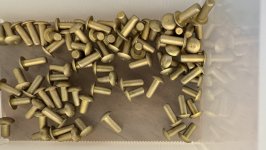
  • Only one error was found in inventory. Half of the AN470AD4-4.5 were -5.5. Apparently, others have had the same issue (corrupted bin at the factory?). But, it will be easy to cut the -5.5s down to -4.5s. There were also a couple of odd things listed that I don’t think are actual parts but some remnant of computer reliance. We will see, but I don’t think they are real, stand-alone parts.
  • Unpacking and inventorying, pretty much alone, took about 3 hours but was interrupted frequently by other shop activities. There are surprisingly few parts!
  • The KAIs have changed a bit, probably for the better. A QR code is on the 4th page to direct the builder to the Builder Feedback page. Seems like the drawings are even more detailed than the wing drawings. My favorite, the item numbers remain consistent throughout the Section instead of changing on each page. This will undoubtedly require a little bit of adaptation moving from the Wing KAIs to Tail KAIs since they are done differently, and both work, but it seem to me to be a more logical approach in the Tail KAIs.
  • Different from the Wing kit, the Tail kit commonly has some extra rivets and washers. This is a very welcomed change, especially for folks who haven't built before and collected a lot of spar rivets and washers in their workshops.
The formed pieces in the tail are a bit startling. There are some press-ins already installed! LOTS of pre-dimpled holes, not just for nutplates in this kit. Again, very little deburring needed and, so far, it looks like very little fluting will be required. Time to dive in!!!

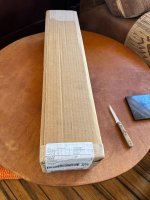
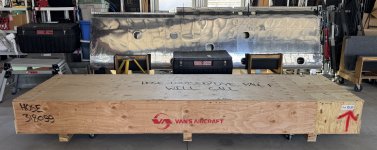
The Box.JPG
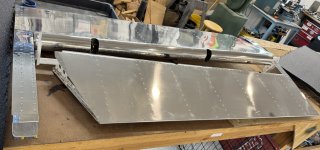
The box was delivered to our hangar by Catmandu and Karen and sits in front of the completed left wing.
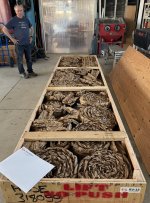
OpenBox.JPG
Crate after opening with inventory list sitting on the corner.
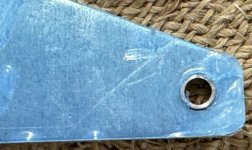
Pre-installed Bushing.JPG
Bushing already pushed in!

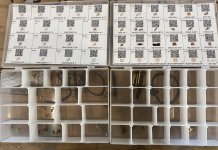
MixedRivets.JPG
The only error found in inventorying...mixed size rivets in one partition of the "tackle boxes". Fortunately, the incorrect sized ones are larger and can be cut to the appropriate size.
 
Last edited:
Vertical Stabilizer – Section 6 - VS-15505

I was able to finish the vertical stabilizer in three part-time days of work. Probably about 15-20 hours mostly working along. Removing the blue plastic then remarking parts, deburring, and primering three pieces of thicker aluminum took about 2-3 hours.

This piece was a true joy to assemble and it put together very fast. No submissions to the Van’s builder feedback was needed. This vertical stabilizer kit meets the very high expectations that were set by Van’s for the RV-15 kit! I did have to countersink a lot of holes of two different sizes, just to get a taste of earlier building skills, I guess. There are also quite a few solid rivets, both flush and round-head, to squeeze. Boy, I sure appreciate our too-expensive hydraulic squeezer! But, no shooting of rivets was required.

Only one task was beyond my immediate capacity. A #12 reamer was called for on six holes and, perhaps surprisingly, we don’t have one. But, it wasn’t a show stopper. All of the holes will not be used until much later (maybe a year?), so an order off to ACS is scheduled next week, long before reaming those holes will be necessary.

The only other “lesson learned” was at the very last on page 6-36. I had been squeezing these rivets with two dyes until I reached the leading edge and the dye wouldn’t fit. I switch to a “no-hole” yoke, which worked great. I then realized that I would have had better success on all the rivets with the “no-hole” yoke.

This effort was really fun. In the future, I expect folks will buy and start the tail kit first and it will be a wonderful way to start! Working almost entirely alone, the total time spent on this sub-kit was probably less than 15 hours. Maybe more like 10 hours.

On to the rudder!IMG_8931.JPG
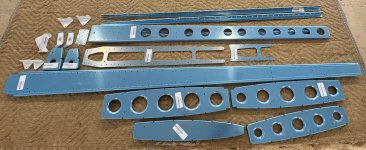
Let the fun begin! All parts of the VS sub-kit ready to be made ready.

IMG_9176.JPG
Cleco the skin in its entirety before pulling and squeezing rivets!

IMG_8941.JPG
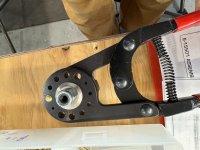
This area at the leading edge on both sides wouldn't allow a squeezer with a dye into the cramped space. A "no-hole" yoke worked great here.
Finished.jpeg
Finished!
 
Last edited:
Rudder – Section 7 - R-15503

Expectations met....and greatly exceeded. I pulled out the rudder sub-kit yesterday afternoon, did the prep work in about two hours as there are few parts and no fluting was required, and did 20 minutes of assembling last night after an evening social event because I was anxious to get started. The rudder was completed today! Probably about 10-12 hours of work, mostly solo. No KAIs issues. No missing parts. No fabrication. Pretty much just pulling off blue plastic, cleaning up edges, primering a few pieces, and very quick deburring of edges and one side of the holes. Then mostly Cleco and rivet. I did have a proto-RV-15 builder, Chris O'Neill, drop in and he helped with one two-person task. And, Paul helped pull the 448 blind rivets and add "goop" between the stringers. This tail kit, at least so far, is amazing! It really has been a pleasure of assembling.

Lessons learned (and there isn't much):
1. Paul has a DIY tool made from PVC materials that helped a lot in setting and "torquing" the bearing rods on page R07-10. A second person was helpful for this step and I was lucky that Chris happened to drop by this morning.
SettingTensionOnRodEndBearing.JPG
Paul's PVC tool allowed Chris to hold the rod end bearing in place without damaging the bearing, while I tightened the lock nut and "torqued" it.

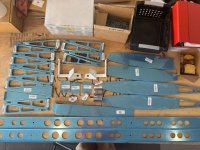
RudderPieces.JPG
You basically build to assemblies: The rudder skeleton/spar, seen in the upper right, and the rudder skin with stiffeners. Once both are completed, the two are mated and the skin is closed out.

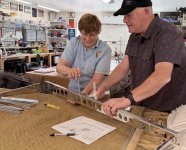
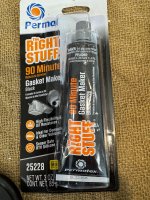
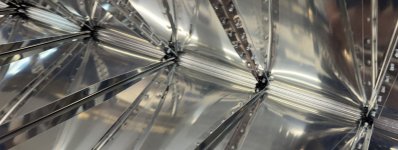
2. Although not described in the KAIs, Wheeler North (AlphaAlpha) had alerted us to the advisability of adding a soft buffer (he suggested ProSeal) between the stiffeners before closing the rudder skin. This would be between Steps 1 and 2 on page 07-14. While this is probably more important in fast RVs (and adds a very small amount of weight at the extreme aft end), I decided to do something similar. Paul suggested using black Right Stuff, which doesn't require mixing. This step was definitely a two-person job and we pre-briefed on exactly how we were going to do it so there was no putting together and then pulling apart. One person pried the two side of the rudder skin open wide (we felt a bit like dentists!) while the other squirted a glob of Right Stuff on and between the aft ends of the stiffeners. Once applied to all pairs of stiffeners, the skeletal framework was inserted, we ensured that the starboard side of the skin with the broken edge was overlapping the port side, and the skin was quickly Cleco-ed on. Planning it out ahead of time led to a very smooth and successful assembly.
IMG_8964.JPG
Right Stuff is an alternative to ProSeal for providing a pliable buffer between the rudder stiffeners.

RightStuff-EndofStiffener.JPG
The little black dobs of Right Stuff where the stiffeners come close together are used to prevent cracks forming from vibration. Commonly done on "high-speed" RVs, we decided to add these dobs to the RV-15 rudder.

RudderFinished.JPG
Completed rudder only took just over a day of work.

There isn't much else to write about this Section 7.

I did receive the #12 reamer in the mail today from ACS, many days faster than they had predicted. I reamed the 6 holes in the vertical stab and also called that Section 6 "complete" today.
Number12Reamer.JPG With this #12 reamer in hand today, I also finished Section 6.
 
Horizontal Stabilizer – Section 8 – HS-15505

Van’s success with this tail kit keeps going! I have completed the tail (except two little tasks awaiting delivery) and it has been close to flawless! Below is the report on the horizontal stabilizer, probably the most time-consuming part of the kit. It took me 7 days of almost entirely solo, part-time work. I would guess about 40 hours. Probably a full 8 hours of that was spent at the front end removing blue plastic, deburring, and primering about a dozen pieces.

I found only one, obvious corrections in the KAIs and no issues with the parts. I do have one question, which maybe I should have answered before completing the section according to the KAIs. How are the (presumably) fiberglass tips going to attached? Unlike the elevators, there is no end row of open holes for later attachment. The answer is currently a mystery but I followed the KAIs. An example of “Trust”, but failure to verify. ☹ I’m hoping it works out but all that would likely be lost is drilling out about a score of rivets.

Lessons learned:

Very early on, I realized that many of the pieces are symmetrical or nearly so. It was really helpful to label everything as “top”, “bottom”, “port”, and “starboard” as soon as you started manipulating pieces. As soon as the KAIs start showing arrows indicating forward, up, and left, start marking your pieces accordingly.

Page 08-08 – While the directions have one drilling out the powder coat, which we need to do to get the Clecos in, I found that I also have to “chase” as least some of the holes to then get the rivets in. No biggie, obviously.

Page 08-11 – I found this task a bit difficult. “Big Mama”, Dave Howe’s built deeeeeep throated yoke, to the rescue. This is one of two or three times that I needed a second person to help, by holding the spar.

Page 08-21&22 – I ended up shooting the rivets in Step 3.
IMG_8994.JPG
I found it easier to shot some rivets that were near flanges and other interference areas.


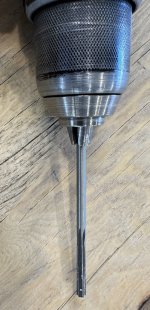
Page 08-27 – The KAIs don’t tell you (but, perhaps, you’ve already learned by now) that you will need to use a #12 drill to remove powder coat and then, probably, to chase the holes.

Page 08-28 – I have done tasks like Step 1 before and dreaded trying to align every thing. However, using a Washer Wrench, as the KAIs suggested, worked great and this ended up being a very easy task.
IMG_9001.JPGIMG_8999.JPG
A Washer Wrench made Page 08-28 easy.

IMG_9002.JPG
Like each sub-assembly so far, I completes a skeleton and then covers it. Here is the completed horizontal stab skeleton.


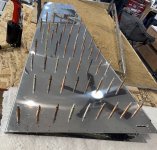
Page 08-30 - Best hack of this section was Paul's suggestion that I make a wooden wedge to tape to the "top" of the no-hole yoke so that it would lie level on the workbench and allow the squeezer to come down in line with the rivet. It worked GREAT! 84 nutplates and 168 rivets knocked off in no time!

IMG_9352.JPG
Best hack of the project, so far. I love our Numatx squeezer! Perhaps the best Valentine's Day gift, ever.

Page 08-35a – First, before I started, I taped over the two rows of holes on each side that are NOT supposed to be riveted. What they are eventually for, I don’t know. Some sort of fairing attachment? You won’t work with them at all during tail construction. Then, as directed, I riveted the spars first and then, following the advice in the Wing Section, I started at the center and worked outward. One other hint, I found it worked best to rivet all the top holes (A), including the one flush rivet (B) and then the single side rivet (another A). The last rivet lined up nicely doing it this way.
IMG_9019.JPG
Cover or clearly mark those two rolls of holes in the center on each side and keep them covered/marked until done. Note that the last hole leading edge side does not get covered. Check the KAI drawings carefully.

Page 08-36, Step 1 – This part presented my biggest challenges. The challenge comes from the dimples extending to within 1/8” of the edge so a “traditional” break, as outlined in Section 5 can’t carry pass the many dimpled holes. I tried using the breaking tool that came in the kit, made the groove only 1/8” deep, and found that I couldn’t get a break. Likely that my hand strength is inadequate for this moderately thick sheet of aluminum. I ended up using our regular breaking tool and hacked my way along the edges. Any dreams of a Lindy (or even Workmanship) Award are now vanished. Fortunately, I have no such dreams! I’m pretty sure the plane will not fall out of the air due to the resulting gaps. Other builders will likely find ways to do it better.

Page 08-36, Step 3 – Starting the screws on the second side requires a second person or strapping the skin down. We realized that figuring out how to tighten the straps without damaging the skin on the aft edge would take some time so Paul just pulled the skin towards the aft while I installed the six middle (waxed) screws on each side. After that, I was able to put the remaining screws alone.

IMG_9024.JPG
Hardware box is nearly empty at the end of the project. I suppose those bolts will come in handy later....or I really screwed up somewhere!

DONE!
 
Last edited:
Elevators – Section 9 – HS-15505

Wow. Just, wow! Another super quick build with really high-quality parts. Although I am writing up this tail section in order, the truth is that I built the elevators before the horizontal stab. I can attest that you can build each of the tail components, vertical stab, horizontal stab, rudder, and elevators in any order. In order of ease and speed, I would probably place the rudder as easiest, followed by elevators, vertical stab, and then horizontal stab. None are hard. All are super high quality. The horizontal stab will also be the hardest to find space for storing, so making it last makes sense to me. However, I ended up moving the elevators ahead of the horizontal stab because, at that time, Paul’s F1 Rocket was about to be painted and most of the shop became overtaken by the John Stahr “experience”. I carved out one, small section of the shop and the elevators fit but the horizontal stab would not have found a place.

As noted elsewhere, there was one (and only one) factory-induce problem. One part was miss punched and replacements are on their way. Otherwise, the KAIs and parts provided were flawless. Van’s seems to have SIGNIFICANTLY up their game and learned from earlier experiences. I also, during this part of the build, ran out of one size of rivets that had been shorted on original delivery. No real problem as I cut a bunch of longer rivets in our supplies to the proper length.

IMG_8974.JPGIMG_8975.JPG
Many parts but a super-quick build. A good rivet cutter is great to keep progress moving forward.

Lessons learned (so few!):

Page 09-16 – Be sure to clearly mark (or tape off) the lines of holes that should NOT be pulled.
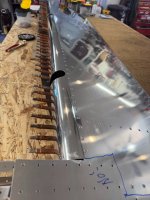
IMG_8978.JPGAs always, clearly mark (or tape over) areas that should NOT have rivets pulled when working on large areas. (I clearly mark areas to be pulled when working on small areas.)

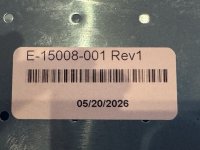
Page 09-21 – My part E-15008-001 was incorrectly punched and will soon be replaced. This is probably only an issue for the folks who got their kits during the first week…the first 20…and they should have been contacted by now. But, for details, see my post in the RV-15 forum.

That’s it! The build took 4 days and, maybe, 30 hours. But, I don’t log time and there was so much going on simultaneously that my estimate is rough. I expect that prepping and installing the two skins when they arrive and then installing the counterweights will take less than an hour.

Entire tail now completed (except that additional hour of work in the near future) two weeks before my original delivery date for the kit. Hooray!
 
Last edited:
Thanks for the notes, Louise! Progress is looking good.

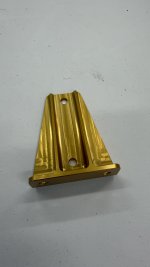
Were the HS brackets in your pic above unfinished, or did you choose to prime them? Mine arrived with gold anodizing:

IMG_8036.jpeg
 
The KAIs specifically say to Coat these parts "with a suitable corrosion resistant finish. The anodized finish on these components is not intended as a stand alone corrosion preventative." Thus, I primered these beautiful pieces. :( See Page 08-07, Step 5.
 
Interesting!! I had not read that yet.
I also have not put the strut attach points into the wing - same deal there?

I wonder what the point of that nice finish is…
 
Taping over un-riveted areas is how I do it. I use red electrical tape, which I only use for important notices to myself. It releases without residue anytime, at least the 3M version does, and if I see it I know something there needs attention.

Dave
 
The KAIs specifically say to Coat these parts "with a suitable corrosion resistant finish. The anodized finish on these components is not intended as a stand alone corrosion preventative." Thus, I primered these beautiful pieces. :( See Page 08-07, Step 5.
That is really interesting as the anodized finish makes the aluminum highly corrosion resistant. There is a mention of "sealing" it, though.

From the web:

Yes, anodized aluminum is highly corrosion resistant. The anodizing process transforms the metal's surface into a durable, thick aluminum oxide layer that acts as an impermeable barrier against oxygen, moisture, and environmental elements. [1, 2, 3]

Key Performance Factors
  • Normal Environments: Properly anodized parts resist corrosion for decades, making them ideal for outdoor architecture and consumer goods.
  • Sealing: The anodized layer is naturally porous and requires a post-treatment seal (usually with boiling water or chemicals) to achieve peak corrosion resistance.
  • Limitations: While superior to standard aluminum, the protective layer can degrade if exposed to harsh, highly acidic or alkaline environments, or continuous salt spray, unless specialized sealants are applied.
    • Damage: If the hard anodic layer is scratched or chipped, the underlying aluminum is exposed. However, the corrosion will be localized, showing up as a white or gray powder rather than spreading.[1, 2, 3, 4]
 
Elevators – Section 9 – HS-15505 -- Part 2

The tail is truly done now. The two replacement strips arrived last night in a small, very light package through FedEx. I ripped the blue plastic off while watching TV last night then spent a couple of hours in the shop finishing both elevators this morning. Completely done twelve days before the original shipping/pickup date of June 9th. Truly a great experience! Back to finishing the starboard wing now that Paul's rocket is painted and there is room in the shop for the big, old wing.
Package arrives.JPG RevisedPart.JPG CompletedElevators.JPG
Fed Ex package brought good things! Be sure your kit has the "Rev1" part. Both elevators completed , meaning the entire tail kit is completed.
 
Horizontal Stabilizer – Section 8 – HS-15505

Van’s success with this tail kit keeps going! I have completed the tail (except two little tasks awaiting delivery) and it has been close to flawless! Below is the report on the horizontal stabilizer, probably the most time-consuming part of the kit. It took me 7 days of almost entirely solo, part-time work. I would guess about 40 hours. Probably a full 8 hours of that was spent at the front end removing blue plastic, deburring, and primering about a dozen pieces.

I found only one, obvious corrections in the KAIs and no issues with the parts. I do have one question, which maybe I should have answered before completing the section according to the KAIs. How are the (presumably) fiberglass tips going to attached? Unlike the elevators, there is no end row of open holes for later attachment. The answer is currently a mystery but I followed the KAIs. An example of “Trust”, but failure to verify. ☹ I’m hoping it works out but all that would likely be lost is drilling out about a score of rivets.

Lessons learned:

Very early on, I realized that many of the pieces are symmetrical or nearly so. It was really helpful to label everything as “top”, “bottom”, “port”, and “starboard” as soon as you started manipulating pieces. As soon as the KAIs start showing arrows indicating forward, up, and left, start marking your pieces accordingly.

Page 08-08 – While the directions have one drilling out the powder coat, which we need to do to get the Clecos in, I found that I also have to “chase” as least some of the holes to then get the rivets in. No biggie, obviously.

Page 08-11 – I found this task a bit difficult. “Big Mama”, Dave Howe’s built deeeeeep throated yoke, to the rescue. This is one of two or three times that I needed a second person to help, by holding the spar.

Page 08-21&22 – I ended up shooting the rivets in Step 3.
View attachment 118848
I found it easier to shot some rivets that were near flanges and other interference areas.


Page 08-27 – The KAIs don’t tell you (but, perhaps, you’ve already learned by now) that you will need to use a #12 drill to remove powder coat and then, probably, to chase the holes.

Page 08-28 – I have done tasks like Step 1 before and dreaded trying to align every thing. However, using a Washer Wrench, as the KAIs suggested, worked great and this ended up being a very easy task.
View attachment 118850View attachment 118849
A Washer Wrench made Page 08-28 easy.

View attachment 118853
Like each sub-assembly so far, I completes a skeleton and then covers it. Here is the completed horizontal stab skeleton.


Page 08-30 - Best hack of this section was Paul's suggestion that I make a wooden wedge to tape to the "top" of the no-hole yoke so that it would lie level on the workbench and allow the squeezer to come down in line with the rivet. It worked GREAT! 84 nutplates and 168 rivets knocked off in no time!

View attachment 118855
Best hack of the project, so far. I love our Numatx squeezer! Perhaps the best Valentine's Day gift, ever.

Page 08-35a – First, before I started, I taped over the two rows of holes on each side that are NOT supposed to be riveted. What they are eventually for, I don’t know. Some sort of fairing attachment? You won’t work with them at all during tail construction. Then, as directed, I riveted the spars first and then, following the advice in the Wing Section, I started at the center and worked outward. One other hint, I found it worked best to rivet all the top holes (A), including the one flush rivet (B) and then the single side rivet (another A). The last rivet lined up nicely doing it this way.
View attachment 118854
Cover or clearly mark those two rolls of holes in the center on each side and keep them covered/marked until done. Note that the last hole leading edge side does not get covered. Check the KAI drawings carefully.

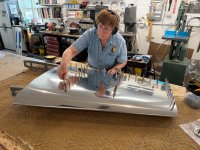
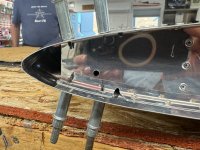
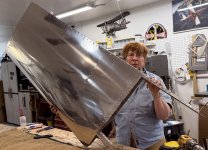
Page 08-36, Step 1 – This part presented my biggest challenges. The challenge comes from the dimples extending to within 1/8” of the edge so a “traditional” break, as outlined in Section 5 can’t carry pass the many dimpled holes. I tried using the breaking tool that came in the kit, made the groove only 1/8” deep, and found that I couldn’t get a break. Likely that my hand strength is inadequate for this moderately thick sheet of aluminum. I ended up using our regular breaking tool and hacked my way along the edges. Any dreams of a Lindy (or even Workmanship) Award are now vanished. Fortunately, I have no such dreams! I’m pretty sure the plane will not fall out of the air due to the resulting gaps. Other builders will likely find ways to do it better.

Page 08-36, Step 3 – Starting the screws on the second side requires a second person or strapping the skin down. We realized that figuring out how to tighten the straps without damaging the skin on the aft edge would take some time so Paul just pulled the skin towards the aft while I installed the six middle (waxed) screws on each side. After that, I was able to put the remaining screws alone.

View attachment 118856
Hardware box is nearly empty at the end of the project. I suppose those bolts will come in handy later....or I really screwed up somewhere!

DONE!

I started looking at the dimple edge distance issue you mentioned in step 8-36. I need to get this figured out because I plan to purchase additional LE parts for eventual replacement from back country abuse. What I'm wondering is if a jig can be built out of two strips of .125 that sandwich those dimples just to the edge, then the remaining metal sticking out can be "encouraged" to some sort of break. Another option is to do a full break between dimples, then a reduced break around the dimples. Thinking out loud here...
 
I started looking at the dimple edge distance issue you mentioned in step 8-36. I need to get this figured out because I plan to purchase additional LE parts for eventual replacement from back country abuse. What I'm wondering is if a jig can be built out of two strips of .125 that sandwich those dimples just to the edge, then the remaining metal sticking out can be "encouraged" to some sort of break. Another option is to do a full break between dimples, then a reduced break around the dimples. Thinking out loud here...
Looking at the stall video that Van's released about a week ago, it seemed clear that the break went right through the dimples. I showed it to Paul and he said that almost certainly Van's made the edge break BEFORE the dimples. So, a solution for you is to just order the appropriate sheet of aluminum and fabricate the piece old style. Easy to cut the metal and drill the holes, but you lose the beautiful leading edge fold. The "right" answer is probably for Van's to leave the dimpling to the builder/assembler so we can make the break before dimpling.