
yahugh

Member
Patron
I'm in the process of converting an RV-7 from a Subaru engine to an O-360. The firewall has a number of non-standard penetrations that are no longer used and which I need to cover up. I'm wondering how to do this in a manner that will retain the integrity of the firewall. There are two openings like the one shown below. I made some patches out of 24 ga stainless sheet metal which I planned to attach using the existing nut plates. But will this do the job? Should I use some sort of sealant, like MIL-S-38249 Firewall Sealant?
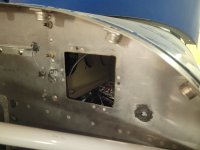
20260721_193747.jpg
 
Supposedly the firewall is not structural. Plate over it with stainless steel, use the existing nutplates and add at least 4 more fasteners around the perimeter. Screws and all metal locknuts will work fine here. Assemble with Fire Barrier 2000+ and put a bead around the perimeter.

Don Broussard
RV9 Rebuild in Progress
57 Pacer
 
Another product you could use Flamemaster CS 1900 firewall sealant.
Fashion a cover plate of stainless steel of same thickness or thicker. Double or triple the number of fasteners around the perimeter of the hole, especially corners.
 
Thanks all for your replies. Additional fasteners are incoming. As for sealants, the Flamemaster CS 1900 product claims a higher service temperature than the 3M Fire Barrier 2000+ (400°F vs 302°F) but what really gets my attention is the former's claim "Can withstand flash temperatures up to 2,000°F". Does this difference really matter or is it just lipstick on a pig?
 
Thanks all for your replies. Additional fasteners are incoming. As for sealants, the Flamemaster CS 1900 product claims a higher service temperature than the 3M Fire Barrier 2000+ (400°F vs 302°F) but what really gets my attention is the former's claim "Can withstand flash temperatures up to 2,000°F". Does this difference really matter or is it just lipstick on a pig?

Here is the link to the DanH firewall sealant tests.


At post #42 he makes the comment:

CS1900 looks like an excellent sealant for use between fay surfaces and in thick sections with mechanical fixation. Good resistance to direct flame but with a lot of smoke and burning, so I'd be very careful about allowing any more than a trace to show on the cabin side of a firewall. Adhesion is poor. Mixing is a PITA.
