climberrn

Well Known Member
Friend
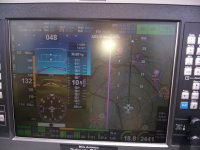
There's a lot of talk about alternative engines, or electronic (electrically dependent) fuel injection for efficiency, but here are some impressive numbers from today’s flight. 6.4GPH at 10,900DA cruising at 147TAS. This is from a stock compression IO-390, RSA-5 fuel injection with dual PMags set at the recommended 20 degree starting advance. Usually cruise around 170KT true over 10K feet but in light of fuel prices, decided to pull all 3 knobs back a little more. What great machines.IMG_5408.jpeg
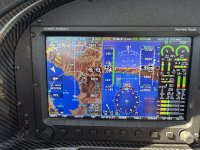
 
It's no secret. Easiest way to increase the miles per gal is to slow down. True in cars, true in airplanes.
 
Very nice! That's efficiency!

Can you elaborate on this a bit? Usually the mags are timed right at TDC or even slightly after TDC.
Most engines Pmag’s are timed at TDC to get the 26 degree starting point. Angle valve engines, specifically mine want the timing at 20 degrees, so it’s timed 6 degrees after TDC.
 
There's a lot of talk about alternative engines, or electronic (electrically dependent) fuel injection for efficiency, but here are some impressive numbers from today’s flight. 6.4GPH at 10,900DA cruising at 147TAS. This is from a stock compression IO-390, RSA-5 fuel injection with dual PMags set at the recommended 20 degree starting advance. Usually cruise around 170KT true over 10K feet but in light of fuel prices, decided to pull all 3 knobs back a little more. What great machines.View attachment 116854
More evidence against the misguided idea of people wanting to use a smaller engine for better overall fuel economy :rolleyes:

It looks like you could improve performance a bit by doing some injector balance work.
 
Is there a barrier to prevent you from operating overquare? Like 22" MP, 2000 RPM?
At altitude, a lack of atmospheric pressure.

i don't know if the picture is at WOT, but it's probably fairly close. Comparatively higher manifold pressure to RPM ratio will be slightly more efficient for the same power output. It's why cars have an overdrive or sometimes two. Alas, the manifold pressure still needs to be available at that altitude.
 
It looks like you could improve performance a bit by doing some injector balance work.
Explain, because EGT’s are not the same ?

I always thought that time to peak EGT was the determining factor since EGT probes slightly different locations can give very different temps.
 
I always thought that time to peak EGT was the determining factor since EGT probes slightly different locations can give very different temps.
It is
I based the comment on an EGT temp delta that is much larger than typical if the probes are all installed at pretty close to the same distance from the cyl. But you are correct in implying there could be other reasons.
 
My fixed pitch RV-4 with an O-360 will do 6gph up at 15,500 to 17,500, and still do 160-165 KTAS. I bet you can do better by pulling the RPM down low.. 2000 to 2100 rpm. Lower RPM allows you to lean it deeper.
 
Is there a barrier to prevent you from operating overquare? Like 22" MP, 2000 RPM?
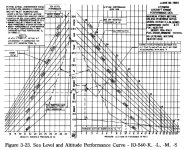
Lycoming included a limit line on all the older power charts, in the lower left corner. However, there is no such line on the recent 390 charts. I don't know why.

IO540K Power Chart.jpg
 
Efficiency seems to me to be the focus of the OP.

The principle on over-square is the slower turning motor gives more time for the combustion event to complete itself. More of the fuel gets burned up before the exhaust valve opens up. Also, the theory says that a slower turning engine lowers internal turning resistance. This might improve efficiency a bit. As the prop slows, the MP might climb a bit. Lower RPM definatly will result in less power output, so a slower cruise speed until the mixture is richened up to recover the FF drop off.

When LOP the FF indication gives a direct indication of Power Output. So 6 GPH LOP has the same HP output at 2300 RPM as it does at 2000 RPM. As you experiment declare and set a FF, then test different RPM setting (re-adjusting mixture & MP to recover the declared FF) and see if your airspeed changes.

I looked at the IO-390 power chart like Dan's 540 chart refers to before my post #5. That Lycoming Chart showed data for 2000 RPM, (but not 1800 RPM like my IO-360 has.) If Lycoming published it, Lycoming approves. Beware I may not have seen the chart for your EXACT engine model.

I've done some of this Over Square cruise experimentation....up to 5 units over square. I am in the midst of seeing results...it takes time. Very low CHT's and Oil Temps has limited me from full exploration. I sense that the lower the power setting the lower the RPM should be for peak efficiency. That means at higher altitudes a slower turning prop might boost things a bit if efficiency is a goal.

But efficiency really is everyones goal.....going faster is an efficiency measure....right? So set your FF LOP and see how fast you can get it to go at that Density Altitude by testing different rpms.
 
The principle on over-square is the slower turning motor gives more time for the combustion event to complete itself. More of the fuel gets burned up before the exhaust valve opens up.

Nope. Combustion is complete well before the exhaust valve opens.
 
I rarely run below 2350-2400 due to increased harmonic vibrations.
Don't really care that much about ultimate efficiency, if I want to save gas I slow down.
 
This has been interesting to read through. Like the OP I've played around a little bit with trying to get max mpg out of my plane.

While it's fun to see how you can max out a goal like that, usually after a few minutes of putt-putting along I hear this little voice say "you didn't build a fast airplane because you wanted to go slow" and that's the end of that :)
 
Went up in a friends 180HP 7A today, we played around a little more. Tried running 2050 RPM for a bit. Couldn't get over the feel of the engine turning so slowly. After the trial without changing anything else, we tried 2350 RPM. Picked up 10 KTS true, and increased fuel burn by 1GPH. Not going to quote specific numbers since his configuration is so different than mine. I will say that I was able to get the same speed on 1.5GPH less with the 390. That's not a fair comparison since we have different props, and a different build, even though they are both 7A's.

Fun to play around. Im not going to change the way I fly but it's fun to see what they can do. Didn't build a fast airplane to putt around all the time!
 
Really need to define "efficiency" to make comparisons. Maximum MPG? Least gph? Lowest BSFC? Longest flight time?

Maximum leaning; note I'm throttled roughly 3" to keep nozzle bleed high. At 6.5 gph and 21 knots dead on the tail, MPG is 26.9, but of course the tailwind makes it cheating. If I assume the indicated power percentage is accurate, BFSC is 0.35, but again, that may be a bad bet. More like 0.40 is a typical minimum.

100+ LOP 600w.jpg
 
Last edited:
Really need to define "efficiency" to make comparisons. Maximum MPG? Least gph? Lowest BSFC? Longest flight time?
+1

I posted on this a couple of times. For me I define the term “efficiency” as best MPG but still going RV speeds to get some where.

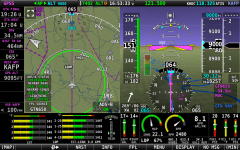
The center of such study needs to recognize that your airplane is a system (engine, prop and airframe). So the sweet spot for your plane maybe much different than your buddies. On 4+ hour cross counters the last few years I took data speed vs fuel low at various RPMs. All data was 8K’ to 12K’, engine at WOT and 20-30 degrees LOP. Fairing through the data I found a the best RPM to be 2480 - but this was a fairly flat curve.

Here is a screenshot at 9K’. Go higher speed stays about the same and fuel flow drops off (~7.5 gph at 12K’). This is an RV-8 with an IO-360M1B and Hartzell BA prop.

Shoot fire we have RVs to go fast and get someplace, not loiter like a P-3 over the North Atlantic looking for Ivan.

Carl
 

Attachments

  • screenshot-N8PH-SN12727-16.7.0.11423-20260105-165333-013-en_US.png
    screenshot-N8PH-SN12727-16.7.0.11423-20260105-165333-013-en_US.png
    927.2 KB · Views: 53
The efficiency of these RVs is incredible. Superior IO360 Catto 3 blade RV-8 getting 31 statute mpg
 

Attachments

  • 0620141322.jpg
    0620141322.jpg
    593.8 KB · Views: 57
Is there a barrier to prevent you from operating overquare? Like 22" MP, 2000 RPM?
You fly "over square" ever time you push the throttle up on take off. It does not hurt the engine. In fact it is designed to run in this condition continuously as long as you are not exceeding any other limitations (RPM, CHT, Oil Temp). At cruise, if you leave the throttle wide open (WOT) and leave the prop full forward, adjusting the mixture to your liking (rich or lean) for the altitude, you can run it all day long. If you want to save a little fuel, run quieter, less fuel, dial back the prop to a comfortable cruise RPM and adjust your mixture. You are not hurting the engine WOT, unless of course you have a turbocharger. That is a whole other story and set of limitations.
 
But it allows a little more time for the down force of the combustion to act on the piston. The gases are still expanding right up until they are exhausted.

The limited efficiency gain at lower RPM is due to reduction of mechanical friction and pumping loss.
 
The limited efficiency gain at lower RPM is due to reduction of mechanical friction and pumping loss.
I believe the reduction in RPM also reduces the amount of energy lost in swinging the prop. All of it is incremental and running at max designed RPM will not hurt the engine as I have stated in other posts. It is quieter running at low RPM....;>)
 
The Lower RPM connected with efficiency due to pumping loss and mechanical friction is a textbook answer I'd seen for decades. I'd like to see real data. Does anyone have any? I think the best way to achieve data for the answer is fly LOP at a fixed fuel flow, and document cruise speed at various RPM settings.