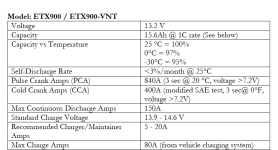
Thanks!! How exactly do you vent it inside the cockpit??I installed the vented version of the EathX several years ago in the old -4. One of the best things I've done for the airplane in the past 20 years!

I have one on my -7 for several years now. It spins the O-360 much better than the 680. Just don't let it stay off of the tender very long. They are panful to get beck to operation when the voltage goes below the threshold.Anyone running an EarthX inside there 4? I'm thinking about replacing my oddessy inside my my front channel to loose a little weight and more cranking power. Your suggestions appreciated!

You vent it outside the airplane with special hoses from EarthX. You’ll need to drill a hole in the bottom of the plane and run the hose through the fuselage with a vent fitting available from EarthX. It’s a pretty easy job.Thanks!! How exactly do you vent it inside the cockpit??

I’ll be the Debbie Downer. A local RV8’s EarthX caught on fire last year on the taxiway. Fortunately, they got it out of the airplane before the airframe suffered serious damage.
I’ve had two EarthX batteries installed on the same airplane die suddenly while taxiing because the airplane only had a vacuum pad mounted alternator. As soon as the RPM increased above 1500 and the alternator started making power, the BMS shut down both batteries (depleted batteries and too much charge?).
Finally, if you have an ignition/fuel injection system that relies heavily on electrical power, ask the manufacturer if they approve. One of the popular companies does not recommend EarthX.
This confirms my fears about BMS's are not unwarranted. I continue to be anti BMS in an airplane. Just not a good cost benefit ratio IMHO. I am sure these kinds of issues are rare, but just not worth it for me. I wasn't really thinking about the fire risk from lithium technology, but now throw that in as well.I’ll be the Debbie Downer. A local RV8’s EarthX caught on fire last year on the taxiway. Fortunately, they got it out of the airplane before the airframe suffered serious damage.
I’ve had two EarthX batteries installed on the same airplane die suddenly while taxiing because the airplane only had a vacuum pad mounted alternator. As soon as the RPM increased above 1500 and the alternator started making power, the BMS shut down both batteries (depleted batteries and too much charge?).
Finally, if you have an ignition/fuel injection system that relies heavily on electrical power, ask the manufacturer if they approve. One of the popular companies does not recommend EarthX.
Really? An anecdote with 0 data behind/around/near it and suddenly you're fears are validated?This confirms my fears about BMS's is not unwarranted. I continue to be anti BMS in an airplane. Just not a good cost benefit ratio IMHO. I am sure these kinds of issues are rare, but just not worth it for me.
Sure, these are a limited set of shut down criteria. The real question to be asking is what combination of variables could happen in flight that would trigger these? Unless you are creative enough, it would seem there are edge cases where these could trigger in real life scenarios.Interesting to attribute the issue to the vacuum pad alternator and nothing else.
The BMS will only take the battery cells offline in the following conditions -- Over Amps on the output stage (Short circuit), Over Amps on the input stage (Deeply discharged cells), Over voltage on input stage, and Over/Under temperature limits. -- were one/more of these reached with the Vacuum Pad alternator?
Yes really. Have you ever heard of a lead acid battery self igniting into flames on an aircraft? I haven't. One case, regardless of the reason, is MORE than enough to make a decision in my case. Don't care what mistake the installer or pilot may have made (not saying this was the case, just countering the potentioal argument); No gaurantee I wouldn't make the same mistake. Might be different if it were something I really needed, but there are well proven alternatives that exist without this potential.Really? A anecdote with 0 data behind/around/near it and suddenly you're fears are validated?
I will give you the fact that this fire was potentially mis diagnosed, but lithium technology has a known historical risk of thermal runaway. You are relying solely an a board with chips to prevent it from happening when the stars align and create the potential. No surprise that 1 in 1000 sees an anomoly that allows it to happen. We all approach risk differently.Yes really. Have you ever heard of a lead acid battery self igniting into flames on an aircraft? I haven't. One case, regardless of the reason, is MORE than enough to make a decision in my case. Don't care how stupid the installer or pilot was; No gaurantee I wouldn't make the same mistake. Might be different if it were something I really needed, but there are well proven alternatives that exist without this potential.
Gross oversubscription of "Lithium"; don't conflate LiCo/LiPoly with LiFePo.I will give you the fact that this fire was potentially mis diagnosed, but lithium technology has a known historical risk of thermal runaway. You are relying solely an a board with chips to prevent it from happening when the stars align and create the potential. No surprise that 1 in 1000 sees an anomoly that allows it to happen. We all approach risk differently.
Sure - but you gotta figure out the variables first.Sure, these are a limited set of shut down criteria. The real question to be asking is what combination of variables could happen in flight that would trigger these? Unless you are creative enough, it would seem there are edge cases where these could trigger in real life scenarios.
No, but they're failure modes are different and just as deadly -- Ever seen a hydrogen/hydrogen sulfide gas fueled explosion? I have -- terrifying. That's why Mooney, Piper vents the tail-cone mounted battery now.Yes really. Have you ever heard of a lead acid battery self igniting into flames on an aircraft? I haven't. One case, regardless of the reason, is MORE than enough to make a decision in my case. Don't care what mistake the installer or pilot may have made (not saying this was the case, just countering the potentioal argument); No gaurantee I wouldn't make the same mistake. Might be different if it were something I really needed, but there are well proven alternatives that exist without this potential.

OWT?Gross oversubscription of "Lithium"; don't conflate LiCo/LiPoly with LiFePo.
This is why OWTs "never die" -- I suppose you don't go swimming for 30 minutes after you eat...
Old Wives TaleOWT?
I couldn't find that. Something about wastewater treatment.

fully understand the differences and never suggested that the risks are the same, only that it is not zero. so, you are telling me that lifepo has no risk of thermal runaway? So why have a bms that prevents overcharging? pretty sure the express purpose is to prevent thermal runaway, which is still possible, just much harder to kick off than other li types.Gross oversubscription of "Lithium"; don't conflate LiCo/LiPoly with LiFePo.
This is why OWTs "never die" -- I suppose you don't go swimming for 30 minutes after you eat...

I've never seen or heard of a LiFePO4 battery in a thermal runaway condition. Other "lithium" chemistries? Yes. Venting? Yes. I have seen a lot of people try (unsuccessfully) to get a LiFePO4 to enter thermal runaway. Power drills, hammers, nails, etc. No luck. The only real danger with LiFePO4 is if it gets damaged (driving nails through it) it can vent dangerous gasses that you do not want to breathe. That is a legitimate concern....are telling me that lifepo has no risk of thermal runaway?

Decades ago, I went out to my garage and got in my car to go to work. Turned the key - sounded like a shotgun blast! Smoke came out from under the hood! Popped the hood and found the top blown clean off my standard issue wet-cell lead/acid battery. So by your reasoning Larry, I should NEVER have a wet-cell lead/acid battery in any of my vehicles…right? Those things blow up!fully understand the differences and never suggested that the risks are the same, only that it is not zero. so, you are telling me that lifepo has no risk of thermal runaway? So why have a bms that prevents overcharging? pretty sure the express purpose is to prevent thermal runaway, which is still possible, just much harder to kick off than other li types.
if you are saying lifepo is totally safe with no risk, please post a source. if the battery is counting on the bms to prevent it, well, you need to consider what happens if the bms fails.
Yes, lifepo batteries are quite safe, but not completely immune from issues. Yes, it takes abuse to kick it off but do we really understand exactly what maldies may appear in our systems that could do this? Agree that BMS controls can prevent this from happening, but electronic systems are not bullet proof. I am not fear mongering here and agree that the lifepo safety record is excellent. But that is not the same as risk free.I've never seen or heard of a LiFePO4 battery in a thermal runaway condition. Other "lithium" chemistries? Yes. I have seen a lot of people try (unsuccessfully) to get a LiFePO4 to enter thermal runaway. Power drills, hammers, nails, etc. No luck. The only real danger with LiFePO4 is if it gets damaged (driving nails through it) it can vent dangerous gasses that you do not want to breathe.
If I had any concerns with "lithium" batteries, I would be FAR more worried about having a cell phone or iPad in the cabin than a LiFePO4 battery FWF. People are using non LiFePO4 batteries all the time in the cabin with no fears at all but freak out at the thought of using the only truly "safe" lithium chemistry FWF. Pretty funny.
Well, then I stand corrected. I had never heard of a lead acid battery self-combusting ans starting a fire. I am guessing the incidence rate is pretty low though. Not saying it is high on these lifepo batteries, but do believe a big part of their safety record is due to BMS protection and we must consider electronic system failures and resulting loss of the safety net.Decades ago, I went out to my garage and got in my car to go to work. Turned the key - sounded like a shotgun blast! Smoke came out from under the hood! Popped the hood and found the top blown clean off my standard issue wet-cell lead/acid battery. So by your reasoning Larry, I should NEVER have a wet-cell lead/acid battery in any of my vehicles…right? Those things blow up!
Many of us have delved deeply into the history of various failures of “Lithium Batteries” and when you actually look at facts (not anecdotal stories or YouTube clips with still images of burned vehicle batteries), you find that almost all such cases do not involve Lithium Iron batteries, and when they do, they involved those that did not have a BMS to protect them.
Nothing is foolproof - I’ll grant you that! But doing the actual research (not just anecdotes from the internet) and gathering evidence before stating opinions is what makes good engineering.
<snip><snip>
Amp Draw after start: After every start my 40A alternator is huffing and puffing all the amps it can. The EarthX Gobbles up those amps like I've never seen before. I see over 30 plus amps but it calms down after a few minutes. This is normal for these batterys. By the time I am doing the run-up output will be around 12 Amps.


We should drain all the fuel out of our tanks and the oil out of the engine before we fly too. Have you ever seen what happens when those catch fire???Decades ago, I went out to my garage and got in my car to go to work. Turned the key - sounded like a shotgun blast! Smoke came out from under the hood! Popped the hood and found the top blown clean off my standard issue wet-cell lead/acid battery. So by your reasoning Larry, I should NEVER have a wet-cell lead/acid battery in any of my vehicles…right? Those things blow up!

Man, I'd love to hear more about this story. I'm trying to wrap my head around this...A local RV8’s EarthX caught on fire last year on the taxiway. Fortunately, they got it out of the airplane before the airframe suffered serious damage.
FTFYA local RV8’s with an EarthX caught on fire last year on the taxiway

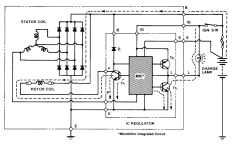
I think what you're referencing is the direct connection of the B+ wire circuit to the field circuit (ref: ND regulator block diagram.) and a 'failed closed' of the Tr1 "switch". This failure mode will provide unregulated DC to the field circuit (the rotor) and cause the 90V runaway.I’ll leave the battery melt down risk for others to debate.
What keeps me wary about EarthX is the BMS. I’ve had a failed alternator voltage regulator drive buss voltage high. The alternator did have a stand alone output solenoid powered from an Over Voltage Crowbar trip. In my case the over voltage trip failed and buss voltage got up to ~17 volts before I recognized the situation and tripped the alternator. I had 3+ hours of dual PC-625 battery capacity to get home on my then ship powered dual EI setup.
Here the time for me to figure out what was going on the voltage excursion was limited to the batteries absorbing the excessive alternator current (for a period of time) transforming it to heat.
Reading about the EarthX BMS, I understand under the same condition the EarthX will disconnect from the buss, protecting the battery. That is the rub.
I understand a shorted field can push alternator output north of 90 volts in a seconds if the battery “sump” is removed. While the battery is protected, your $30K panel is not.
My recommendation is to verify, via testing, that whatever you are using for over voltage protection works. Perhaps doing this test as part of your yearly checks.
Note - panel or EI backup batteries are useless if you fried the electronics.
Carl


Would add, if you don’t like lithium batteries don’t get on a commercial jet. We have hundreds of them onboard.I don't have a problem with some folks being uneasy about using a LiFePO4 battery FWF whether that fear is warranted or not. What I find strange is many of these same people have no concerns at all about the lithium backup battery in their G5, the lithium battery in their IBBS backup, the lithium battery in their cell phone and iPad, the lithium batteries in their O2 generators and laptops, etc. Those are all in the cockpit! If you're afraid of what is FWF, you should be REALLY afraid of what is behind it because most of those batteries are not LiFePO4!
i don't worry much about a battery FWF, as the engine is probably just as likely to catch on fire as the battery. My fear is in the 10, where the battery is near my baggage compartment with air moving from the tail fwd. A fire there is a huge problem. Also, have decent confidence that if my cell phone battery burst into flames in the cockpit, I would survive it. it is maybe 2 ah at 5V (10 watt/hrs), where as the earth x is 18ah @12V (215 watt/hrs); A HUGE difference in energhy potential.I don't have a problem with some folks being uneasy about using a LiFePO4 battery FWF whether that fear is warranted or not. What I find strange is many of these same people have no concerns at all about the lithium backup battery in their G5, the lithium battery in their IBBS backup, the lithium battery in their cell phone and iPad, the lithium batteries in their O2 generators and laptops, etc. Those are all in the cockpit! If you're afraid of what is FWF, you should be REALLY afraid of what is behind it because most of those batteries are not LiFePO4!
Howdy Carl,What keeps me wary about EarthX is the BMS. I’ve had a failed alternator voltage regulator drive buss voltage high. The alternator did have a stand alone output solenoid powered from an Over Voltage Crowbar trip. In my case the over voltage trip failed and buss voltage got up to ~17 volts before I recognized the situation and tripped the alternator. I had 3+ hours of dual PC-625 battery capacity to get home on my then ship powered dual EI setup.
Reading about the EarthX BMS, I understand under the same condition the EarthX will disconnect from the buss, protecting the battery. That is the rub.
I understand a shorted field can push alternator output north of 90 volts in a seconds if the battery “sump” is removed. While the battery is protected, your $30K panel is not.
Carl

 Also, note capacity at -30 C (-22 F). These batteries are great and who doesn't mind the weight loss!