macflyer

Well Known Member
Friend
Anyone running an EarthX inside there 4? I'm thinking about replacing my oddessy inside my my front channel to loose a little weight and more cranking power. Your suggestions appreciated!
 
Anyone running an EarthX inside there 4? I'm thinking about replacing my oddessy inside my my front channel to loose a little weight and more cranking power. Your suggestions appreciated!
I have one on my -7 for several years now. It spins the O-360 much better than the 680. Just don't let it stay off of the tender very long. They are panful to get beck to operation when the voltage goes below the threshold.
 
Thanks!! How exactly do you vent it inside the cockpit??
You vent it outside the airplane with special hoses from EarthX. You’ll need to drill a hole in the bottom of the plane and run the hose through the fuselage with a vent fitting available from EarthX. It’s a pretty easy job.
 
I’ll be the Debbie Downer. A local RV8’s EarthX caught on fire last year on the taxiway. Fortunately, they got it out of the airplane before the airframe suffered serious damage.

I’ve had two EarthX batteries installed on the same airplane die suddenly while taxiing because the airplane only had a vacuum pad mounted alternator. As soon as the RPM increased above 1500 and the alternator started making power, the BMS shut down both batteries (depleted batteries and too much charge?).

Finally, if you have an ignition/fuel injection system that relies heavily on electrical power, ask the manufacturer if they approve. One of the popular companies does not recommend EarthX.
 
I’ll be the Debbie Downer. A local RV8’s EarthX caught on fire last year on the taxiway. Fortunately, they got it out of the airplane before the airframe suffered serious damage.

I’ve had two EarthX batteries installed on the same airplane die suddenly while taxiing because the airplane only had a vacuum pad mounted alternator. As soon as the RPM increased above 1500 and the alternator started making power, the BMS shut down both batteries (depleted batteries and too much charge?).

Finally, if you have an ignition/fuel injection system that relies heavily on electrical power, ask the manufacturer if they approve. One of the popular companies does not recommend EarthX.

Details would be nice -- would hate to jump to conclusions with a limited set of facts:

On the RV-8 fire --

1. Which model of EarthX?
2. What was the source of the fire - or exothermic event? Inter/Intra cell damage? Failed connectors at the terminals?
3. What was the state of charge of the battery?
4. What was the age of the battery?
5. What was happening electrically before the event? Volts, Amps.?

On your shutdown issue --

Same questions as above -- and:
1. What alternator was used?

Interesting to attribute the issue to the vacuum pad alternator and nothing else.
The BMS will only take the battery cells offline in the following conditions -- Over Amps on the output stage (Short circuit), Over Amps on the input stage (Deeply discharged cells), Over voltage on input stage, and Over/Under temperature limits. -- were one/more of these reached with the Vacuum Pad alternator?


edit: I ask these questions, because I am concerned that I *may* have inadvertently done something in my installations that could cause or lend to the cause of the reported failures. This is why I harp on understanding root cause so much -- it's not necessarily for the benefit of the OEM/supplier, but rather my own benefit.
 
Last edited:
I’ll be the Debbie Downer. A local RV8’s EarthX caught on fire last year on the taxiway. Fortunately, they got it out of the airplane before the airframe suffered serious damage.

I’ve had two EarthX batteries installed on the same airplane die suddenly while taxiing because the airplane only had a vacuum pad mounted alternator. As soon as the RPM increased above 1500 and the alternator started making power, the BMS shut down both batteries (depleted batteries and too much charge?).

Finally, if you have an ignition/fuel injection system that relies heavily on electrical power, ask the manufacturer if they approve. One of the popular companies does not recommend EarthX.
This confirms my fears about BMS's are not unwarranted. I continue to be anti BMS in an airplane. Just not a good cost benefit ratio IMHO. I am sure these kinds of issues are rare, but just not worth it for me. I wasn't really thinking about the fire risk from lithium technology, but now throw that in as well.
 
Last edited:
This confirms my fears about BMS's is not unwarranted. I continue to be anti BMS in an airplane. Just not a good cost benefit ratio IMHO. I am sure these kinds of issues are rare, but just not worth it for me.
Really? An anecdote with 0 data behind/around/near it and suddenly you're fears are validated?
 
Last edited:
Interesting to attribute the issue to the vacuum pad alternator and nothing else.
The BMS will only take the battery cells offline in the following conditions -- Over Amps on the output stage (Short circuit), Over Amps on the input stage (Deeply discharged cells), Over voltage on input stage, and Over/Under temperature limits. -- were one/more of these reached with the Vacuum Pad alternator?
Sure, these are a limited set of shut down criteria. The real question to be asking is what combination of variables could happen in flight that would trigger these? Unless you are creative enough, it would seem there are edge cases where these could trigger in real life scenarios.
 
Really? A anecdote with 0 data behind/around/near it and suddenly you're fears are validated?
Yes really. Have you ever heard of a lead acid battery self igniting into flames on an aircraft? I haven't. One case, regardless of the reason, is MORE than enough to make a decision in my case. Don't care what mistake the installer or pilot may have made (not saying this was the case, just countering the potentioal argument); No gaurantee I wouldn't make the same mistake. Might be different if it were something I really needed, but there are well proven alternatives that exist without this potential.
 
Last edited:
Yes really. Have you ever heard of a lead acid battery self igniting into flames on an aircraft? I haven't. One case, regardless of the reason, is MORE than enough to make a decision in my case. Don't care how stupid the installer or pilot was; No gaurantee I wouldn't make the same mistake. Might be different if it were something I really needed, but there are well proven alternatives that exist without this potential.
I will give you the fact that this fire was potentially mis diagnosed, but lithium technology has a known historical risk of thermal runaway. You are relying solely an a board with chips to prevent it from happening when the stars align and create the potential. No surprise that 1 in 1000 sees an anomoly that allows it to happen. We all approach risk differently.
 
Last edited:
I will give you the fact that this fire was potentially mis diagnosed, but lithium technology has a known historical risk of thermal runaway. You are relying solely an a board with chips to prevent it from happening when the stars align and create the potential. No surprise that 1 in 1000 sees an anomoly that allows it to happen. We all approach risk differently.
Gross oversubscription of "Lithium"; don't conflate LiCo/LiPoly with LiFePo.

This is why OWTs "never die" -- I suppose you don't go swimming for 30 minutes after you eat...
 
Sure, these are a limited set of shut down criteria. The real question to be asking is what combination of variables could happen in flight that would trigger these? Unless you are creative enough, it would seem there are edge cases where these could trigger in real life scenarios.
Sure - but you gotta figure out the variables first.
Yes really. Have you ever heard of a lead acid battery self igniting into flames on an aircraft? I haven't. One case, regardless of the reason, is MORE than enough to make a decision in my case. Don't care what mistake the installer or pilot may have made (not saying this was the case, just countering the potentioal argument); No gaurantee I wouldn't make the same mistake. Might be different if it were something I really needed, but there are well proven alternatives that exist without this potential.
No, but they're failure modes are different and just as deadly -- Ever seen a hydrogen/hydrogen sulfide gas fueled explosion? I have -- terrifying. That's why Mooney, Piper vents the tail-cone mounted battery now.
 
Last edited:
Gross oversubscription of "Lithium"; don't conflate LiCo/LiPoly with LiFePo.

This is why OWTs "never die" -- I suppose you don't go swimming for 30 minutes after you eat...
OWT?
I couldn't find that. Something about wastewater treatment.
 
I have about 170 hours on my ETX680. My viewpoint:

Amp Draw after start: After every start my 40A alternator is huffing and puffing all the amps it can. The EarthX Gobbles up those amps like I've never seen before. I see over 30 plus amps but it calms down after a few minutes. This is normal for these batterys. By the time I am doing the run-up output will be around 12 Amps. I would not run this battery with a small vacuum pad 8 amp alternator. My B&C 8 amp alternator needs high RPM way above idle to produce its voltage + amps. I firmly believe no EarthX battery would be in a suitable charge state after a taxi and run-up with that small alternator alone. Additionally, EarthX mandates the alternator not be oversized... too many heat generating amps flowing into from too large of an alternator is not approved.

The EarthX ETX-900 battery is certified. The 680 is not. They both have a robust monitoring system to protect from faults. A high risk problematic FAA certificated product would generate an AD. I'm not saying risk is absent, rather if risk becomes significant then we should see an AD on the 900 battery. We all have various risk tolerance. I feel fine if I think its "very unlikely to happen to me" and I do extra things to help mitigate it. For example, I monitor the alternator amp output after start and will not takeoff if those amps are above a threshold. I'm also okay flying over the Great Lakes and large forrest at night.

EarthX continuing maintenance procedures mandates annual capacity checks. The procedure measures if the battery has 80% of the amp-hour capacity left. If it fails then it should be considered not airworthy. I never did a capacity check with my lead-acid battery? Before I installed the ETX-680C, if my engine started, I thought my battery was over. But I might have had a good easy start with a poor battery capacity which serves as my emergency back-up.

Cold Temperature effects output. For example, At 0F I had a very slow start followed by a battery shut-down iaw its built in safety feature that monitors the battery's health. The feature worked as it was designed. A warm EarthX starts nice. Around 45F battery temp the speed of the prop is not as fast during start. This could make it unsuitable for un-supported Arctic environments.

I like mine. I am keeping it.
 
Last edited:
Last year I replaced my working Earth-X in my -4. It performed well for seven years but I figured it was a good time to put it out to pasture.

Zero issues with the old one or the replacement; however, despite my mother's admonitions I do still run with scissors in my hands and other sundry high-risk activities like motorcycles & fast cars. Still looking for that bad girl she always warned me about.
 
Gross oversubscription of "Lithium"; don't conflate LiCo/LiPoly with LiFePo.

This is why OWTs "never die" -- I suppose you don't go swimming for 30 minutes after you eat...
fully understand the differences and never suggested that the risks are the same, only that it is not zero. so, you are telling me that lifepo has no risk of thermal runaway? So why have a bms that prevents overcharging? pretty sure the express purpose is to prevent thermal runaway, which is still possible, just much harder to kick off than other li types.

if you are saying lifepo is totally safe with no risk, please post a source. if the battery is counting on the bms to prevent it, well, you need to consider what happens if the bms fails.
 
Last edited:
...are telling me that lifepo has no risk of thermal runaway?
I've never seen or heard of a LiFePO4 battery in a thermal runaway condition. Other "lithium" chemistries? Yes. Venting? Yes. I have seen a lot of people try (unsuccessfully) to get a LiFePO4 to enter thermal runaway. Power drills, hammers, nails, etc. No luck. The only real danger with LiFePO4 is if it gets damaged (driving nails through it) it can vent dangerous gasses that you do not want to breathe. That is a legitimate concern.

If I had any concerns with "lithium" batteries, I would be FAR more worried about having a cell phone or iPad in the cabin than a LiFePO4 battery FWF. People are using non LiFePO4 batteries all the time in the cabin with no fears at all but freak out at the thought of using the only truly "safe" lithium chemistry FWF. Pretty funny.
 
Last edited:
I mentioned it's been great in my old RV-4. It has. Details are as follows

(EarthX EXT900-VNT) Installed 1-15-2022 Vented overboard.
B&C SD-8 alternator, that's the only alternator in the airplane.
I bought the battery directly from EarthX and bought the charger maintainer from them for it.
The maintainer is on it anytime it's in the hangar; however, it often makes multiple legs on any given day and has made several multi day outing with no problems.
The SD-8 has no problem bringing the voltage up to 14.3v in 3-5 minuets of flight, taxi voltage after a start is usually about 13v.
IO-360-A1A angle valve 200HP with a B&C starter.
Ive had several occasions where I had more than usual trouble getting it started after heat soaking on a hot ramp while getting lunch, that battery doesn't quit.
After four and a half years and 400 hours it's never had a single hiccup and shows no signs of slowing down.
 
fully understand the differences and never suggested that the risks are the same, only that it is not zero. so, you are telling me that lifepo has no risk of thermal runaway? So why have a bms that prevents overcharging? pretty sure the express purpose is to prevent thermal runaway, which is still possible, just much harder to kick off than other li types.

if you are saying lifepo is totally safe with no risk, please post a source. if the battery is counting on the bms to prevent it, well, you need to consider what happens if the bms fails.
Decades ago, I went out to my garage and got in my car to go to work. Turned the key - sounded like a shotgun blast! Smoke came out from under the hood! Popped the hood and found the top blown clean off my standard issue wet-cell lead/acid battery. So by your reasoning Larry, I should NEVER have a wet-cell lead/acid battery in any of my vehicles…right? Those things blow up!

Many of us have delved deeply into the history of various failures of “Lithium Batteries” and when you actually look at facts (not anecdotal stories or YouTube clips with still images of burned vehicle batteries), you find that almost all such cases do not involve Lithium Iron batteries, and when they do, they involved those that did not have a BMS to protect them.

Nothing is foolproof - I’ll grant you that! But doing the actual research (not just anecdotes from the internet) and gathering evidence before stating opinions is what makes good engineering.
 
I've never seen or heard of a LiFePO4 battery in a thermal runaway condition. Other "lithium" chemistries? Yes. I have seen a lot of people try (unsuccessfully) to get a LiFePO4 to enter thermal runaway. Power drills, hammers, nails, etc. No luck. The only real danger with LiFePO4 is if it gets damaged (driving nails through it) it can vent dangerous gasses that you do not want to breathe.

If I had any concerns with "lithium" batteries, I would be FAR more worried about having a cell phone or iPad in the cabin than a LiFePO4 battery FWF. People are using non LiFePO4 batteries all the time in the cabin with no fears at all but freak out at the thought of using the only truly "safe" lithium chemistry FWF. Pretty funny.
Yes, lifepo batteries are quite safe, but not completely immune from issues. Yes, it takes abuse to kick it off but do we really understand exactly what maldies may appear in our systems that could do this? Agree that BMS controls can prevent this from happening, but electronic systems are not bullet proof. I am not fear mongering here and agree that the lifepo safety record is excellent. But that is not the same as risk free.

The following is from a science direct published research

https://www.sciencedirect.com/science/article/abs/pii/S2352152X24019972

Introduction​

Due to the good performance and the environmental benefits, lithium-ion batteries are widely used in portable devices and electric vehicles. It is also gradually used in energy storage, large transporters and other fields. Among several commercial cathode materials, lithium iron phosphate (LFP) batteries have obvious advantages of good safety and low cost. In recent years, it was selected as a cathode material for new batteries by many manufacturers.

However, the intrinsic safety of lithium iron phosphate batteries has not been completely solved. Thermal runaway (TR) will occur under abusive conditions, and even lead to fire and explosion accidents. The induction factors of TR are mainly divided into thermal abuse, mechanical abuse and electrical abuse. Thermal abuse includes overheating and external heat, electrical abuse includes overcharge, over-discharge and internal short circuit (ISC), and mechanical abuse includes extrusion, penetration and bending [1,2]. When the lithium-ion battery is abused, the temperature continues to rise, and a series of exothermic reactions begin to occur in the battery [3].
...
 
Last edited:
Decades ago, I went out to my garage and got in my car to go to work. Turned the key - sounded like a shotgun blast! Smoke came out from under the hood! Popped the hood and found the top blown clean off my standard issue wet-cell lead/acid battery. So by your reasoning Larry, I should NEVER have a wet-cell lead/acid battery in any of my vehicles…right? Those things blow up!

Many of us have delved deeply into the history of various failures of “Lithium Batteries” and when you actually look at facts (not anecdotal stories or YouTube clips with still images of burned vehicle batteries), you find that almost all such cases do not involve Lithium Iron batteries, and when they do, they involved those that did not have a BMS to protect them.

Nothing is foolproof - I’ll grant you that! But doing the actual research (not just anecdotes from the internet) and gathering evidence before stating opinions is what makes good engineering.
Well, then I stand corrected. I had never heard of a lead acid battery self-combusting ans starting a fire. I am guessing the incidence rate is pretty low though. Not saying it is high on these lifepo batteries, but do believe a big part of their safety record is due to BMS protection and we must consider electronic system failures and resulting loss of the safety net.

Not trying to post re hashed internet garbage here or youtube opinions and posted research data above, which is fundamentally favorable. Also not trying to talk folks out of them. My primary dislike is not fire risk, but concerns with the BMS disconnecting my battery from the electrical system in edge cases where electrical system problems exists and believe the battery could help minimize it. I was just reacting to the post about a fire and realize i may have jumped the gun on that as we have little data on that incident. just another nail in the coffin on my thinking, but don't expect others to feel the same. you are correct that there is risk everywhere and how we process that and make decisions is very unique. i do feel that data from both sides should be considered though. very possible there are folks running around thinking these are as safe as a AA flashlight battery and my research says that is not the case.

and yes i agree that my cell phone is just as big a risk, maybe bigger. Key difference is the volume of energy in the airplane battery vs my cell phone as well as the large energy potential offered by the alternator that could kick things off without a bms.
 
Last edited:
<snip>

Amp Draw after start: After every start my 40A alternator is huffing and puffing all the amps it can. The EarthX Gobbles up those amps like I've never seen before. I see over 30 plus amps but it calms down after a few minutes. This is normal for these batterys. By the time I am doing the run-up output will be around 12 Amps.
<snip>

Same. Nice to know. Thanks.

By the way. I'm sure everyone knows our hobby has many aspects far more dangerous than an EarthX battery. Yes, I know that's anecdotal. Just trying to herd the cats. 😁
 
Decades ago, I went out to my garage and got in my car to go to work. Turned the key - sounded like a shotgun blast! Smoke came out from under the hood! Popped the hood and found the top blown clean off my standard issue wet-cell lead/acid battery. So by your reasoning Larry, I should NEVER have a wet-cell lead/acid battery in any of my vehicles…right? Those things blow up!
We should drain all the fuel out of our tanks and the oil out of the engine before we fly too. Have you ever seen what happens when those catch fire???

Skylor

p.s. I have also experienced a wet cell lead acid battery explosion in my car and a close friend of mine has as well, so it's not that uncommon,
 
I’ll leave the battery melt down risk for others to debate.

What keeps me wary about EarthX is the BMS. I’ve had a failed alternator voltage regulator drive buss voltage high. The alternator did have a stand alone output solenoid powered from an Over Voltage Crowbar trip. In my case the over voltage trip failed and buss voltage got up to ~17 volts before I recognized the situation and tripped the alternator. I had 3+ hours of dual PC-625 battery capacity to get home on my then ship powered dual EI setup.

Here the time for me to figure out what was going on the voltage excursion was limited to the batteries absorbing the excessive alternator current (for a period of time) transforming it to heat.

Reading about the EarthX BMS, I understand under the same condition the EarthX will disconnect from the buss, protecting the battery. That is the rub.

I understand a shorted field can push alternator output north of 90 volts in a seconds if the battery “sump” is removed. While the battery is protected, your $30K panel is not.

My recommendation is to verify, via testing, that whatever you are using for over voltage protection works. Perhaps doing this test as part of your yearly checks.

Note - panel or EI backup batteries are useless if you fried the electronics.

Carl
 
A local RV8’s EarthX caught on fire last year on the taxiway. Fortunately, they got it out of the airplane before the airframe suffered serious damage.
Man, I'd love to hear more about this story. I'm trying to wrap my head around this...

Battery catches on fire due to thermal runaway (thermal runaway is different than venting). Flames shooting out of it with heavy smoke pouring out of the engine compartment. Top of cowling melting from the extreme heat, etc

Pilot gets out of airplane and finds the tools he needs to remove the battery cables. While heavy smoke is pouring out from the cowling, he removes the cowling. He then proceeds to remove each battery cable with temps over 1,000F (and up to 1,800F) and manages to survive without his hands/arms literally burned to the bone.

Hmmm....
 
I don't have a problem with some folks being uneasy about using a LiFePO4 battery FWF whether that fear is warranted or not. What I find strange is many of these same people have no concerns at all about the lithium backup battery in their G5, the lithium battery in their IBBS backup, the lithium battery in their cell phone and iPad, the lithium batteries in their O2 generators and laptops, etc. Those are all in the cockpit! If you're afraid of what is FWF, you should be REALLY afraid of what is behind it because most of those batteries are not LiFePO4!
 
I’ll leave the battery melt down risk for others to debate.

What keeps me wary about EarthX is the BMS. I’ve had a failed alternator voltage regulator drive buss voltage high. The alternator did have a stand alone output solenoid powered from an Over Voltage Crowbar trip. In my case the over voltage trip failed and buss voltage got up to ~17 volts before I recognized the situation and tripped the alternator. I had 3+ hours of dual PC-625 battery capacity to get home on my then ship powered dual EI setup.

Here the time for me to figure out what was going on the voltage excursion was limited to the batteries absorbing the excessive alternator current (for a period of time) transforming it to heat.

Reading about the EarthX BMS, I understand under the same condition the EarthX will disconnect from the buss, protecting the battery. That is the rub.

I understand a shorted field can push alternator output north of 90 volts in a seconds if the battery “sump” is removed. While the battery is protected, your $30K panel is not.

My recommendation is to verify, via testing, that whatever you are using for over voltage protection works. Perhaps doing this test as part of your yearly checks.

Note - panel or EI backup batteries are useless if you fried the electronics.

Carl
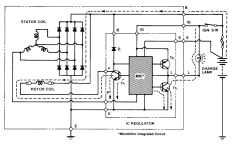
I think what you're referencing is the direct connection of the B+ wire circuit to the field circuit (ref: ND regulator block diagram.) and a 'failed closed' of the Tr1 "switch". This failure mode will provide unregulated DC to the field circuit (the rotor) and cause the 90V runaway.

Screenshot 2026-06-30 at 2.35.28 PM.png

This is why you should modify the stock ND regulator to connect the field supply to and external, protected and switched source (which is what B&C and PP accomplishes). (credit to: @hgerhardt , AeroElectric).
 
Last edited:
i have sold more than 100 of the Earthx to my other group of experimental aircraft owners and nobody except one had a problem. They work terrifically and do not require venting unless specified in the TSO for that aircraft. The only problem I've seen was a turbine trying to charge a 24v Earthx at 300A where the maximum charge current is specified as 80A. For turbines, we modify the starter-gen to reduce the charge amperage until the battery is brought back up (usually before it reaches the runway). I recommend trying one. All of the Continental and Lycoming owners I know who swapped to EarthX love them. I've had NO returns in 5 years.

In fact, there is an RV owner here making custom boxes for them. They are very popular. Don't fear the nonsense. Go with the factory data and call them for first-hand knowledge.
 
I don't have a problem with some folks being uneasy about using a LiFePO4 battery FWF whether that fear is warranted or not. What I find strange is many of these same people have no concerns at all about the lithium backup battery in their G5, the lithium battery in their IBBS backup, the lithium battery in their cell phone and iPad, the lithium batteries in their O2 generators and laptops, etc. Those are all in the cockpit! If you're afraid of what is FWF, you should be REALLY afraid of what is behind it because most of those batteries are not LiFePO4!
Would add, if you don’t like lithium batteries don’t get on a commercial jet. We have hundreds of them onboard.
 
I don't have a problem with some folks being uneasy about using a LiFePO4 battery FWF whether that fear is warranted or not. What I find strange is many of these same people have no concerns at all about the lithium backup battery in their G5, the lithium battery in their IBBS backup, the lithium battery in their cell phone and iPad, the lithium batteries in their O2 generators and laptops, etc. Those are all in the cockpit! If you're afraid of what is FWF, you should be REALLY afraid of what is behind it because most of those batteries are not LiFePO4!
i don't worry much about a battery FWF, as the engine is probably just as likely to catch on fire as the battery. My fear is in the 10, where the battery is near my baggage compartment with air moving from the tail fwd. A fire there is a huge problem. Also, have decent confidence that if my cell phone battery burst into flames in the cockpit, I would survive it. it is maybe 2 ah at 5V (10 watt/hrs), where as the earth x is 18ah @12V (215 watt/hrs); A HUGE difference in energhy potential.
 
What keeps me wary about EarthX is the BMS. I’ve had a failed alternator voltage regulator drive buss voltage high. The alternator did have a stand alone output solenoid powered from an Over Voltage Crowbar trip. In my case the over voltage trip failed and buss voltage got up to ~17 volts before I recognized the situation and tripped the alternator. I had 3+ hours of dual PC-625 battery capacity to get home on my then ship powered dual EI setup.

Reading about the EarthX BMS, I understand under the same condition the EarthX will disconnect from the buss, protecting the battery. That is the rub.

I understand a shorted field can push alternator output north of 90 volts in a seconds if the battery “sump” is removed. While the battery is protected, your $30K panel is not.
Carl
Howdy Carl,
If I read it right, the BMS will not allow the overvoltage to damage the battery by blocking current going into the battery but not entirely disconnecting the battery from the bus. When the OV is resolved, the battery will provide electrons to the bus as usual. It does the disconnect when the battery is drained to protect the cells from over discharge, but that's a different thing. From the EarthX site:

Does the BMS shut down the battery in an over voltage situation?
No.
Aircraft electrical system over-voltage protection is provided by an independent over-voltage protection device typically built into the alternator regulator. In the event of an alternator regulator failure where the voltage increases to above 16 volts, your regulators over voltage protection device is the first line of protection for it should operate in < 1 second. The regulator over-voltage protection device shuts down the alternator by removing the field (pops the field breaker). If the alternator doesn’t shutdown, the EarthX BMS’s over-voltage protection will block incoming charge current after a 3 second delay above 16 volts. The time delay is to allow the aircraft alternator over voltage protection to activate first. The discharge current (current out of battery) is unaffected in this situation. The circuit is like a diode, blocking flow in one direction (charge current into the battery), while allowing current to flow from the battery (discharge current). Once the alternator is shutdown or fails and the voltage returns to < 15 volts, the BMS’s over-voltage protection automatically resets (allowing charge current).

I don't think I understand how your overvolt system is setup. Output solenoid? Is that a contactor on the B lead?

The B&C external regulator that I'm using has overvoltage protection built into it which is supposed to be really quick. They call it crowbar and how it works is by grounding the field wire which blows the breaker. With no voltage to the field, the alternator is offline immediately and a low voltage light is flashed.
Once the alternator is offline, for whatever reason, you need to know that you are on battery power only and have a plan for what happens next.

I replaced a pair of PC680s with EarthX batteries in my 6. I have two to make sure I can keep my electronic ignitions and panel alive. The thing about the LiFe battery is that it will maintain over 13v under load until it is very nearly dead and the BMS is about to take it off the buss. The B&C low voltage alert doesn't reliably tell me that the alternator is gone because it's set at about 13v. Great for lead acid batteries. To make sure I get prompt notification of alternator out, I set alarms on my EFIS for low volt at 13.5 or maybe .6, I'd have to go back and look at the setup. Also, I alarm at 5 Amps. I check this fairly often by pulling my field breaker in flight. I get visual and audible alarms. If it happens for reals, I'll turn one battery off and monitor voltage on the other one. I'll shed unnecessary loads and it should be good for an hour or better and then I've got another battery to get me on the ground.
Ed
 
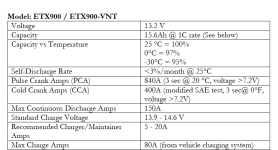
Just to add some data to this thread. The Earth X certified manual states (below) while the experimental manual still states max 14.6 volts. I know the factory has been giving out lower charging voltages, but this is the first I've seen it documented. Just be careful where one is reading the voltage on the bus, voltage drop issues and all that. 😟 Also, note capacity at -30 C (-22 F). These batteries are great and who doesn't mind the weight loss!

Screenshot 2026-06-30 170655.png
Screenshot 2026-06-30 165520.png