Future RV 9 Flyer

Active Member
Friend
Flying to breakfast at 40D I noticed my voltage was up around 16.1 volts. Not the normal 14.5 volts I normally see. Landed fine.On the flight back home I was monitoring voltage closely and voltage went to 13.1 volts and 0 amps,alternator fail light was on. Haven’t pulled the cowl yet to check for loose,broken wires yet but I’m assuming my PP alternator is cooked. Looking for options. Take it to a repair shop,new ND or B&C alternator.9A w Lycoming IO320 w dual Pmags and AFP fuel injection and EarthX battery. The alternator is an Al 12-E160/V.
 

Attachments

  • IMG_0919.jpeg
    IMG_0919.jpeg
    1.8 MB · Views: 31
Flying to breakfast at 40D I noticed my voltage was up around 16.1 volts. Not the normal 14.5 volts I normally see. Landed fine.On the flight back home I was monitoring voltage closely and voltage went to 13.1 volts and 0 amps,alternator fail light was on. Haven’t pulled the cowl yet to check for loose,broken wires yet but I’m assuming my PP alternator is cooked. Looking for options. Take it to a repair shop,new ND or B&C alternator.9A w Lycoming IO320 w dual Pmags and AFP fuel injection and EarthX battery. The alternator is an Al 12-E160/V.
Did it trip the field breaker? 16.1VDC is very close to where a overvolt would likely trip and pop the breaker.
 
Flying to breakfast at 40D I noticed my voltage was up around 16.1 volts. Not the normal 14.5 volts I normally see. Landed fine.On the flight back home I was monitoring voltage closely and voltage went to 13.1 volts and 0 amps,alternator fail light was on. Haven’t pulled the cowl yet to check for loose,broken wires yet but I’m assuming my PP alternator is cooked. Looking for options. Take it to a repair shop,new ND or B&C alternator.9A w Lycoming IO320 w dual Pmags and AFP fuel injection and EarthX battery. The alternator is an Al 12-E160/V.

Pull the unit, take it to O'Reilley's, throw it on their tester - Tell them it's from a 1998 Toyota Tercel, 60A (R110816) so they'll use the correct plug/adapter and test parameters; the belt won't match, but they can use a V-belt easily.

@BoydBirchler is correct - 16.1V is really close to when the Plane Power AL12EI60 fires the SCR/OV circtuit which *should* trip the ALT FIELD circuit breaker. However, the alternator light coming on is indicative of the alternator receiving power to the field/ign input -- so it's probably not the circuit breaker that tripped.
 
Pull the unit, take it to O'Reilley's, throw it on their tester - Tell them it's from a 1998 Toyota Tercel, 60A (R110816) so they'll use the correct plug/adapter and test parameters; the belt won't match, but they can use a V-belt easily.

@BoydBirchler is correct - 16.1V is really close to when the Plane Power AL12EI60 fires the SCR/OV circtuit which *should* trip the ALT FIELD circuit breaker. However, the alternator light coming on is indicative of the alternator receiving power to the field/ign input -- so it's probably not the circuit breaker that tripped.
Breaker didn’t trip. Volts just went to battery voltage and amps to 0. 16 miles from home field so landed with battery only. 13 volts taxing in. We have an alternator shop 2 miles down the road. Going to take it to him.
 
Flying to breakfast at 40D I noticed my voltage was up around 16.1 volts. Not the normal 14.5 volts I normally see. Landed fine.On the flight back home I was monitoring voltage closely and voltage went to 13.1 volts and 0 amps,alternator fail light was on. Haven’t pulled the cowl yet to check for loose,broken wires yet but I’m assuming my PP alternator is cooked. Looking for options. Take it to a repair shop,new ND or B&C alternator.9A w Lycoming IO320 w dual Pmags and AFP fuel injection and EarthX battery. The alternator is an Al 12-E160/V.
My opinion only based on my experience. Save yourself future frustration and potential bad outcome. Buy a B&C and be happy.
 
I picked up my PP alternator from the shop yesterday and he said the regulator and stator are both bad. Rdog420 has a part # from Air Power that is supposed to be the replacement voltage regulator. Not sure it’s worth it,I’d have about $350 into it after repairs
 
I picked up my PP alternator from the shop yesterday and he said the regulator and stator are both bad. Rdog420 has a part # from Air Power that is supposed to be the replacement voltage regulator. Not sure it’s worth it,I’d have about $350 into it after repairs
For $300 more you could buy new. Does that alt shop do stator repairs too?
 
I picked up my PP alternator from the shop yesterday and he said the regulator and stator are both bad. Rdog420 has a part # from Air Power that is supposed to be the replacement voltage regulator. Not sure it’s worth it,I’d have about $350 into it after repairs
How many hours did you get before it failed? Lots of these seem to die in a couple hundred hours. I would consider the B & C at $300 more. More money, but won't have to repeat the experience in a couple years.
 
I picked up my PP alternator from the shop yesterday and he said the regulator and stator are both bad. Rdog420 has a part # from Air Power that is supposed to be the replacement voltage regulator. Not sure it’s worth it,I’d have about $350 into it after repairs
Never accept "it's bad" from a shop -- they need to show you and explain the subjective "bad." If they can't, then move on.

Starting around 2014 or so, the Plane Power stators are glued into the front case, but they are replaceable -- a replacement stator (100mm O.D. IIRC, e.g. Unipoint T502109) is about $130 from various suppliers.
 
Last edited:
How many hours did you get before it failed? Lots of these seem to die in a couple hundred hours. I would consider the B & C at $300 more. More money, but won't have to repeat the experience in a couple years.
...and why NOT? Based on what data (and please don't quote some random VAF user who don't know how to even find the alternator...)?

The stator is a chunk of steel laminate with some plastic insulators and magnet wire (@dmattmul - keep me honest) -- aside from moving electrons through it, making heat and dissipating heat, it doesn't do anything.

The "trick" is in the composition, and application of the "varnish" (again @dmattmul keep me honest) -- how well does it hold up to heat.
 
...and why NOT? Based on what data (and please don't quote some random VAF user who don't know how to even find the alternator...)?

The stator is a chunk of steel laminate with some plastic insulators and magnet wire (@dmattmul - keep me honest) -- aside from moving electrons through it, making heat and dissipating heat, it doesn't do anything.

The "trick" is in the composition, and application of the "varnish" (again @dmattmul keep me honest) -- how well does it hold up to heat.
We have NO source for reliability data in this market. We are at the mercy of using the community posted experiences to infer that data. Far from reliable. However, the number of reports of failed PP alternators on this site is staggering. On the flipside, we almost never see similar reports on B&C's. Sure, a whole bunch more PP's sold than B&C, but again, all we have.

Understand your need for evidence, but it doesn't exist. If you want to continue buying PP because there is no data to prove anything, that is your perogitive. For the rest of us, we take the data we have and formulate decisions. I hasve seen posts from folks that have gone through 3 PP's in 500 hours. I just don't understand how folks can read that and then buy one for $1600, whenh they can buy a B&C for $600, with no similar feedback.
 
...and why NOT? Based on what data (and please don't quote some random VAF user who don't know how to even find the alternator...)?

The stator is a chunk of steel laminate with some plastic insulators and magnet wire (@dmattmul - keep me honest) -- aside from moving electrons through it, making heat and dissipating heat, it doesn't do anything.

The "trick" is in the composition, and application of the "varnish" (again @dmattmul keep me honest) -- how well does it hold up to heat.
...and why NOT? Based on what data (and please don't quote some random VAF user who don't know how to even find the alternator...)?

The stator is a chunk of steel laminate with some plastic insulators and magnet wire (@dmattmul - keep me honest) -- aside from moving electrons through it, making heat and dissipating heat, it doesn't do anything.

The "trick" is in the composition, and application of the "varnish" (again @dmattmul keep me honest) -- how well does it hold up to heat.
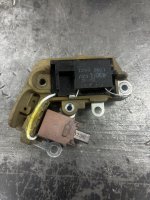
I have about 280 hrs on the engine. My B&C alternator should be delivered today. If I decide to repair it would sit on the shelf for a spare. This a picture of the regulator and brush holder.
 

Attachments

  • IMG_5553.jpeg
    IMG_5553.jpeg
    3.4 MB · Views: 13
We have NO source for reliability data in this market. We are at the mercy of using the community posted experiences to infer that data. Far from reliable. However, the number of reports of failed PP alternators on this site is staggering. On the flipside, we almost never see similar reports on B&C's. Sure, a whole bunch more PP's sold than B&C, but again, all we have.

Understand your need for evidence, but it doesn't exist. If you want to continue buying PP because there is no data to prove anything, that is your perogitive. For the rest of us, we take the data we have and formulate decisions. I hasve seen posts from folks that have gone through 3 PP's in 500 hours. I just don't understand how folks can read that and then buy one for $1600, whenh they can buy a B&C for $600, with no similar feedback.
I do wish we had real data to make decisions :(

With what I do know, am I going purchase a $1600 alternator or even a $600 one? N.F.W.; cost > value. I'll go buy an N.D. clone for $150, add the over-voltage protection to the field circuit, and cooling to the electronics, and run it out to engine TBO, and use the $1450 I "saved" on 100LL.

This argument is moot now (due to the $1600 price tag), but I'll throw it out for consideration anyway and then we can discuss ad nauseam over beer (hint: I'll "buy" the first round at OSH) -- but I'll tip my hand a bit, I believe the answer was in the numbers to wit:

1. How many P-P alternators are installed, and what percentage are installed correctly?
2. How many B&C's are installed, and what percentage are installed correctly?

Totally subjective, but in my experience, I've never seen a P-P installation that was correct (per the installation instructions or AC43-13B) -- every one has been missing something subtle, or more egregious.

The "3 in 500 hour" example, while the operator will NEVER admit to it, is an example of the egregious. The same can be said for the operator with the shorted starter wire, and other wire chafing issues, or the operator with the home brew heat shield with loose screws -- ignore AC43-13B to your own detriment or peril and then blame it on the alternator...seems legit...

It's like going to a crime scene after the forensic cleaning crew has finished their work then determining the COD as "Acute Sodium Hypochlorite Ingestion."

The aforementioned non-compliant installations and operation causes the P-P to fail at a higher rate than the B&C. P-P are apples and B&C are plums -- you can't make an apple pie with plums and you can't make plum jam with apples.

 
Totally subjective, but in my experience, I've never seen a P-P installation that was correct (per the installation instructions or AC43-13B) -- every one has been missing something subtle, or more egregious.
I have a PP and would be interested to take advantage of your experience to avoid installation problems. What kinds of things have you seen? I've got almost 500 hours on mine and want to get another few thousand hours. 😄 Main mod is a 4" pulley.
 
Totally subjective, but in my experience, I've never seen a P-P installation that was correct (per the installation instructions or AC43-13B) -- every one has been missing something subtle, or more egregious.
Brian - have you seen problems with B&C installations as well or is there something unique about P-P alternators that makes them more prone to bad installs?
 
Brian - have you seen problems with B&C installations as well or is there something unique about P-P alternators that makes them more prone to bad installs?
Brian,you mentioned bad installations as causes for failures but I don’t see a bad installment as causing my failure. I had a heat shield on the nearest exhaust pipe and a blast tube and shroud on the back of the alternator. The shop owner said the regulator failed which then caused the stator to fail. What caused the regulator to fail?This is my first build but I don’t think installing an alternator as being the most difficult task on the plane.